


Top Time Recording Apps: Boost Productivity and Accuracy

A time recording app helps businesses and individuals track time, manage timesheets, monitor project time, and generate reports. The best option depends on how you work — a project-based team needs detailed reporting and integrations, a freelancer needs fast time capture and clean exports, and someone who keeps forgetting to start a timer needs automatic recording that runs without any manual input.
In this guide we compare five time recording apps covering those different workflows, with honest assessments of where each one works well and where it falls short.
How We Evaluated These Apps
We tested each app by tracking time across sample projects, reviewing reporting and export options, and verifying pricing directly on each vendor’s website as of July 2026. We also reviewed user feedback on G2 and Capterra to make sure our assessments reflect real-world experience.
Disclosure: Everhour is our product and appears first on this list. We’ve aimed to give every other app here an honest writeup including real limitations.
Quick Overview
Best for project-based teams: Everhour
Best for automatic tracking with manual fallback: TimeCamp
Best for QuickBooks-based businesses: QuickBooks Time
Best for fully automatic desktop recording: Memtime
Best for passive AI-assisted time capture: Timely
Comparison Table
| App | Tracking method | Project tracking | Invoicing | Free plan |
|---|---|---|---|---|
| Everhour | Manual + timer | ✅ | ✅ | ✅ Up to 5 users |
| TimeCamp | Automatic + manual | ✅ | ✅ | ✅ Unlimited users |
| QuickBooks Time | Manual + GPS | ✅ | Via QuickBooks | ❌ |
| Memtime | Fully automatic | ✅ | ❌ | ❌ Trial only |
| Timely | Fully automatic | ✅ | ❌ | ❌ Trial only |
Everhour
Best for: Project-based teams that bill clients and track budgets
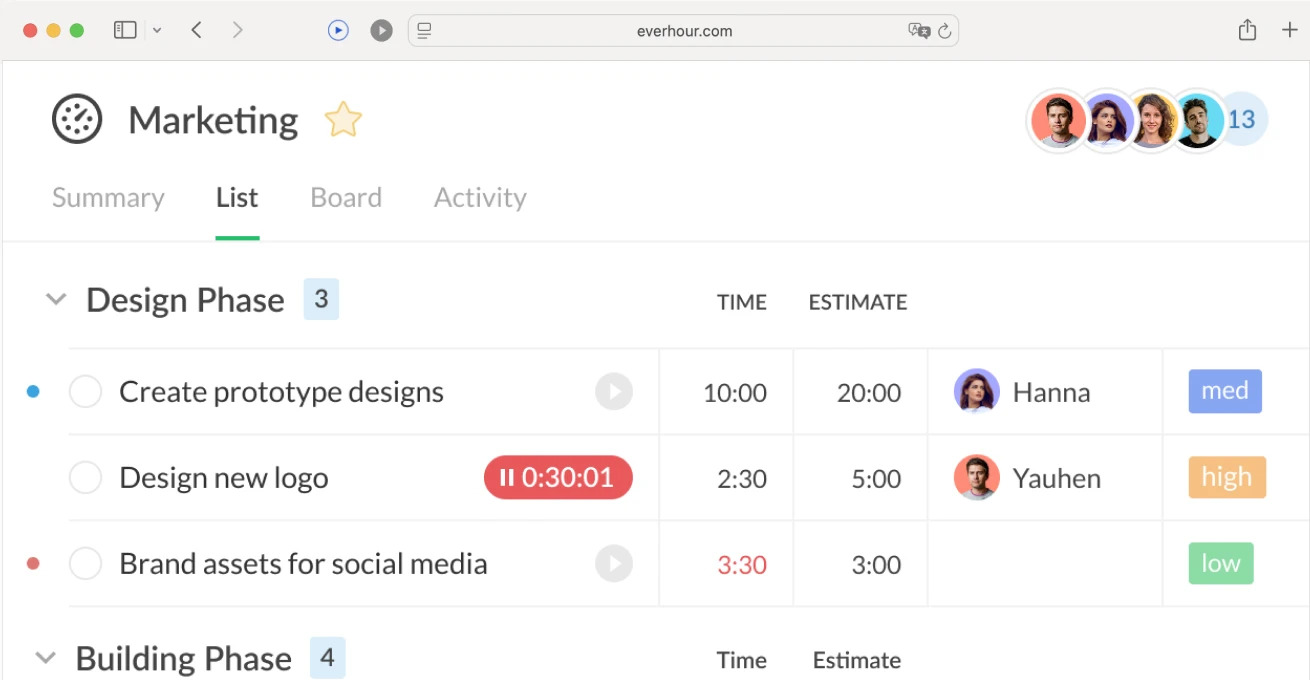
If your team already lives in Basecamp, Trello, Asana, Notion, GitLab, Everhour’s time tracker is less of a new tool and more of an upgrade to the ones you’re already using. Time gets recorded directly inside those platforms against actual tasks, so timesheets build themselves from real work rather than end-of-week guesswork. What makes it stand out for billing is the combination of budget tracking alongside time recording — you can see whether a project is running over budget before you get to the invoice, not after.
Key features
- Time tracking inside Asana, ClickUp, Trello, Jira, Notion, and Basecamp
- Billable and non-billable hour tracking
- Project budgeting with real-time alerts
- Timesheet approvals and payroll export
- Native invoice generation from tracked time
- Reporting by project, client, or team member
Pricing
Free for up to five users. Team plan $8.50/user/month.
TimeCamp
Best for: Teams that need automatic tracking with a manual fallback
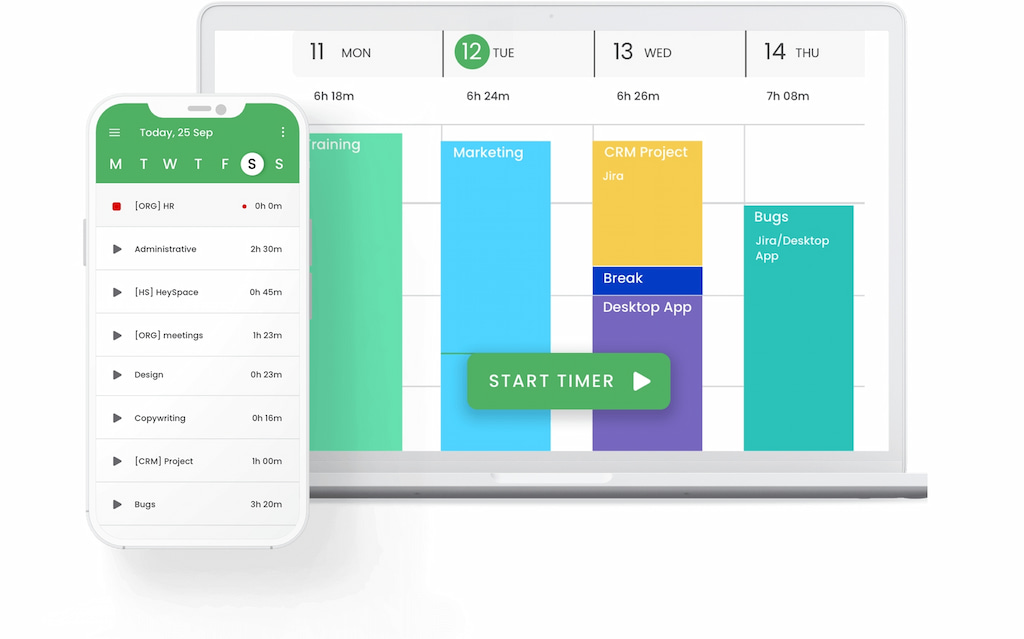
TimeCamp is for teams that know they should track time but keep forgetting to. It runs in the background and records activity automatically, but unlike fully passive tools it also supports manual entry and traditional timesheets — so people who prefer control still have it, and people who need a safety net get one. The free plan is genuinely one of the most generous in this category: unlimited users, unlimited projects, no time limit.
Key features
- Automatic background tracking alongside manual entry
- Traditional weekly timesheets
- Attendance tracking with absences and leave management
- Billing rates and invoicing for client work
- Project and task tracking with budget monitoring
- Customizable reports and payroll exports
Pricing
Free plan with unlimited users and projects. Starter $3.99/user/month. Premium $6.99/user/month. Ultimate $9.99/user/month.
Quickbooks Time
Best for: Businesses already running payroll through QuickBooks
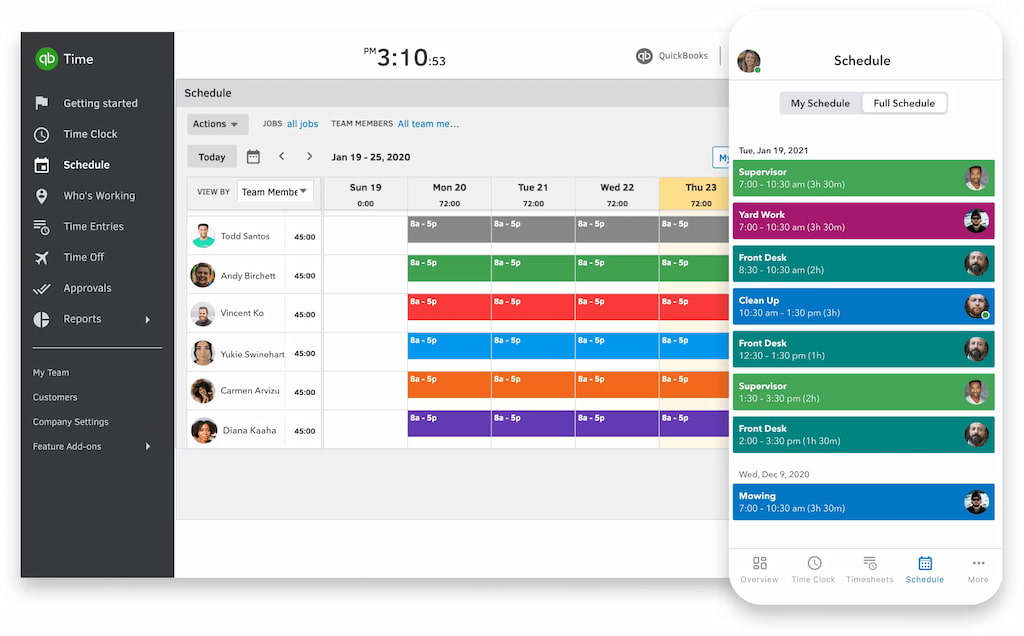
QuickBooks Time has one main reason to exist: if your business runs payroll through QuickBooks, tracked hours flow directly into it without any manual export or re-entry. That sync alone eliminates a meaningful source of payroll errors for businesses already in that ecosystem. On top of that it handles GPS tracking, geofencing, shift scheduling, and job costing for field teams — all feeding into the same QuickBooks account where your invoices and expenses already live.
Key features
- Direct sync with QuickBooks Online and Payroll
- GPS tracking and geofencing for field teams
- Mobile clock-in and clock-out
- Shift scheduling and overtime calculations
- Job costing and labor reports
- Timesheet approvals and payroll exports
Pricing
No free plan. Premium $20/month base fee plus $10/user/month. Elite $40/month base fee plus $12/user/month.
Memtime
Best for: Individual professionals who need granular automatic desktop recording
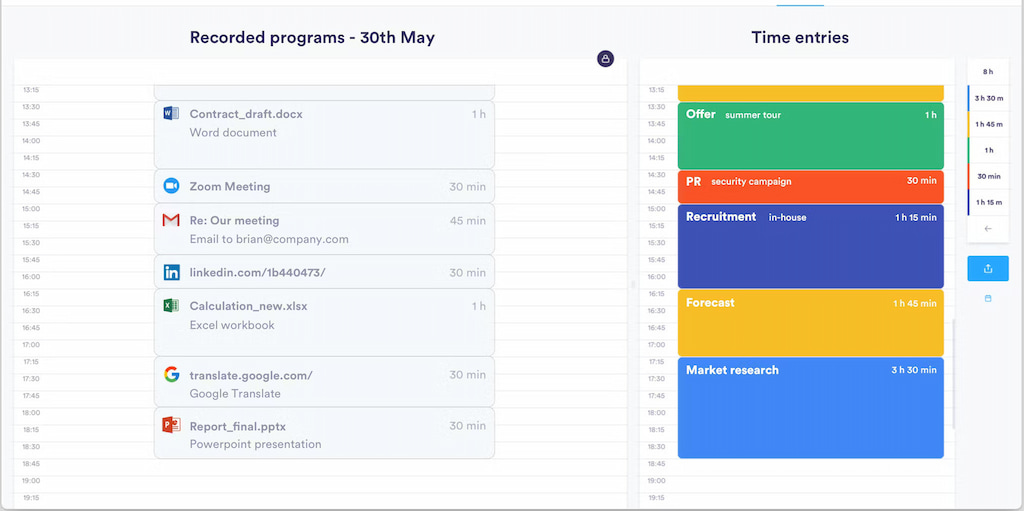
Memtime goes further than most automatic trackers. It doesn’t just record which app was active — it captures the specific files, documents, browser tabs, and emails you were working in throughout the day, giving you a timeline of your actual workday down to the minute. At the end of the day you assign those activities to projects with a few clicks rather than trying to reconstruct hours from memory. For consultants, lawyers, and developers who switch between tasks constantly and need defensible time records for accurate billing, that level of detail is hard to find elsewhere.
Key features
- Fully automatic recording across apps, files, browser tabs, and emails
- Detailed timeline view of the complete workday
- Project and task assignment from recorded activity
- Integrations with Asana, Jira, ClickUp, and other PM tools
- Reporting by project and client
Pricing
No free plan — 14-day trial available. Basic £12/user/month. Connect £18/user/month. Premium £25/user/month.
Timely
Best for: Agencies and project teams that have given up on manual tracking
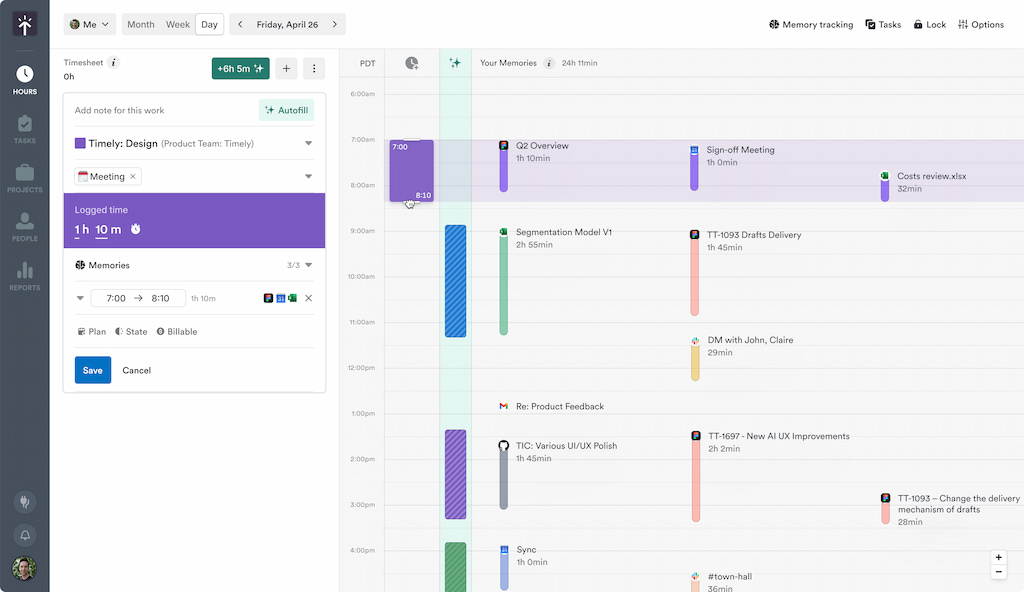
Timely runs silently in the background and captures everything — apps, websites, calendars, documents — without you starting or stopping anything. At the end of the day you review what was captured and drag entries into your timesheet. The AI learns your patterns over time and starts suggesting how to categorize things, which means the cleanup gets faster the longer you use it. Where it edges out Memtime is the team layer — capacity planning, utilization reports, and project budgets are built in, so managers get visibility into how team time is being spent without anyone filling in timesheets manually.
Key features
- Fully automatic background time capture
- AI-assisted timesheet completion from captured activity
- Project budgeting with milestone alerts
- Billable and non-billable hour tracking
- Team capacity and utilization reporting
- Integrations with Asana, Teamwork, and other PM tools
Pricing
No free plan — 14-day trial available. Starter $11/user/month ($9 billed annually). Premium $20/user/month ($16 billed annually). Unlimited $28/user/month ($22 billed annually).
How to Choose
The right choice depends almost entirely on your tracking preference and workflow:
You work inside PM tools and bill clients → Everhour
You want automatic tracking but also need manual fallback → TimeCamp
Your payroll runs through QuickBooks → QuickBooks Time
You need granular file-level automatic recording → Memtime
You want AI-assisted passive capture with team reporting → Timely
FAQ
A time recording app records how long you spend working and organizes those hours into timesheets, projects, tasks, or clients. Depending on the app, recording can be manual (timers and timesheets), automatic (background activity tracking), or a combination of both.
Manual time recording requires you to start and stop a timer or enter hours into a timesheet. Automatic time recording runs in the background and captures activity without any input — apps like Timely and Memtime use this approach. Manual recording gives more control and accuracy for billing; automatic recording removes the burden of remembering to track but requires cleanup of non-work activity.
Everhour is the strongest fit for freelancers who bill clients by the hour and want invoicing built in. TimeCamp is a good free alternative for freelancers who want automatic tracking alongside manual entry. Timely works well for freelancers who want passive capture without timers.
Yes. Everhour has a free plan for up to five users. TimeCamp has the most generous free plan on this list — unlimited users, projects, and tasks with no time limit. QuickBooks Time, Memtime, and Timely don’t have permanent free plans but offer free trials.
Yes. QuickBooks Time syncs directly with QuickBooks Payroll. Everhour supports payroll exports from approved timesheets. TimeCamp exports timesheet data for use in payroll systems. The depth of payroll integration varies by tool.
Yes — all five tools on this list have mobile apps for iOS and Android. QuickBooks Time and TimeCamp are particularly strong on mobile, with GPS clock-in for field workers. Timely and Memtime are primarily desktop-focused, with mobile apps that supplement rather than replace the desktop experience.
Automatic recording tools like Memtime and Timely are more accurate at capturing total time because they don’t rely on you remembering to start a timer. However, manual tracking with timers is often more accurate for billing purposes because it captures intentional work time rather than everything you touched on your computer.
In Summary
Choose Everhour for time recording inside your PM tools with invoicing and budget tracking built in
Choose TimeCamp for automatic recording with a manual fallback and a generous free plan
Choose QuickBooks Time if your payroll and accounting run through QuickBooks
Choose Memtime for granular automatic desktop recording at the file and document level
Choose Timely for passive AI-assisted time capture with team capacity reporting

Maria
A dedicated content enthusiast with extensive experience in international teams and projects of all sizes. Maria thrives on creativity and attention to detail, fueled by a love for fantasy novels, music, classic black-and-white films, and always finding ways to make things better.