


9 Best Time Clock Apps: Your Path to Productivity and Precision
The best time clock app depends on what your business needs to track. Some tools focus on simple employee clock-ins and attendance, while others combine time tracking with scheduling, GPS location tracking, payroll, project management, or productivity monitoring.
In this guide, we compare nine of the best time clock apps for different types of businesses and teams. You’ll find options for project-based teams, remote employees, shift workers, small teams, and companies that need more advanced workforce management features.
How to Choose the Best Time Clock App
The best time clock app should match the way your employees work. Before choosing one, consider whether you need simple clock-in and clock-out functionality or additional features such as scheduling, GPS tracking, payroll integrations, project tracking, or employee monitoring.
The most important factors to compare are:
- Type of workforce: Office, remote, field, or shift-based employees
- Time tracking method: Mobile, web, kiosk, GPS, or biometric clock-ins
- Scheduling: Whether you need employee schedules and shift management
- Payroll integrations: How easily timesheets can be transferred to payroll
- Project tracking: Whether employees need to track time against tasks or clients
- Reporting: The level of detail you need for attendance, overtime, labor costs, or project profitability
- Pricing: Whether the tool fits your team size and budget
Comparison Table
| Time clock app | Best for | Time tracking | Scheduling | GPS / location | Payroll & attendance | Project tracking | Free plan |
|---|---|---|---|---|---|---|---|
| Everhour | Project-based teams | ✓ | — | — | — | ✓ | ✓ |
| Hubstaff | Remote teams | ✓ | ✓ | ✓ | ✓ | ✓ | ✓ |
| Time Doctor | Employee productivity monitoring | ✓ | — | — | ✓ | ✓ | — |
| ClickTime | Project-based organizations | ✓ | — | — | — | ✓ | — |
| TimeCamp | Time tracking and project management | ✓ | — | — | ✓ | ✓ | — |
| ClockInEasy | Small businesses and field teams | ✓ | — | ✓ | ✓ | — | ✓ |
| Buddy Punch | Employee attendance | ✓ | ✓ | ✓ | ✓ | — | — |
| When I Work | Employee scheduling | ✓ | ✓ | ✓ | ✓ | — | — |
| Deputy | Workforce management | ✓ | ✓ | ✓ | ✓ | — | — |
Which Time Clock App Is Best for Your Business?
Here’s a quick breakdown of which time clock app may be the best choice depending on your needs:
- Best for project-based teams: Everhour
- Best for remote employee monitoring: Hubstaff or Time Doctor
- Best for employee scheduling: When I Work or Deputy
- Best for simple clock-in and clock-out tracking: ClockInEasy
- Best for project budgeting and costing: ClickTime
- Best affordable option: TimeCamp
- Best for workforce attendance management: Buddy Punch
The right choice depends on whether you primarily need to track attendance, manage shifts, monitor remote employees, or connect employee hours with projects and client work.
9 Best Time Clock Apps
Everhour: best for project-based time tracking
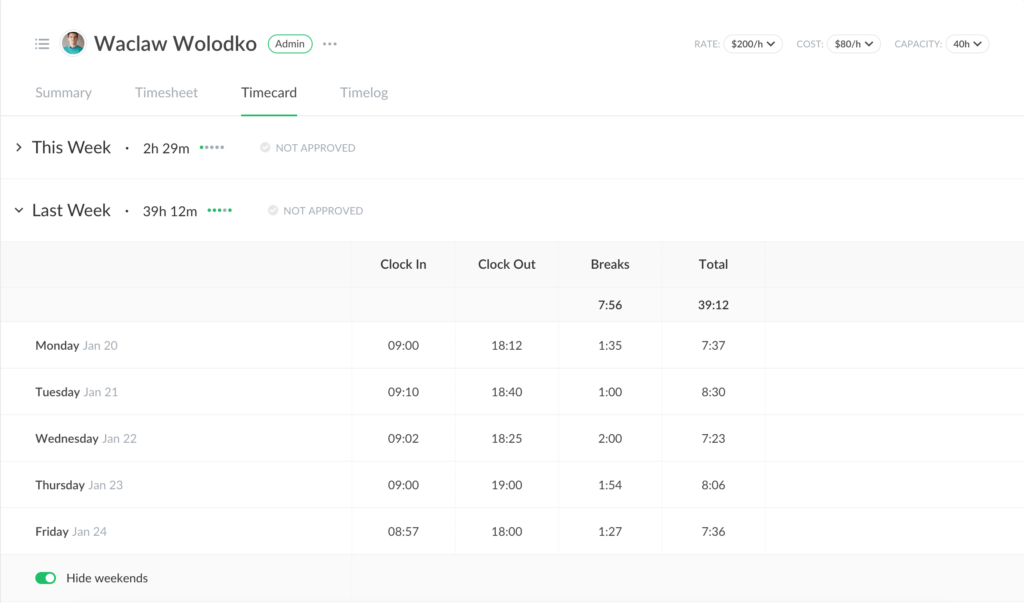
Everhour is a time tracking and project management tool designed for teams that need to connect tracked hours directly to tasks, projects, budgets, and client billing. It works inside project management platforms such as Asana, Trello, Jira, and Notion, so teams can track time without switching between separate tools.
Key features
- Task-based time tracking: Track time directly against tasks and projects to see where team hours are going.
- Project budgets: Set time or cost budgets and monitor progress against them.
- Timesheets and reports: Review tracked hours by employee, project, task, or client and create detailed reports.
- Hourly rates and expenses: Assign billing rates and track project expenses for more accurate client billing.
- Project management integrations: Connect time tracking with popular project management tools, including Asana, Trello, Jira, and Notion.
Best for
Everhour is a good fit for project-based teams, agencies, consultants, and businesses that bill clients by the hour. It’s particularly useful when you want employee time tracking to be part of your existing project management workflow rather than a standalone attendance system.
Pricing
Everhour has a free plan for small teams. Paid plans start at $8.50 per user per month and add features such as advanced reporting, budgeting, invoicing, and other project management capabilities.
Pros
- Strong project and task-level time tracking
- Integrates with popular project management tools
- Useful for project budgeting and client billing
Cons
- Less focused on traditional employee attendance features such as GPS clock-ins and biometric tracking
- Best suited to teams already working with project management software
Hubstaff: best for remote teams and employee monitoring
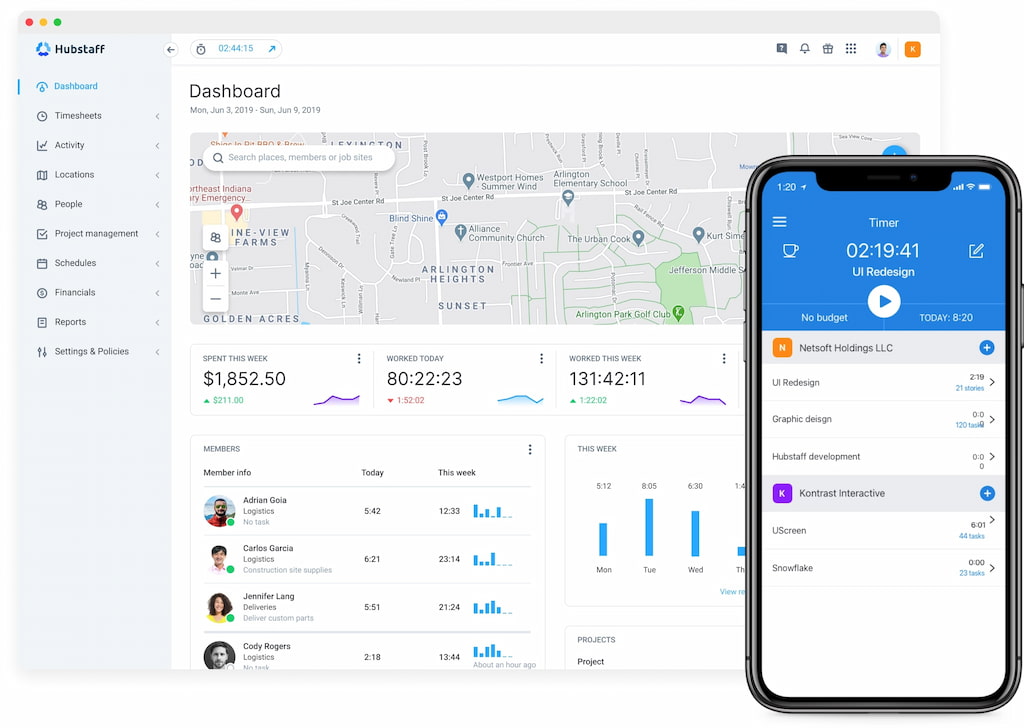
Hubstaff is a time tracking and workforce management platform designed for remote, hybrid, and field teams. In addition to tracking work hours, it offers features such as GPS tracking, activity monitoring, screenshots, payroll integrations, and invoicing.
Key features
- Time tracking: Employees can track time spent on tasks, projects, and work activities using desktop, web, and mobile apps.
- GPS tracking: Location tracking helps businesses monitor where field and mobile employees are working.
- Activity monitoring: Hubstaff can record activity levels and, depending on the plan and settings, capture screenshots and track apps and websites.
- Payroll and invoicing: Tracked hours can be used to simplify payroll processing and create invoices for clients.
- Reporting: Managers can review hours, attendance, activity, and project data through customizable reports.
Best for
Hubstaff is a good fit for remote teams, field-service businesses, and companies that need employee monitoring alongside time tracking. Its GPS and activity-monitoring features make it more suitable for distributed workforces than project-focused time trackers.
Pricing
- Starter: $4.99/user/month
- Grow: $7.50/user/month
- Team: $10/user/month
- Enterprise: $25/user/month
Pros
- Strong remote and field-work features
- GPS and activity monitoring
- Payroll and invoicing capabilities
Cons
- More monitoring-focused than teams may need
- Some advanced features require higher-tier plans
Time Doctor: best for productivity monitoring
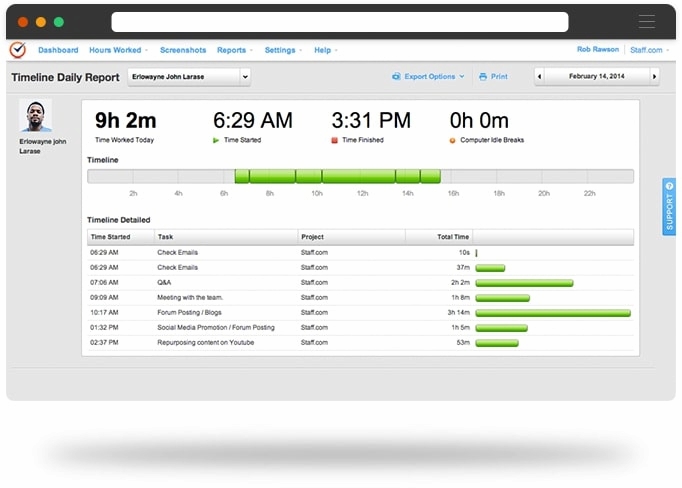
Time Doctor combines employee time tracking with productivity monitoring and workforce analytics. It is designed primarily for businesses that want to understand how employees spend their working time, particularly across remote and distributed teams.
Key features
- Automatic and manual time tracking: Employees can track time spent on tasks and projects using desktop, web, and mobile applications.
- Productivity monitoring: Managers can analyze activity levels and see how working time is distributed.
- App and website tracking: The platform records time spent on applications and websites during tracked work.
- Screenshots: Depending on the plan and configuration, employers can use screenshots to monitor work activity.
- Reporting: Detailed reports provide information about employee hours, productivity, projects, and activity.
Best for
Time Doctor is best suited to remote teams and businesses that need detailed productivity and activity monitoring in addition to basic time tracking.
Pricing
- Basic: $7 per user per month
- Standard: $10 per user per month
- Premium: $20 per user per month
Pros
- Detailed productivity analytics
- Strong remote-work capabilities
- App, website, and activity tracking
Cons
- Monitoring features may feel excessive for teams that only need timesheets
- Less focused on project management than tools such as Everhour
ClickTime: best for project budgeting and reporting
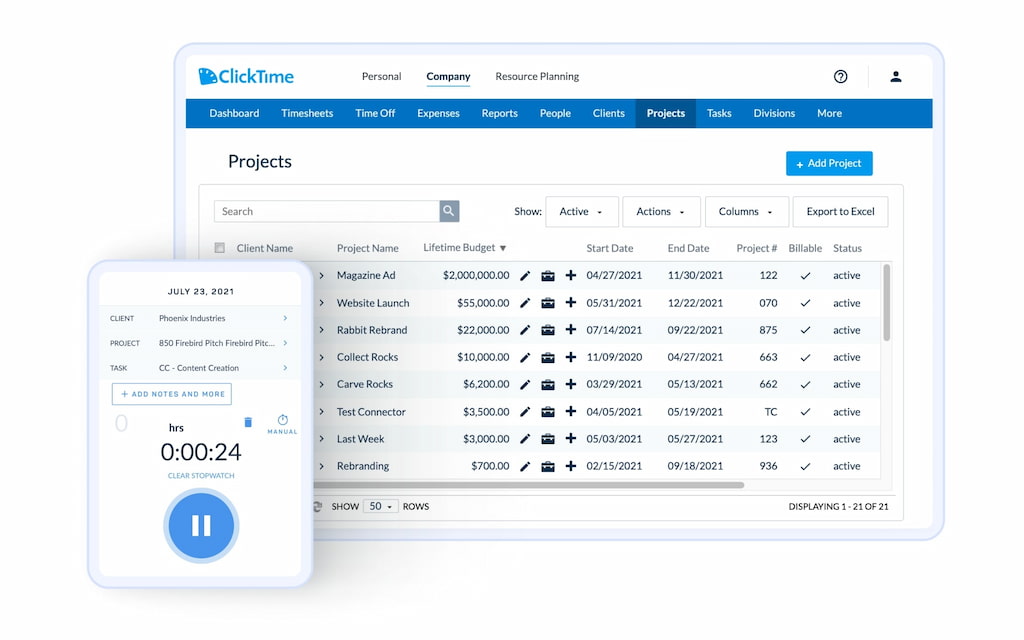
ClickTime is a time tracking and expense management platform built around project-based work. It helps organizations track employee hours against projects, monitor budgets, manage expenses, and analyze project performance.
Key features
- Project time tracking: Employees can record hours against specific projects, clients, and activities.
- Project budgeting: Managers can set budgets and compare planned costs with actual hours and expenses.
- Expense tracking: Teams can record project-related expenses alongside employee time.
- Custom reporting: ClickTime provides detailed reports for analyzing employee hours, project costs, budgets, and utilization.
- Approvals: Managers can review and approve submitted timesheets before they are finalized.
Best for
ClickTime is a strong option for project-based organizations that need detailed budgeting, expense tracking, and reporting. It can be particularly useful when project costs need to be closely monitored alongside employee hours.
Pricing
- Starter: $12 per user/month
- Team: $15 per user/month
- Premier: $27 per user/month
- Enterprise: Custom pricing
Pros
- Strong project budgeting features
- Detailed reporting
- Combines time and expense tracking
Cons
- More expensive than some basic time clock apps
- May be more functionality than small teams need for simple attendance tracking
TimeCamp: best for all-around time tracking
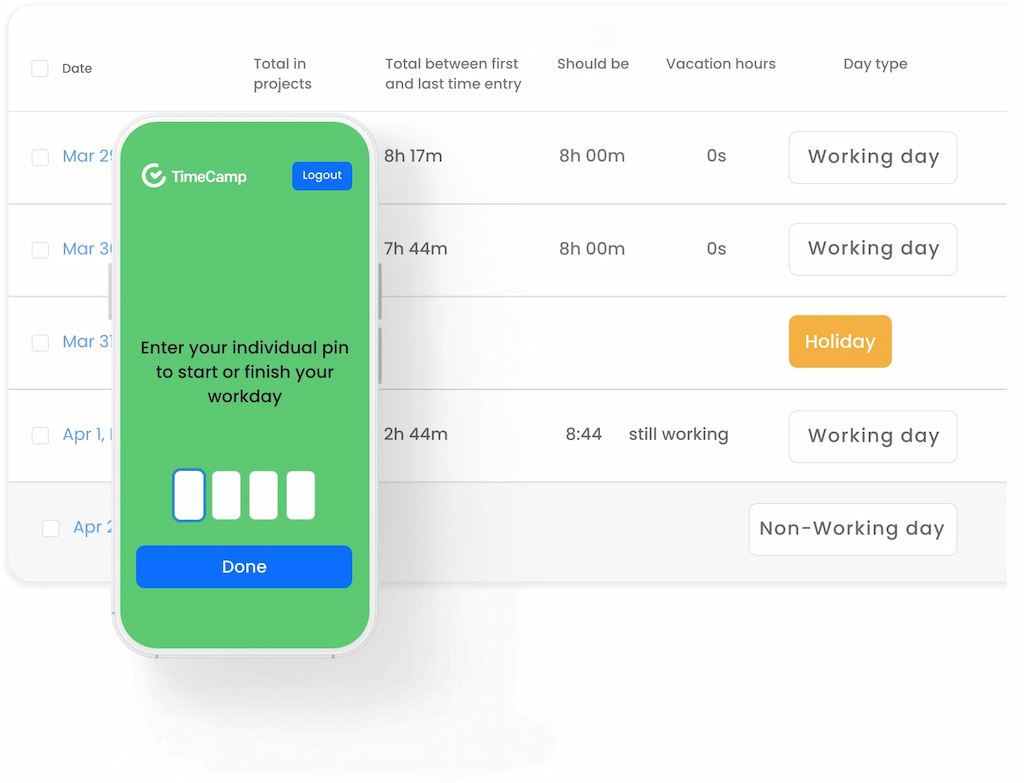
TimeCamp is a time tracking platform that combines employee timesheets, project tracking, productivity monitoring, budgeting, reporting, and invoicing. It supports both automatic and manual time tracking, making it suitable for different working styles.
Key features
- Automatic time tracking: TimeCamp can automatically record time spent working on applications, websites, and projects.
- Timesheets: Employees can review and edit tracked hours and submit timesheets.
- Project tracking: Track time against specific projects, tasks, and clients.
- Invoicing and billing: Convert tracked time into billable hours and invoices.
- Reports: Analyze attendance, productivity, project hours, and billable time.
- Integrations: TimeCamp connects with a range of project management, accounting, and productivity tools.
Best for
TimeCamp is best for businesses looking for an all-around time tracking platform with both employee and project tracking features. It works particularly well for teams that want automatic tracking without giving up traditional timesheets and reporting.
Pricing
- Basic: $3.99/user/month
- Pro: $6.99/user/month
- Ultimate: $9.99/user/month
- Enterprise: Custom
Pros
- Broad range of time tracking features
- Automatic and manual tracking options
- Free plan available
Cons
- Some advanced features are limited to higher plans
- The number of features can make the platform feel more complex for simple use cases
ClockInEasy: best for simple employee time tracking
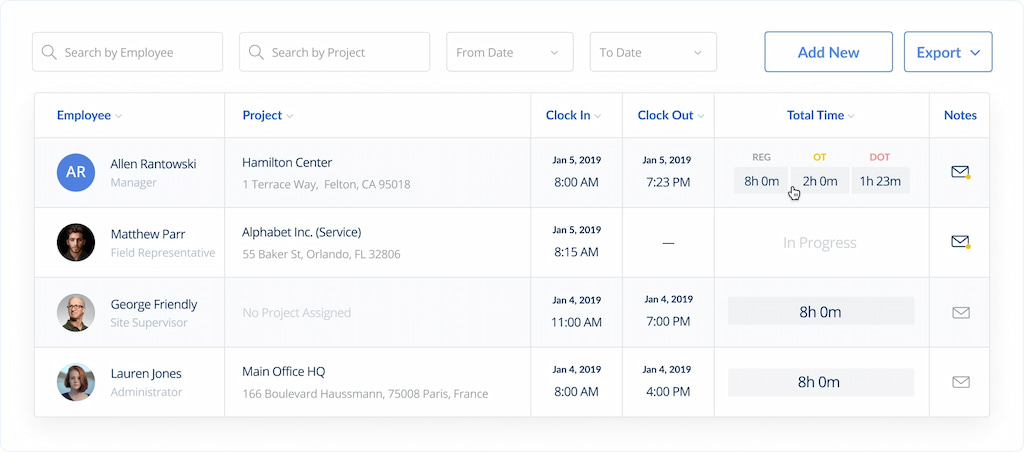
ClockInEasy is an employee time and attendance platform focused on making clocking in and out straightforward. It includes location tracking, photo verification, timesheets, and payroll-oriented reporting.
Key features
- Clock in and out: Employees can record when they start and finish work from supported devices.
- Location tracking: Businesses can use location-based controls to verify where employees clock in.
- Photo verification: Employees can provide a photo when clocking in or out for additional attendance verification.
- Timesheets: Managers can review employee hours and attendance records.
- Payroll reports: Tracked hours can be exported and used to simplify payroll processing.
Best for
ClockInEasy is a good choice for small businesses and teams that primarily need employee attendance tracking rather than project management. Its location and photo verification features can also be useful for businesses with multiple work locations.
Pricing
- Forever Free: $0
- Professional: $4 per user/month
- Enterprise: Custom pricing
Pros
- Simple clock-in and clock-out experience
- Location and photo verification
- Useful payroll-oriented reports
Cons
- Fewer project management features than project-focused time trackers
- Better suited to attendance tracking than detailed project analysis
Buddy Punch: best for employee attendance and flexible clock-ins
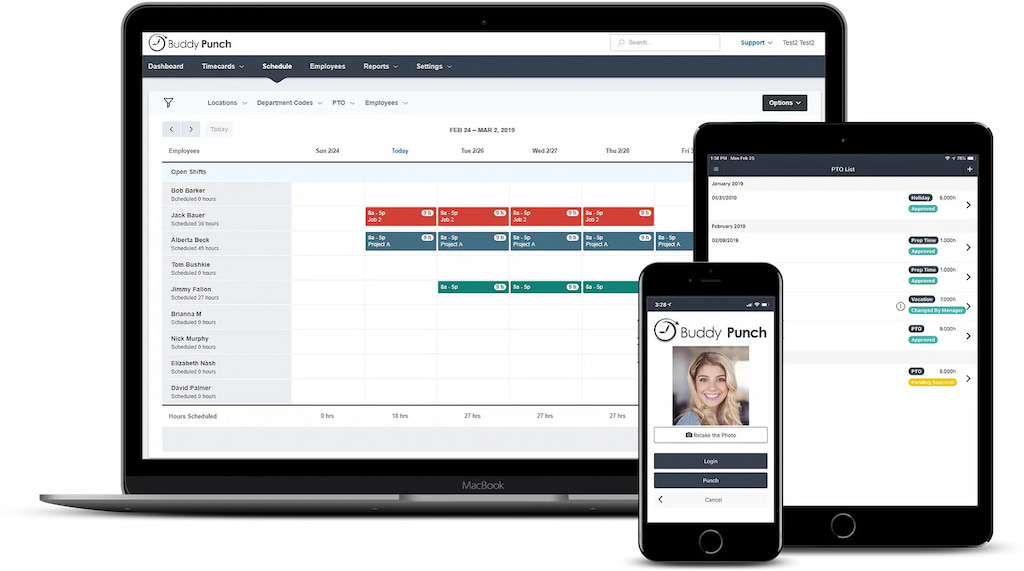
Buddy Punch is an employee time clock and attendance platform that gives businesses several ways to track employee hours. It supports web and mobile clock-ins as well as features such as GPS tracking, overtime management, scheduling, and payroll integrations.
Key features
- Multiple clock-in methods: Employees can clock in through web, mobile, phone, or supported biometric options.
- GPS tracking: Managers can verify employee locations when they clock in and out.
- Overtime tracking: Businesses can configure overtime rules and monitor employee hours.
- Scheduling: Higher-tier plans include employee scheduling and availability management.
- Payroll integrations: Time data can be transferred to supported payroll systems.
Best for
Buddy Punch works well for small and medium-sized businesses that need a dedicated employee time clock with flexible clock-in options and attendance controls.
Pricing
- Starter: $4.99/user/month
- Pro: $6.99/user/month
- Enterprise: Custom pricing
Pros
- Several clock-in options
- Strong attendance and overtime features
- GPS tracking and payroll integrations
Cons
- Primarily focused on employee attendance rather than project tracking
- Some workforce management features require higher-tier plans
When I Work: best for scheduling and time tracking
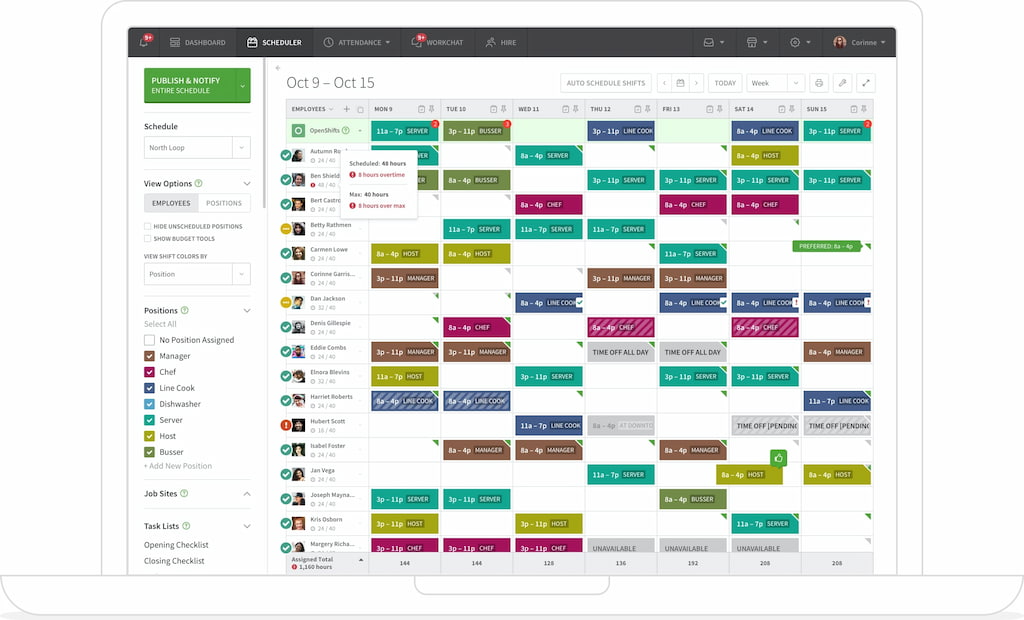
When I Work combines employee scheduling, time tracking, attendance, and team communication in one platform. Its scheduling capabilities make it particularly relevant for businesses where employee shifts and attendance need to work together.
Key features
- Employee scheduling: Create and publish employee schedules using templates and scheduling tools.
- Clock-in and clock-out: Employees can record working hours directly through the platform.
- Attendance tracking: Managers can compare scheduled hours with actual hours worked.
- Shift management: Employees can request shift swaps and access their schedules from mobile devices.
- Team communication: Built-in messaging and announcements help managers communicate schedule changes and updates.
Best for
When I Work is best for shift-based businesses that need employee scheduling and time tracking in the same system. It can be especially useful for teams with frequently changing schedules.
Pricing
- Single location or schedule: $2.50 per user/month
- Multiple locations or schedules: $5 per user/month
Pros
- Strong scheduling functionality
- Time tracking works alongside employee schedules
- Useful mobile experience
Cons
- More focused on shift management than project-based time tracking
- Businesses that only need a basic time clock may not need its scheduling features
Deputy: best for workforce scheduling and compliance
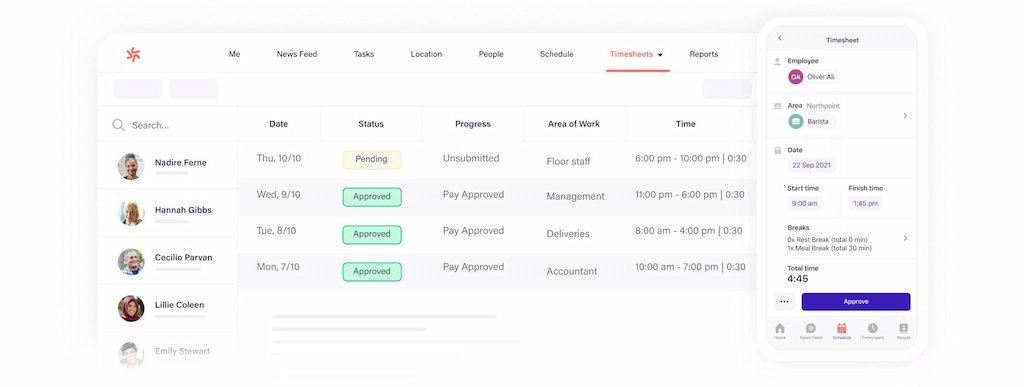
Deputy is a workforce management platform that combines employee scheduling, time and attendance tracking, payroll integrations, and compliance tools. It is designed for businesses managing hourly and shift-based employees.
Key features
- Employee scheduling: Create schedules, manage shifts, and make changes as staffing needs change.
- Time and attendance: Employees can clock in and out while managers monitor attendance and working hours.
- Break and overtime management: Deputy helps businesses manage breaks, overtime, and other workforce rules.
- Payroll integration: Timesheet data can be transferred to supported payroll systems.
- Compliance tools: Higher-tier plans provide tools for managing labor and workplace compliance requirements.
- Mobile app: Employees can access schedules and clock in or out from mobile devices.
Best for
Deputy is a good fit for businesses with hourly, shift-based, or frontline employees that need scheduling, time tracking, and workforce management in one platform.
Pricing
- Lite: $5 per user/month
- Core: $6.50 per user/month
- Pro: $9 per user/month
Pros
- Combines scheduling and time tracking
- Strong workforce management features
- Payroll and compliance capabilities
Cons
- More focused on workforce management than project-based tracking
- Some advanced features are only available on higher-tier plans
Frequently Asked Questions
The best time clock app depends on how your business operates. Everhour is a strong choice for project-based teams, Hubstaff and Time Doctor are better suited to remote employee monitoring, while Deputy and When I Work work well for businesses managing shifts and schedules.
Start with the basics: clock-in and clock-out, timesheets, attendance tracking, and reporting. Depending on your needs, you may also want features such as GPS tracking, employee scheduling, payroll integrations, project tracking, or productivity monitoring.
Yes. Several time clock apps offer free plans with basic time tracking features. However, advanced features such as GPS tracking, scheduling, detailed reporting, and payroll integrations are often only available on paid plans.
Yes. Most modern time clock apps offer mobile apps that let employees clock in and out from their phones. Some also use GPS or location verification to confirm where employees are working.
A time clock app primarily records when employees start and finish work, making it useful for attendance and payroll. Time tracking software can go further by tracking time spent on specific tasks, projects, and clients.
Yes. Time clock apps can automatically calculate employee hours and create timesheets that can be used for payroll. Many tools also integrate directly with payroll and accounting software to reduce manual data entry.
Conclusion
The best time clock app depends on how your team works and what you need to track. Everhour is a strong choice for project-based teams that need to connect work hours with tasks, projects, and client billing. Hubstaff and Time Doctor are better suited to businesses that need remote employee monitoring, while When I Work and Deputy are designed around scheduling and attendance for shift-based teams.
Before choosing a tool, consider whether you need more than basic clock-ins and timesheets. Features such as GPS tracking, employee scheduling, payroll integrations, project tracking, and productivity monitoring can make a significant difference depending on your workforce.
The best option is ultimately the one that covers the features you actually need without adding unnecessary complexity or cost.

Maria
A dedicated content enthusiast with extensive experience in international teams and projects of all sizes. Maria thrives on creativity and attention to detail, fueled by a love for fantasy novels, music, classic black-and-white films, and always finding ways to make things better.