


Best Scheduling and Time Tracking Software: Improve Accuracy and Workflow

Managing employee schedules and tracking work hours can become difficult as a business grows. Spreadsheets and manual processes can lead to scheduling conflicts, missed shifts, overtime errors, and inaccurate time records.
Scheduling and time tracking software brings these processes together. Scheduling tools help managers plan shifts and manage availability, while time tracking tools record hours worked, breaks, and overtime.
In this guide, we compare the best scheduling and time tracking software for small businesses, shift-based teams, remote workers, field teams, and project-based organizations.
The Role of Scheduling and Time Tracking Software
Scheduling and time tracking software helps businesses plan employee shifts, record hours worked, and manage attendance in one place. While scheduling focuses on when employees should work, time tracking records when they actually work.
These tools can help businesses:
- Plan shifts: Create schedules, assign employees, and manage availability.
- Track hours: Record work time, breaks, and overtime.
- Manage attendance: Monitor clock-ins, absences, and late arrivals.
- Control labor costs: Compare scheduled hours with actual hours worked.
- Improve communication: Keep employees updated about schedules and changes.
The combination is especially useful for retail, restaurants, healthcare, construction, field services, and other businesses with shift-based teams.
Key Benefits for Teams and Managers
Scheduling and time tracking software can reduce administrative work while giving managers better visibility into staffing and hours worked.
For managers
- Save time: Create schedules, approve changes, and manage timesheets in one place.
- Reduce errors: Keep schedules and time records accurate and up to date.
- Monitor attendance: Track hours, breaks, absences, and overtime.
- Control labor costs: Compare scheduled hours with actual hours worked.
- Improve coverage: Identify staffing gaps before they become a problem.
For employees
- Access schedules easily: View upcoming shifts from a computer or mobile device.
- Stay informed: Receive updates about schedule changes and open shifts.
- Track hours: Clock in and out without relying on paper timesheets.
- Manage availability: Request time off or swap shifts where supported.
Must-Have Features to Look For
The right scheduling and time tracking software should match how your team works. Look for features such as:
Scheduling features
- Shift planning: Create, edit, and assign employee shifts.
- Employee availability: See when employees are available to work.
- Open shifts and swaps: Let employees claim or exchange available shifts.
- Notifications: Alert employees about new schedules and changes.
Time and attendance features
- Clock in/out: Record when employees start and finish work.
- Break and overtime tracking: Monitor breaks and extra hours accurately.
- Timesheets: Review and approve employee time records.
- Mobile access: Let employees track time and check schedules on the go.
Reporting and integrations
- Payroll integrations: Transfer accurate hours to payroll systems.
- Labor reports: Analyze attendance, overtime, and labor costs.
- Project tracking: Track time against specific projects or tasks when needed.
- Integrations: Connect with project management, accounting, or HR tools.
Best Scheduling and Time Tracking Software
| Software | Best for | Scheduling | Time tracking | Key strengths | Starting price |
|---|---|---|---|---|---|
| Shifts by Everhour | Shift-based teams | ✓ | ✓ | Shift scheduling, open shifts, mobile access | Free; Pro from $5/user/month |
| Everhour | Project-based teams | — | ✓ | Project time tracking, budgets, reporting, integrations | From $8.50/user/month |
| Deputy | Hourly workforces | ✓ | ✓ | Scheduling automation, attendance, payroll integrations | From $5/user/month |
| Homebase | Small businesses | ✓ | ✓ | Scheduling, time clocks, messaging | Free; paid plans from $24/location/month |
| Connecteam | Field and mobile teams | ✓ | ✓ | Mobile scheduling, shift swaps, workforce management | Free plan; paid plans from $29/month |
| When I Work | Small shift-based teams | ✓ | ✓ | Shift scheduling, open shifts, mobile access | From $2.50/user/month |
| Hubstaff | Remote and field teams | ✓ | ✓ | Time tracking, GPS, scheduling, productivity monitoring | From $4.99/user/month |
| Humanity | Multi-location teams | ✓ | ✓ | Scheduling, attendance, reporting | From $2/user/month |
Quick Overview
Best for shift-based teams: Shifts by Everhour
Best for project-based teams: Everhour
Best for hourly workforces: Deputy
Best for small businesses: Homebase
Best for field and mobile teams: Connecteam
Best for budget-conscious shift teams: When I Work
Best for remote workforce monitoring: Hubstaff
Best for multi-location teams: Humanity
Which Scheduling and Time Tracking Software Do You Need?
The right software depends on how your team works and what you need to track.
For shift-based teams
If employees work scheduled shifts, prioritize shift planning, availability management, attendance tracking, open shifts, and shift swaps. Tools such as Shifts by Everhour, Deputy, Homebase, and When I Work are designed around these needs.
For project-based teams
If employees work across projects or clients, look for task-based time tracking, billable hours, project budgets, reporting, and project management integrations. Everhour is particularly suited to this type of workflow.
For field teams
Field and mobile teams often need mobile scheduling, GPS tracking, location-based time tracking, and job-based reporting. Connecteam, Hubstaff, and similar workforce management tools can be a better fit.
For remote teams
Remote teams may prioritize time tracking, scheduling, workload visibility, and productivity reporting. The right choice depends on whether you need simple time records or more detailed employee monitoring.
Best Scheduling and Time Tracking Software Solutions
Everhour
Best for: Project-based teams that need time tracking, budgets, reporting, and integrations.
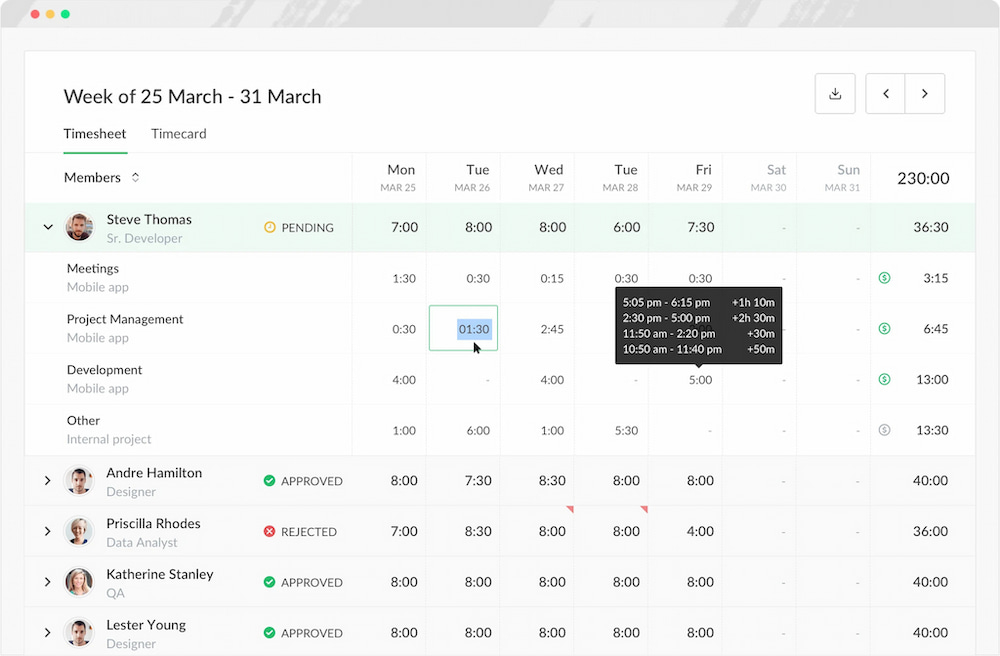
Everhour combines time tracking with project management, budgeting, reporting, and billing. Teams can track time with a timer or manual entries, connect time to projects and tasks, and compare estimates with actual hours. It also integrates with tools such as Asana, ClickUp, Jira, Trello, and other project management platforms.
Key features
- Project and task time tracking
- Billable and non-billable hours
- Project budgets and estimates
- Customizable reports
- Project management integrations
Pricing
- Free: Up to 5 seats with basic time tracking
- Team: $8.50 per seat/month when billed annually
Shifts by Everhour
Best for: Shift-based teams that need scheduling, attendance, and time tracking in one place.
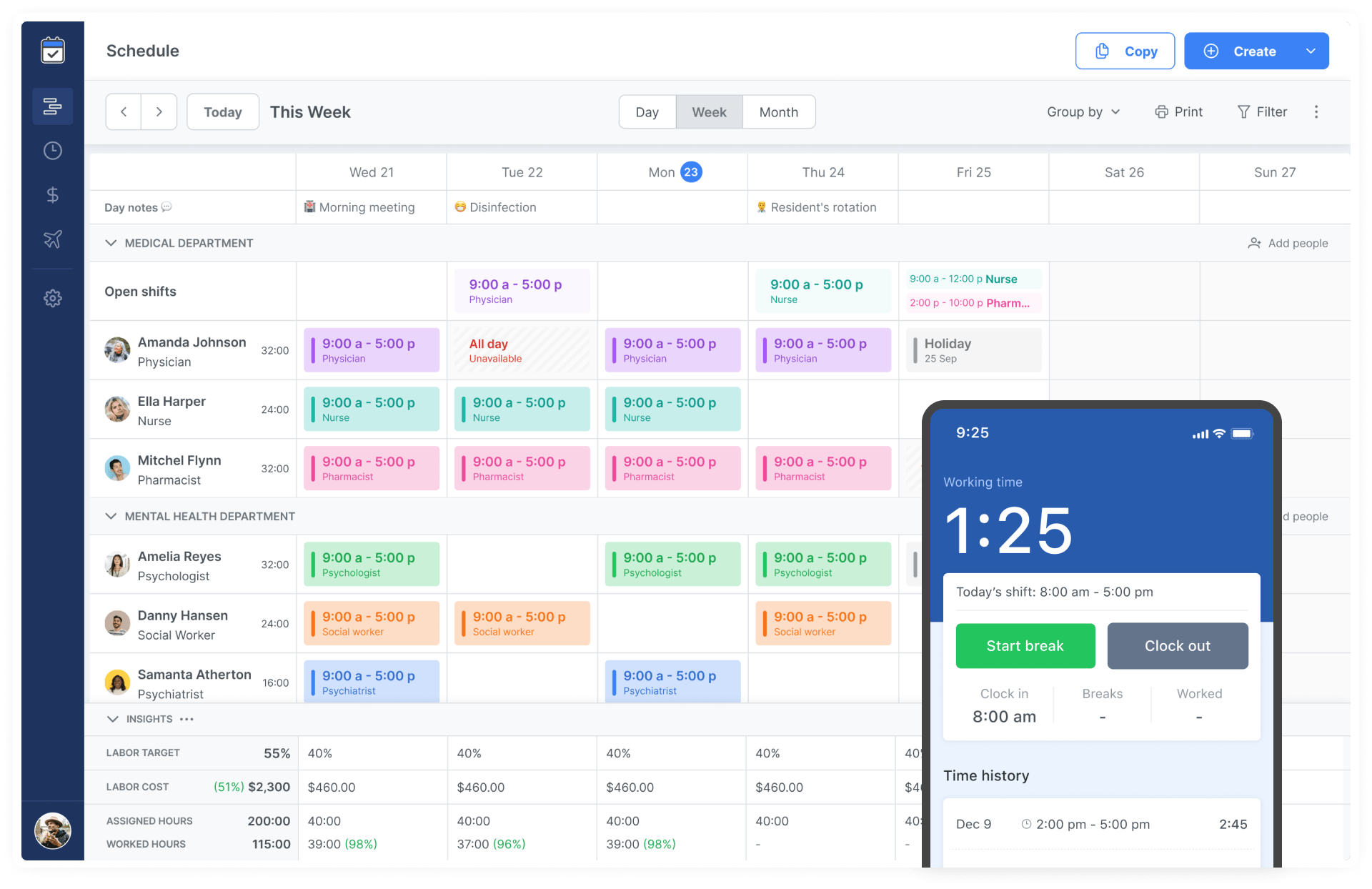
Shifts by Everhour combines employee scheduling with attendance and time tracking. Managers can create and publish schedules, manage availability and time-off requests, and handle open shifts and shift changes. Employees can also clock in, track breaks, and view their schedules.
Key features
- Employee shift scheduling
- Clock-in and attendance tracking
- Time-off management
- Open shifts and shift swaps
- Team communication
Pricing
- Free
- Pro: $5/user/month
Deputy
Best for: Hourly businesses that need workforce scheduling and time and attendance management.
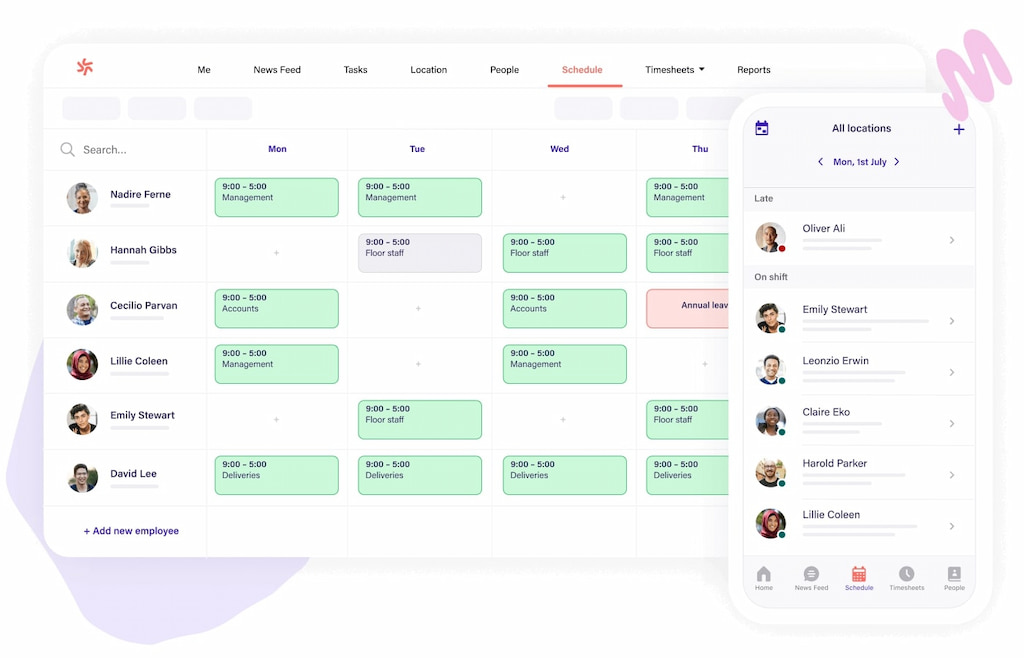
Deputy focuses on employee scheduling, attendance, and workforce management. It’s particularly suited to businesses with hourly employees and recurring shifts.
Key features
- Employee scheduling
- Time and attendance
- Shift planning
- Payroll integrations
- Workforce reporting
Pricing
Lite $5/user/month. Core $6.50/user/month. Pro $9/user/month. Enterprise custom.
Homebase
Best for: Small businesses that need simple scheduling, time clocks, and team communication.
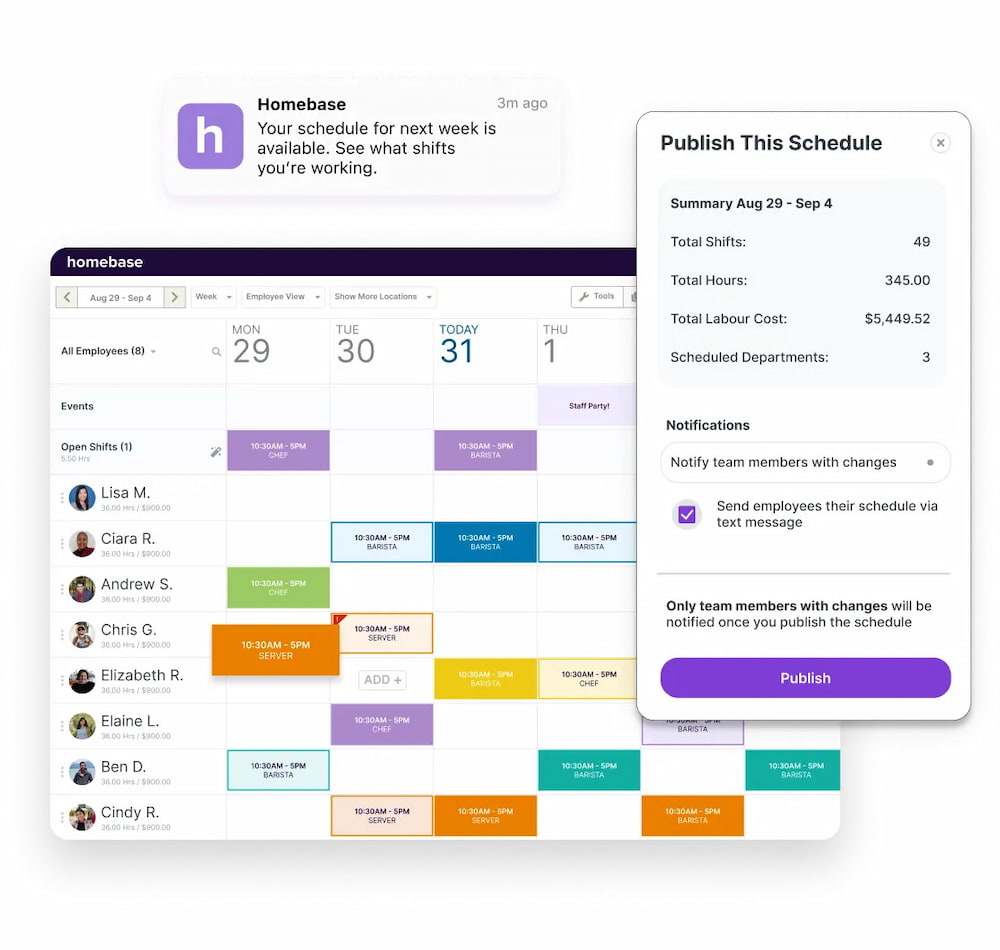
Homebase combines employee scheduling with time tracking and workforce management features. It’s particularly relevant for small businesses and hourly teams.
Key features
- Employee scheduling
- Time clocks and timesheets
- Employee messaging
- Time-off management
- Labor cost tracking
Pricing
Free plan available. Essentials $24/month per location. Plus $56/month per location. All-in-One $96/month per location.
Connecteam
Best for: Field and deskless teams that manage employees primarily through mobile devices.
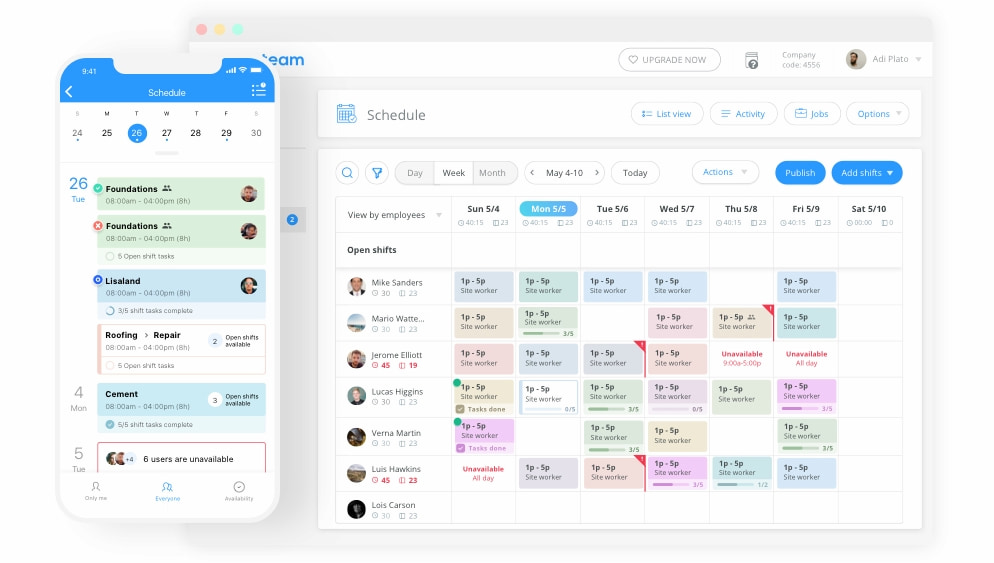
Connecteam combines scheduling and time tracking with communication, task management, and other workforce management features. It’s particularly useful for teams whose employees work away from a central office.
Key features
- Mobile employee scheduling
- Time tracking
- GPS and location features
- Shift swaps
- Task management and communication
Pricing
Free plan for up to 10 users. Basic $29/month for first 30 users. Advanced $49/month. Expert $99/month.
When I Work
Best for: Small shift-based teams looking for straightforward scheduling and time tracking.
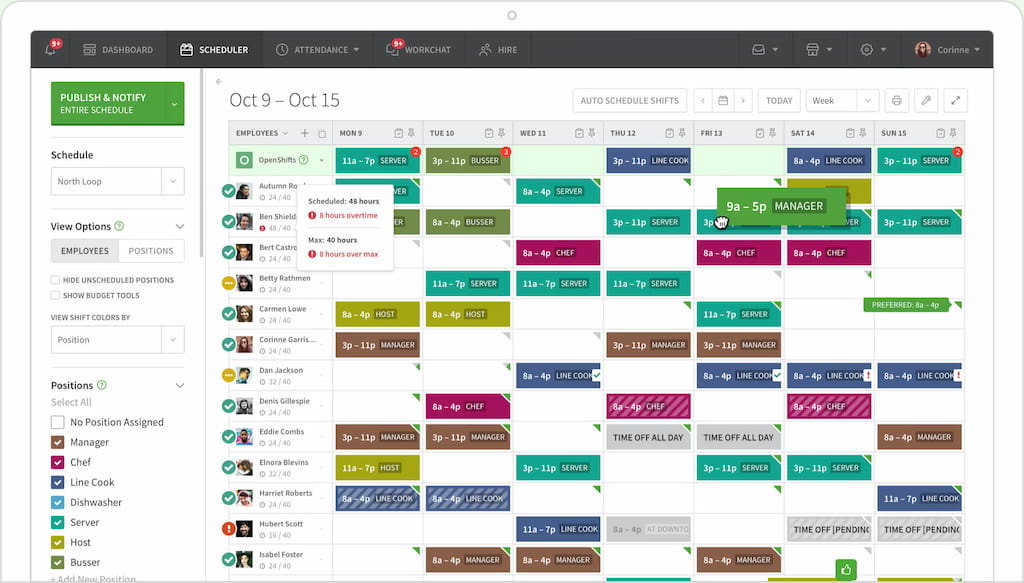
When I Work focuses on creating employee schedules, managing availability, and tracking work hours. Its mobile-first approach makes it useful for teams where employees need easy access to their schedules.
Key features
- Shift scheduling
- Time tracking
- Employee availability
- Open shifts
- Mobile access
Pricing
Essentials $2.50/user/month. Pro $5/user/month. Time tracking add-on $1.50-$2/user/month. 14-day free trial available.
Hubstaff
Best for: Remote and field teams that need time tracking alongside workforce monitoring.
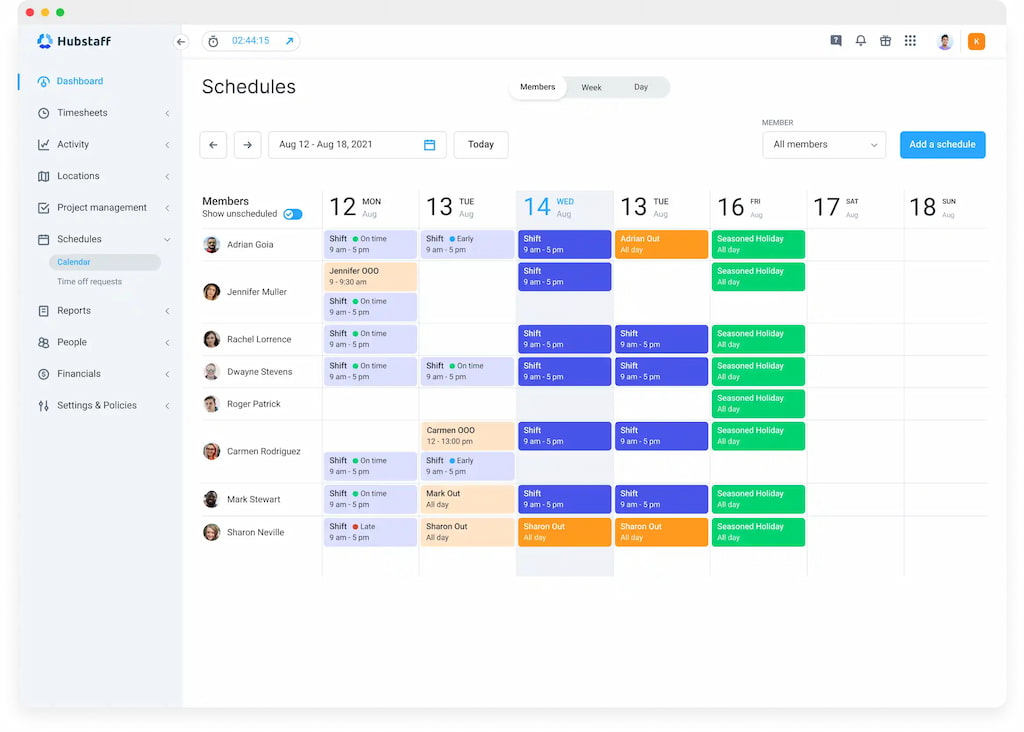
Hubstaff combines time tracking with features such as GPS tracking, scheduling, activity monitoring, and productivity reporting. This makes it more suitable for businesses that need visibility into both work hours and employee activity.
Key features
- Time tracking
- Employee scheduling
- GPS tracking
- Activity monitoring
- Productivity reports
Pricing
Starter $4.99/user/month. Grow $7.50/user/month. Team $10/user/month. Enterprise $25/user/month.
Humanity
Best for: Larger or multi-location teams with complex scheduling needs.
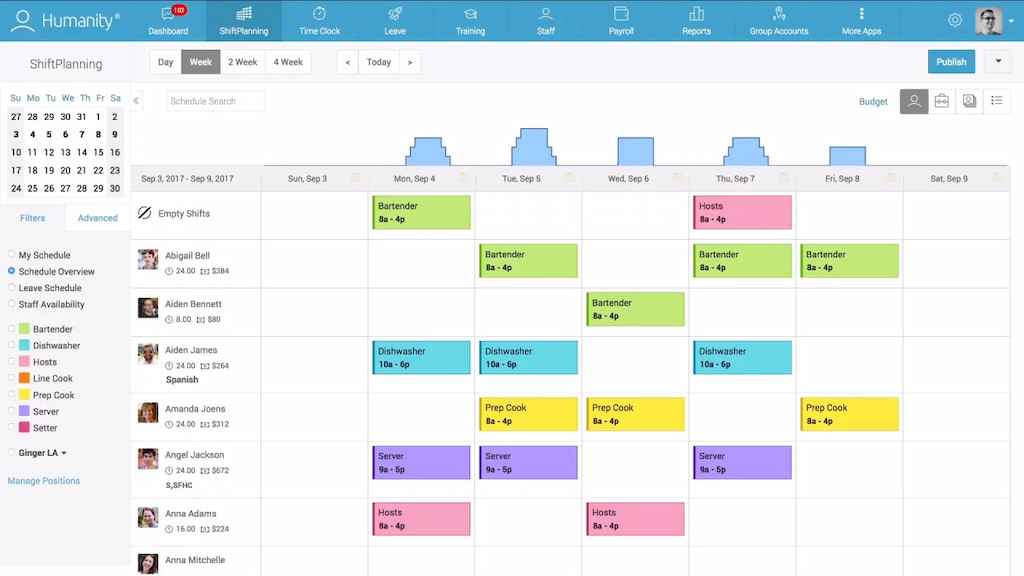
Humanity focuses primarily on employee scheduling and workforce management, with features for shift planning, attendance, and managing teams across multiple locations.
Key features
- Employee scheduling
- Attendance tracking
- Multi-location management
- Shift planning
- Workforce reporting
Pricing
Starts at approximately $3/user/month — contact Humanity directly for current pricing.
Shifts by Everhour vs. Everhour: Which One Do You Need?
Shifts by Everhour and Everhour both track work hours, but they are designed for different workflows. Shifts focuses on employee scheduling and shift-based work, while Everhour focuses on project and task-based time tracking, budgeting, and reporting.
| Shifts by Everhour | Everhour | |
|---|---|---|
| Best for | Shift-based teams | Project-based teams |
| Main focus | Employee scheduling and attendance | Project and task time tracking |
| Shift scheduling | ✓ | — |
| Clock-in/out | ✓ | ✓ |
| Time-off management | ✓ | ✓ |
| Project time tracking | — | ✓ |
| Project budgets | — | ✓ |
| Billable hours | — | ✓ |
| Project management integrations | — | ✓ |
| Open shifts and swaps | ✓ | — |
Choose Shifts by Everhour if your main challenge is creating employee schedules, managing availability, coordinating shifts, and tracking attendance. Employees can also view schedules, request time off, and pick up available shifts.
Choose Everhour if your team works on projects and needs to track time against tasks, clients, budgets, or billable work. Everhour also integrates with project management platforms such as Asana, Jira, Trello, and ClickUp.
FAQ
Scheduling and time tracking software helps businesses create employee schedules, track hours worked, manage attendance, and monitor overtime in one place. Many tools also include features such as shift swaps, time-off requests, payroll integrations, and reporting.
The main benefits include less administrative work, more accurate time records, better shift coverage, easier communication, and greater visibility into labor costs. It can also help managers identify overtime and scheduling issues before they become costly.
Look for features such as shift scheduling, clock-in and clock-out, timesheets, overtime tracking, time-off management, mobile access, shift swaps, notifications, reporting, and payroll integrations. The right combination depends on your industry and how your team works.
Yes. Many scheduling platforms also include time tracking, allowing employees to clock in and out and managers to compare scheduled hours with actual hours worked.
Yes. Small businesses can use it to replace spreadsheets and manual scheduling while keeping track of hours, attendance, and shift coverage. Many providers offer free or low-cost plans for smaller teams.
Scheduling determines when employees are expected to work, while time tracking records when they actually work. Using both together lets managers compare scheduled and actual hours, identify overtime, and improve staffing decisions.
Many platforms offer mobile apps that let employees view schedules, clock in and out, request time off, and receive notifications about schedule changes. This is particularly useful for hourly and field-based teams.
Many solutions integrate with payroll or accounting platforms, allowing businesses to transfer approved hours and reduce manual data entry. Availability varies by software and payroll provider.
The best option depends on your team’s needs. Shifts by Everhour is designed for teams that want scheduling and time tracking in one system, while tools such as Deputy, Homebase, and Connecteam may be better suited to specific workforce or industry requirements.
Conclusion
Scheduling and time tracking software helps businesses manage shifts, track hours, improve attendance visibility, and reduce the administrative work involved in workforce management.
The right solution depends on your team. Shifts by Everhour is a good fit for businesses that want scheduling, time tracking, communication, and shift management in one simple platform. Other tools may be better suited to specific needs such as payroll, workforce monitoring, or complex multi-location operations.
Before choosing a tool, focus on the features that matter most to your team: scheduling, time tracking, availability and time-off management, mobile access, reporting, and payroll integrations.

Maria
A dedicated content enthusiast with extensive experience in international teams and projects of all sizes. Maria thrives on creativity and attention to detail, fueled by a love for fantasy novels, music, classic black-and-white films, and always finding ways to make things better.