


How to Avoid Scope Creep (Without Killing Client Relationships)

Scope creep happens when a project starts expanding beyond its original plan, without proper control over time, budget, or deliverables. It’s one of the most common reasons projects are late, go over budget, and become difficult to manage. In most cases, scope creep doesn’t come from major changes. It builds gradually through small requests, unclear expectations, and missing processes.
This article explains how to avoid scope creep with clear scope definition, structured change management, and practical strategies you can apply from the start of any project.
What Is Scope Creep?
Scope creep is the gradual expansion of a project’s work beyond its original scope, without proper adjustments to time, budget, or resources.
It usually happens through small, unplanned additions rather than one major change.
Example: A client initially requests a website with five pages. Midway through the project, they ask for “just one more page,” then additional revisions, new features, and extra integrations. None of these changes are formally documented or priced. Over time, the project becomes significantly larger than originally agreed.
Why scope creep is a problem
- Project timeline delays — Additional work extends deadlines and disrupts planning
- Budget overruns — Extra tasks increase costs without corresponding compensation
- Team stress and burnout — Uncontrolled changes create pressure, confusion, and rework
Without clear boundaries and processes, scope creep can quickly turn a manageable project into an unstructured and inefficient one.
Why Scope Creep Happens
Scope creep rarely comes from one major mistake. It builds gradually when projects lack clear structure, defined boundaries, and control over changes.
- Unclear project scope — When teams don’t clearly define project deliverables, timelines, or responsibilities, they create room for interpretation. This allows additional work to slip in without being recognized as a change.
- Poor communication — Misalignment between teams and clients often leads to assumptions. What one side considers “included,” the other may see as extra work.

- No change control process — Without a formal system to manage requests, teams add changes informally. Small additions stack up and expand the project over time.
- Underestimating complexity — Teams often scope projects too loosely at the start. As work progresses, new requirements emerge that were not initially considered.
- Lack of boundaries — Trying to be flexible or accommodating can lead to accepting extra work without evaluating its impact on time and resources.
- Undefined feedback and revision cycles — When teams don’t set revision limits, feedback loops continue indefinitely and keep adding more work.
Scope creep is rarely intentional. It’s usually the result of missing structure, unclear expectations, and unmanaged changes.
How to Avoid Scope Creep
Preventing scope creep requires building control into the project from the start, not reacting to changes after they happen. In practice, this comes down to defining scope precisely, enforcing structure, and managing every change deliberately.
Define the project scope clearly from the start
A strong Scope of Work (SOW) within your statement of work removes ambiguity and sets the foundation for the entire project. It should clearly define:
- Deliverables
- Timelines
- Responsibilities
- Assumptions
- What is explicitly out of scope
Defining exclusions is especially important, as it prevents more work later based on interpretation.
Set clear expectations with clients or stakeholders
Before execution begins, all stakeholders should align on what the project is intended to achieve. This includes agreed understanding of:
- Project goals
- Expected outcomes
- What “completion” looks like
Without this alignment, scope tends to expand as different interpretations emerge during delivery.
Document everything early
All decisions and agreements should be documented as early as possible in the project. Avoid relying on informal or verbal alignment. Vague phrasing like “small changes,” “as needed,” or “we’ll adjust later” often leads to scope disputes. A clear written reference ensures everyone is working from the same understanding.
Use a formal change request process
Handle scope changes through a formal process, not informal decisions. Every new request should go through a structured review where you assess:
- Impact on timeline
- Impact on cost
- Impact on resources
Only after approval should the change be added to the project scope. This prevents uncontrolled accumulation of small additions.
Track work and project progress
Monitoring employee productivity and actual work against planned scope is essential for early detection of scope creep. A time tracker like Everhour can help by giving clear visibility into time spent across tasks and how it compares to original estimates.
Key indicators to track include:
- Time spent vs estimated time
- Tasks completed vs original scope
- Unplanned or repeated work
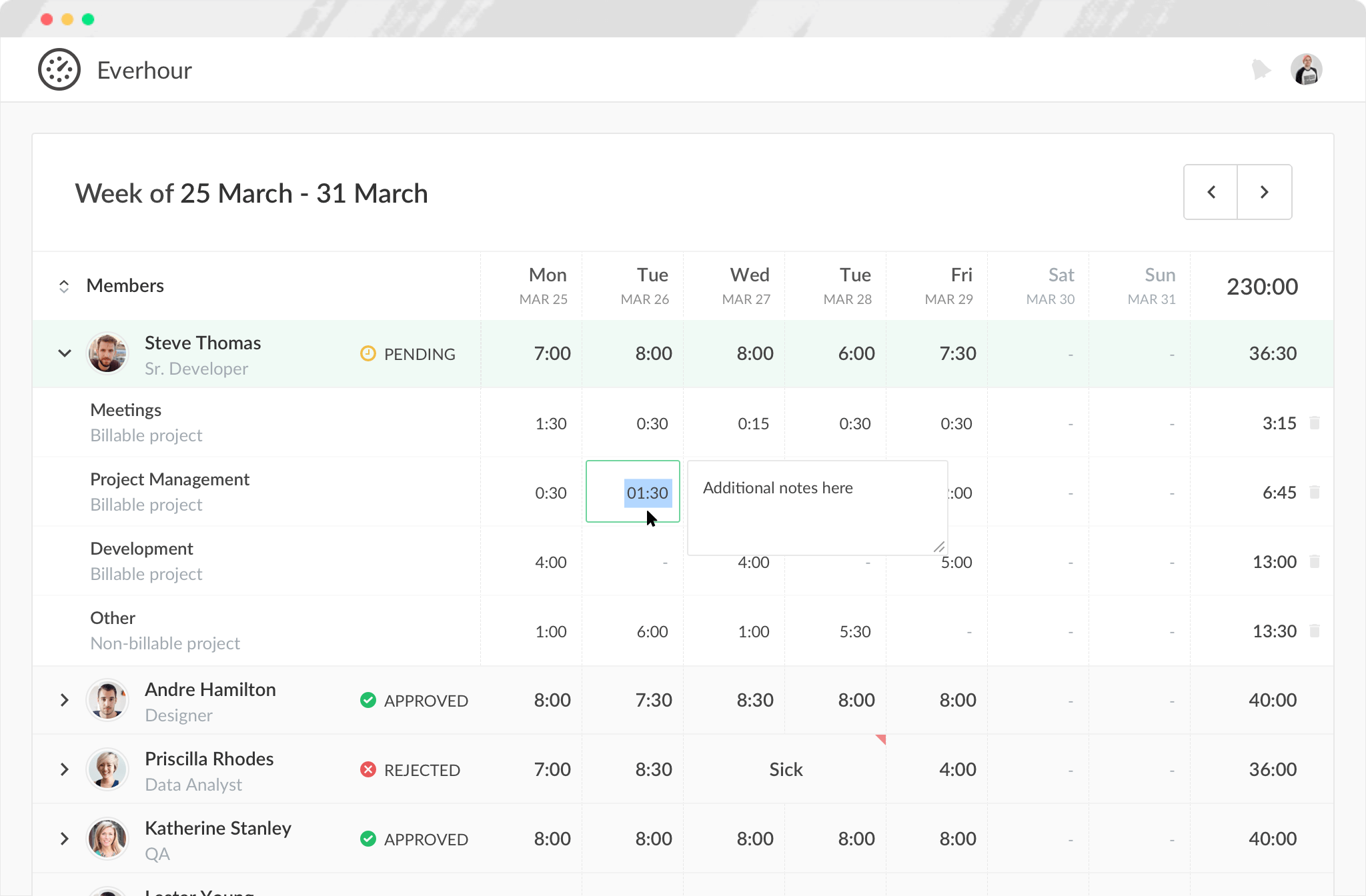
This helps identify when the project is drifting before it becomes a larger issue.
Require impact assessment before approval
No change should be approved without a clear understanding of its consequences. Even small additions can have downstream effects on timelines, dependencies, and workload.
Lock scope at key milestones
Projects should have defined checkpoints where scope is reviewed and re-confirmed. This prevents gradual drift and ensures that any expansion is intentional rather than accidental.
Define strict revision and feedback rules
Unlimited revisions are a common source of hidden scope growth. Setting a fixed number of feedback cycles or structured review windows prevents continuous rework.
Centralize scope ownership
A single person (project manager or lead) must be responsible for enforcing scope boundaries. Without clear ownership, scope control becomes inconsistent and reactive.
Align all stakeholders before execution
Scope should only be finalized once all decision-makers agree. Late alignment issues are one of the most common triggers of mid-project expansion.
Treat exceptions as exceptions
Flexibility should not become default behavior. Any deviation from scope should be explicitly justified, documented, and approved as an exception, not absorbed silently into the project.
Scope Creep Examples (Quick Scenarios)
Scope creep is easiest to understand through real project situations. In most cases, it starts small and gradually expands until it significantly affects timelines, budget, or workload.
1️⃣ Small “extra” requests turning into major work
A project starts with a clearly defined set of deliverables, but additional “quick” requests are introduced along the way. Individually, they seem minor, such as small design tweaks, extra features, or additional content.
Over time, these small additions accumulate and begin to require meaningful time and resources, even though they were never part of the original scope. What starts as minor adjustments can eventually reshape the project entirely.
2️⃣ Expanding deliverables mid-project
In some cases, the scope itself changes after work has already started. For example, a project initially focused on building a basic feature set may gradually expand to include additional modules, integrations, or functionality.
Because the foundation is already in progress, these additions often require rework, adjustments to existing plans, and extended timelines. Without formal change control, the project effectively grows beyond its original boundaries.
3️⃣ Undefined revisions and feedback loops
Another common scenario is when revision rounds are not clearly limited. Feedback is provided continuously, with new changes introduced in each iteration rather than finalizing existing decisions.
This creates an ongoing loop where work is repeatedly adjusted, refined, and expanded. Without defined boundaries for feedback cycles, projects can remain open-ended far longer than originally planned.
Tools That Help Prevent Scope Creep
Using the right tools helps teams maintain visibility, structure, and control over project scope. They reduce reliance on memory, informal communication, and assumptions.
Project management apps
Project management tools help define, organize, and track work in a structured way. They make it easier to ensure that tasks stay aligned with the original scope and that any deviations are visible.
These tools typically help with:
- Task assignment and ownership
- Milestone tracking
- Progress visibility across teams
- Centralized documentation of work
By keeping all project activity in one place, they reduce the risk of informal or untracked scope changes.
Time tracking tools
Time tracking tools help identify when actual work starts exceeding planned estimates. This is one of the clearest early indicators of scope creep.
Everhour is great for:
- Tracking time spent on tasks and projects
- Comparing actual effort vs estimates
- Identifying unplanned or repeated work
- Providing visibility into where time is being lost
This makes scope expansion measurable rather than subjective, which helps teams react early before it escalates.
Documentation and collaboration tools
Clear documentation is essential for maintaining scope control across the entire project lifecycle. Collaboration tools ensure that decisions, updates, and agreements are recorded and accessible to all stakeholders.
They are typically used for:
- Storing scope definitions and SOWs
- Documenting decisions and changes
- Centralizing communication and feedback
- Reducing reliance on scattered messages or verbal updates
When documentation is consistent and accessible, it becomes much harder for scope to drift unnoticed.
How to Manage Scope Creep When It Happens
Even with strong planning, scope creep can still occur. The key is to detect it early and respond in a structured way before it escalates.
Identify it early
Scope creep is easiest to manage if you catch it at the beginning. Warning signs include repeated “small” requests, increasing revision cycles, or tasks that were not part of the original scope appearing in day-to-day work.
Early identification prevents small deviations from becoming structural changes to the project.
Reassess scope, timeline, and budget
Once scope creep is detected, the first step is to reassess the original project constraints. Even minor additions can affect delivery timelines, resource allocation, and overall cost. This step ensures that any change is evaluated in context, rather than being treated in isolation.
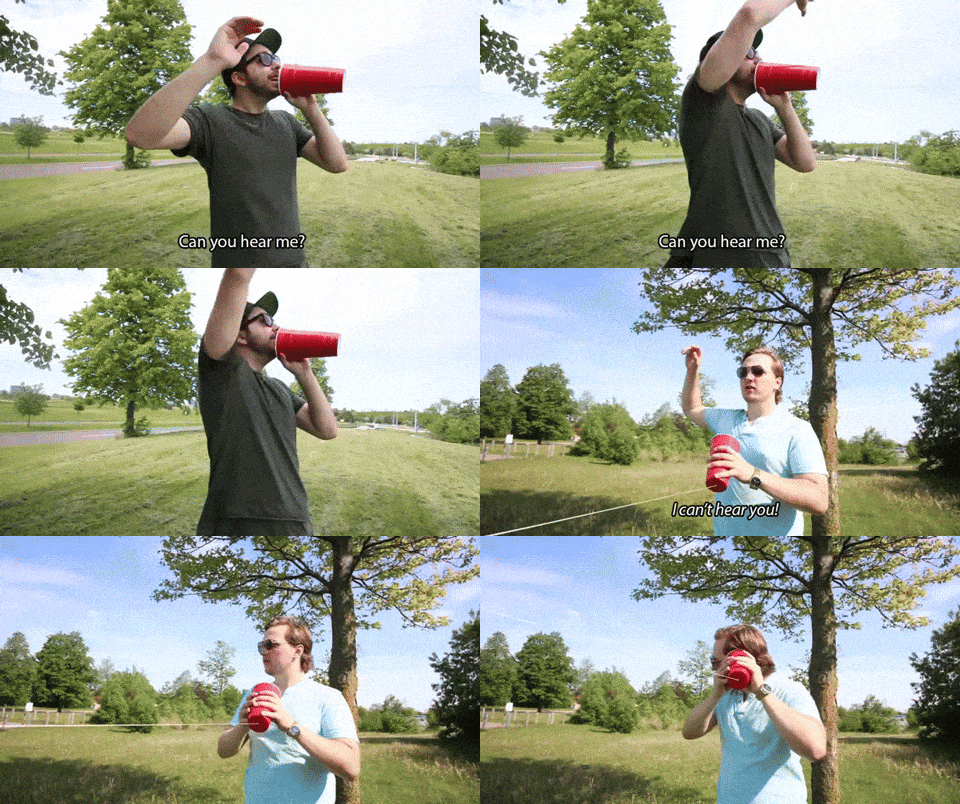
Communicate impact clearly
All stakeholders should understand what the changes mean in practical terms. This includes how added work affects deadlines, effort, and priorities. Clear communication helps prevent unrealistic expectations and ensures that decisions are made with full visibility of trade-offs.
Renegotiate or re-scope if needed
If scope expansion becomes significant, the project should be formally adjusted. This may involve renegotiating timelines, updating budgets, or splitting work into phases.
In some cases, the best solution is to redefine the project scope entirely rather than continuously absorbing changes into the original plan.
Best Practices to Keep Projects Under Control
These practices focus on maintaining long-term project stability by building control into how teams plan, communicate, and execute work. Unlike reactive scope management, these are ongoing habits that reduce the likelihood of scope issues appearing in the first place.
Build strong project structure from the start
Well-controlled projects begin with a solid operational structure. This includes clearly defined scope documentation, agreed responsibilities, and a shared understanding of how decisions will be made.
When structure is weak, projects rely too heavily on interpretation, which increases the risk of uncontrolled changes later.
Maintain a consistent decision-making framework
Projects stay stable when decisions follow a predictable project management process rather than being made ad hoc. This means ensuring that every new request, clarification, or adjustment goes through the same evaluation path. A consistent framework prevents exceptions from becoming the default way of working.
Keep visibility across all work streams
Control depends on visibility. Teams need a clear view of what is being worked on, how it connects to the original scope, and where effort is being spent. Without visibility, scope drift becomes difficult to detect until it has already impacted delivery.
Strengthen accountability for scope decisions
Every project should have clear ownership over scope control. This ensures that decisions about what is included, excluded, or changed are not fragmented across multiple stakeholders. Accountability helps maintain consistency in how scope boundaries are enforced.
Standardize communication and documentation practices
Clear, structured communication prevents misunderstandings from turning into scope expansion. This includes documenting decisions, confirming agreements in writing, and avoiding informal alignment on changes. When communication is standardized, there is less room for assumptions to influence project direction.
Use milestones as control points, not just checkpoints
Milestones should be treated as structured review points where scope, progress, and priorities are actively evaluated, not just progress markers. This allows teams to confirm alignment and prevent gradual drift across longer projects.
Reinforce discipline around approvals
A key factor in project control is discipline in how work is approved. Even small deviations should go through the same approval logic as larger changes to ensure consistency. This prevents gradual erosion of the original scope through repeated minor exceptions.
FAQ: Scope Creep
Scope creep is when a project expands beyond its original scope without formal approval, often affecting time, cost, and resources.
Scope creep is usually happens because of unclear requirements, poor initial planning, informal change requests, and lack of stakeholder alignment.
Scope creep leads to missed deadlines, increased costs, reduced quality, and reduced control over project delivery.
Common signs include repeated small requests, increasing revisions, unplanned tasks, and growing differences between planned and actual work.
Prevent it by defining a clear scope of work, aligning stakeholders early, using a formal change request process, and tracking progress against the original plan.
An example is when a project starts with a fixed set of deliverables but additional features or revisions are added during execution without adjusting time or budget.
Scope creep is generally negative, but controlled changes can improve outcomes if they are formally approved and properly resourced.
Reassess the project scope, timeline, and budget, communicate the impact clearly, and formally approve changes or renegotiate project terms.
Conclusion
Scope creep is one of the most common challenges in project management, but it is also highly preventable. The most effective way to avoid it is to combine clear scope definition, structured communication, and strict change control. Ultimately, strong scope control is not about limiting flexibility. It is about ensuring that every change is intentional, transparent, and aligned with project goals.
Tools like Everhour can support this process by helping teams track time, compare planned vs actual work, and spot scope changes early before they escalate.

Maria
A dedicated content enthusiast with extensive experience in international teams and projects of all sizes. Maria thrives on creativity and attention to detail, fueled by a love for fantasy novels, music, classic black-and-white films, and always finding ways to make things better.