


Automatic Time Tracking vs Task-Based Tracking: The Complete Guide

Time tracking has become a standard part of project management, payroll, and workforce planning. Businesses use it to understand where time is spent, improve project estimates, manage billable hours, and balance team workloads. The two most common approaches are automatic time tracking and manual task-based time tracking. While both help organizations understand how work is performed, they serve different purposes and suit different types of teams.
Automatic Time Tracking
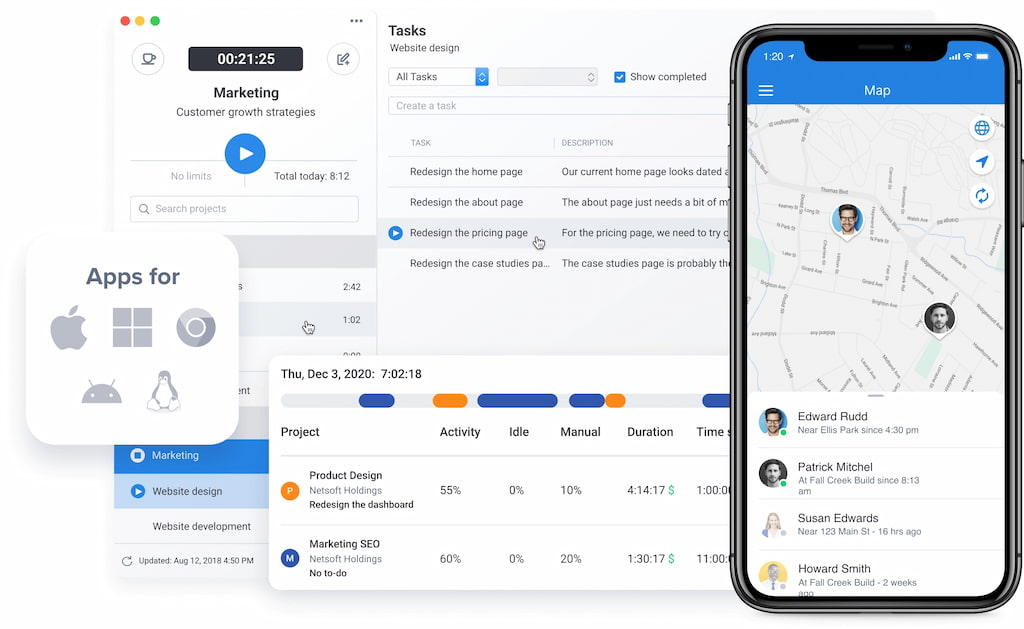
Automatic time tracking records work activity with little or no manual input from employees. Instead of asking users to start and stop a timer for every task, it automatically creates a timeline of how time is spent throughout the workday.
Depending on the software, it can track:
- Application and software usage
- Websites visited
- Active versus idle time
- Coding activity
- Keyboard and mouse activity
- Periodic screenshots (in some tools)
Once the tracker is running, it collects activity data in the background and generates reports showing where time was spent. These insights can help individuals understand their work habits and give managers a better view of workloads, productivity, and billable hours.
However, automatic time tracking has one important limitation: it records activity, not context. For example, it may show that someone spent four hours in Figma, Visual Studio Code, or PowerPoint, but it can’t explain what they were working on. Were they designing a new feature, fixing bugs, preparing a client presentation, or reviewing feedback? Without that context, activity logs are less useful for project reporting, budgeting, or client invoicing.
For this reason, automatic time tracking works best when the goal is to understand overall work patterns, reduce manual effort, or gain visibility into computer activity. Teams that need detailed project reporting or task-level insights often prefer task-based time tracking instead.
Popular examples of automatic time tracking tools include Hubstaff, Time Doctor, and ActivTrak, which automatically record activity data such as app usage, websites visited, and active time.
Tracking Time by Tasks
Task-based time tracking records the time spent on specific projects, tasks, or clients rather than monitoring everything happening on a computer. Employees manually start and stop timers or enter their hours after completing a task, creating a direct connection between time worked and the actual work delivered.
Unlike automatic time tracking, this approach provides context. Instead of simply knowing that someone spent three hours in a design application, you know those hours were spent creating a landing page, fixing a software bug, preparing a client presentation, or reviewing code.
Common examples include tracking time for:
- Designing a homepage
- Fixing software bugs
- Writing blog content
- Attending client meetings
- QA testing
- Sprint planning
- Customer support tasks
Because every hour is linked to a specific activity, task-based time tracking makes it much easier to:
- Analyze project costs
- Prepare accurate client invoices
- Compare estimates with actual time spent
- Monitor team workloads
- Improve future project planning
- Measure project profitability
A task-based time tracker like Everhour integrates with popular project management platforms such as Asana, Jira, ClickUp, Trello, Notion, and GitHub. By connecting time tracking with existing tasks and projects, these integrations help employees log hours without disrupting their workflow while giving managers more accurate project-level reporting.
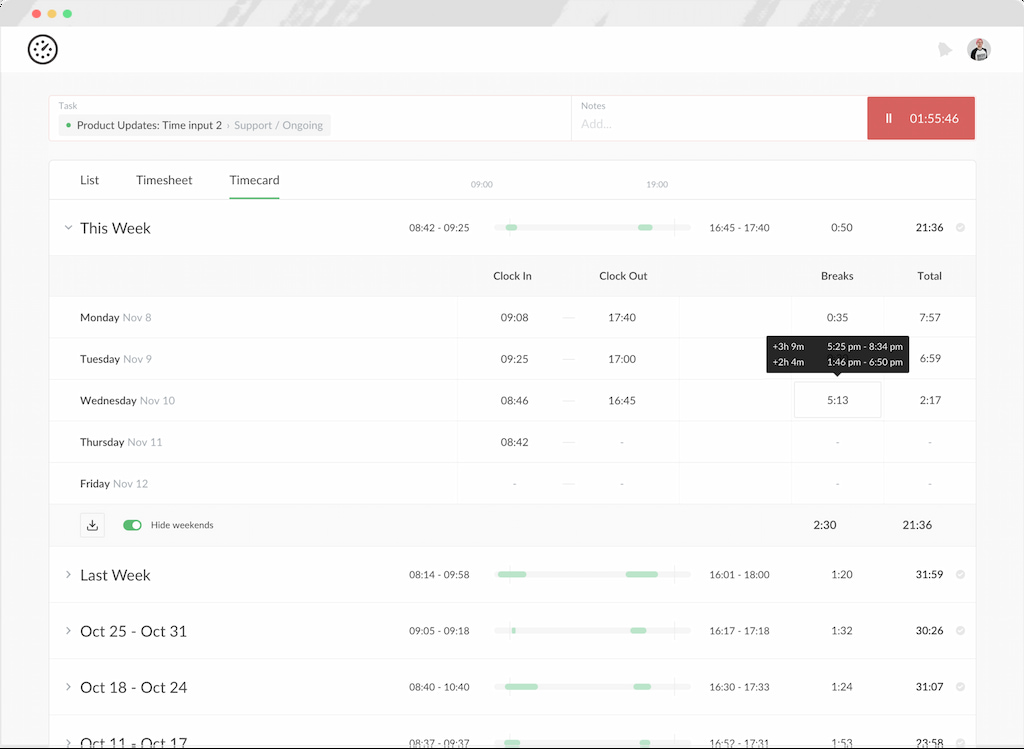
The biggest challenge is that it relies on users remembering to log their time. However, modern time tracking tools make this much easier with built-in timers, reminders, browser extensions, and integrations that reduce manual work while still giving managers accurate, project-level reporting.
Automatic Time Tracking vs. Task-Based Time Tracking
| Feature | Automatic time tracking | Task-based time tracking |
|---|---|---|
| How it works | Records activity automatically with little or no user input | Users manually log time against projects, tasks, or clients |
| Starts automatically | ✅ | ❌ |
| Tracks specific tasks | ❌ | ✅ |
| Accuracy for billing | ⚠️ Limited | ✅ Excellent |
| Employee privacy | Lower (may monitor activity or screenshots) | Higher (tracks only work entered by the user) |
| Project reporting | Limited | ✅ Detailed project and task reports |
| Client invoicing | Difficult | ✅ Easy to generate accurate invoices |
| Resource planning | Limited | ✅ Helps estimate future work and workloads |
| Productivity insights | Activity-based | Work-based |
| Best for | Monitoring computer activity and personal productivity | Project management, billing, and team planning |
Neither approach is universally better. The right choice depends on how your team works. Automatic time tracking is useful when you need an overview of computer activity or want to understand how time is spent throughout the day. Task-based time tracking is better for project-based work because it links every hour to a specific task, making reporting, budgeting, invoicing, and planning much more accurate.
Who Should Use Each Time Tracking Approach?
The right time tracking method depends on your goals. Some organizations need visibility into overall computer activity, while others need detailed records tied to projects, clients, and budgets.
Automatic time tracking
Automatic time tracking is best suited for organizations that want to understand how time is spent without requiring employees to manually start and stop timers. It’s particularly useful for:
- Remote monitoring, where managers need an overview of employee activity.
- Compliance-heavy industries that require detailed records of computer usage.
- Cybersecurity and IT teams that need activity logs for auditing or security purposes.
- Freelancers who want insights into their work habits and productivity without manually tracking every task.
Task-based time tracking
Task-based time tracking is ideal for businesses where work is organized around projects, deliverables, or clients. It’s especially valuable for:
- Agencies managing multiple clients and billable hours.
- Software development teams estimating sprints, tracking engineering effort, and managing project budgets.
- Consultants who bill clients based on the time spent on specific work.
- Designers tracking creative work across projects and revisions.
- Marketing teams measuring the time invested in campaigns, content, and client work.
- Project-based businesses that need accurate reporting, budgeting, invoicing, and profitability analysis.
Many organizations combine both approaches.
For example, employees may use automatic activity tracking to better understand their personal productivity, while the business relies on task-based time tracking for project management, reporting, resource planning, and client billing.
How to Choose the Right Time Tracking Approach
The best time tracking method depends on what you’re trying to achieve. Some businesses need accurate project data for budgeting and client billing, while others prioritize visibility into employee activity or productivity trends. The table below can help you choose the approach that best fits your needs.
| If you need… | Choose… | Why |
|---|---|---|
| Client billing | Task-based tracking | Links time directly to billable projects and tasks. |
| Employee monitoring | Automatic tracking | Records activity with minimal manual input. |
| Productivity analysis | Either | Automatic tracking shows activity patterns, while task tracking reveals how time is spent on meaningful work. |
| Project budgeting | Task-based tracking | Compares estimated and actual hours for better cost control. |
| Payroll | Both | Automatic tracking verifies hours worked, while task tracking allocates them to projects or clients. |
| Remote workforce oversight | Automatic tracking | Provides visibility into activity, workloads, and work habits across distributed teams. |
| Agile software development | Task-based tracking | Tracks time against user stories, sprints, and development tasks. |
| Consulting or agency work | Task-based tracking | Simplifies invoicing, reporting, and profitability analysis. |
| Personal productivity | Automatic tracking | Helps identify distractions and understand daily work patterns. |
FAQs
Automatic time tracking records work activity with little or no manual input. Depending on the software, it can log application usage, websites visited, active vs idle time, or screenshots to create a timeline of how time is spent throughout the workday.
Task-based time tracking requires users to log time against specific projects, tasks, or clients. That way, it’s easier to analyze project costs, prepare invoices, estimate future work, and measure team productivity.
It depends on what you need. Automatic time tracking is better for monitoring activity and work patterns, while task-based tracking works better for teams that need project reports, budgets, or client billing.
Yes. Many businesses use both. Automatic tracking shows overall activity, while task-based tracking is better for projects, reporting, and billing.
It can. Some tools track screenshots, websites, or keyboard activity, which some employees may find intrusive. Employers should be clear about what data is collected.
Task-based time tracking is generally the better choice because it records time against specific projects, tasks, or clients. This makes it easier to create accurate invoices and explain exactly what work was completed.
For project reporting and billing, yes. Task-based tracking shows where time is spent, helps monitor costs, and makes invoicing easier. Automatic tracking shows activity but lacks detailed project insights.
Task-based time tracking is typically the best option for project management because it links time directly to tasks, milestones, and deliverables.
Final Thoughts
Choosing between automatic and task-based time tracking comes down to your goals. If you need visibility into employee activity, automatic tracking may be the better fit. If you need accurate project reporting, budgeting, and client billing, task-based tracking is the stronger choice.
Many teams combine both approaches, using automatic tracking for productivity insights and task-based tracking for project management. For organizations already using tools like Asana, Jira, ClickUp, Trello, or Notion, Everhour makes task-based time tracking simple, accurate, and easy to adopt.

Mike
An IT entrepreneur, executive, and former engineer with a passion for innovation and leadership. Mike focuses on driving company growth while keeping the team inspired. Outside of work, he enjoys tennis, snowboarding, traveling, reading, and, of course, putting his heart and soul into Everhour.