


Job Market Trends: 10 Key Shifts Shaping the Future of Work

The job market is changing as new technologies reshape occupations, businesses adjust their hiring strategies, and employees reconsider what they expect from work. Some industries are expanding while others face slower growth, and employers increasingly need skills that didn’t exist in the same form just a few years ago.
These changes affect more than recruitment. They influence how companies plan their workforce, allocate resources, develop employees, and compete for talent. Understanding current job market trends helps employers make better staffing decisions and gives employees a clearer picture of where career opportunities may be heading.
In this article, we’ll explore 10 key job market trends in 2026-2027, backed by labor market statistics and workforce research, and explain what they mean for businesses and employees.
What Are Job Market Trends?
Job market trends are patterns and developments that influence employment, hiring demand, compensation, and the skills employers need. They reflect changes in the economy, technology, workforce demographics, and employee expectations.
Some trends emerge quickly in response to economic conditions, while others develop over several years. For example, a temporary increase in hiring may reflect seasonal demand, whereas the growing use of AI across occupations represents a broader shift in how work is performed.
To understand these changes, researchers and businesses monitor several key indicators:
- Employment and unemployment rates: Show how many people are working or actively looking for work.
- Job openings and hiring rates: Indicate employer demand for workers and how quickly vacancies are being filled.
- Wage growth: Helps track changes in compensation and competition for talent.
- Labor force participation: Measures the share of the population working or looking for work.
- Skills demand: Reveals which qualifications and capabilities employers increasingly seek.
In the US, the Bureau of Labor Statistics (BLS) publishes regular employment reports, job openings and labor turnover data, and long-term employment projections. Together, these sources help distinguish short-term labor market fluctuations from structural changes that may shape the future of work.
10 Key Job Market Trends to Watch in 2026
1. AI and automation are changing job requirements
Artificial intelligence and automation are changing how employees perform everyday tasks, from writing and data analysis to customer support and software development. As businesses adopt these technologies, demand is growing for workers who can use AI tools effectively, evaluate their output, and combine technical capabilities with human judgment.
The shift is already visible in workforce data. According to the Federal Reserve’s 2025 report on the economic well-being of US households, one in four US workers reported using generative AI at work in 2025. LinkedIn’s 2026 Labor Market Report also found that US job postings requiring AI literacy skills grew by 70% year over year.
However, AI adoption doesn’t necessarily mean entire occupations will disappear. In many cases, automation changes specific tasks within a role rather than replacing the role itself. Employees may spend less time on routine processes and more time reviewing results, solving problems, communicating with clients, or making decisions.
For employers, this creates two related challenges: identifying which tasks can be automated and helping existing employees develop the skills needed to work with new tools.
AI literacy is becoming relevant across a wider range of occupations, not just technical roles.
2. Skills-based hiring is gaining ground
Employers are increasingly looking beyond formal degrees and job titles when evaluating candidates. Instead, they’re placing greater emphasis on demonstrable skills, practical experience, and the ability to perform specific tasks.
This approach can widen talent pools by allowing companies to consider candidates with nontraditional career paths, professional certifications, or skills gained through hands-on experience. It’s particularly relevant in fields where technology and job requirements evolve faster than traditional education programs.
The shift also reflects changing workforce needs. The World Economic Forum’s Future of Jobs Report 2025 estimates that 39% of workers’ existing skill sets will be transformed or become outdated between 2025 and 2030. As roles evolve, employers need better ways to assess what candidates can actually do rather than relying exclusively on credentials.
Skills-based hiring also affects internal talent management. Organizations can identify employees with transferable skills and consider them for new responsibilities or career paths instead of automatically recruiting externally.
3. Demand for specialized skills is increasing
As industries adopt new technologies and business processes become more complex, employers need increasingly specialized capabilities. Areas such as AI and machine learning, big data, cybersecurity, and software development are creating demand for skills that weren’t widely required across the workforce a decade ago.
The World Economic Forum’s Future of Jobs Report 2025 identifies AI and big data, networks and cybersecurity, and technological literacy among the fastest-growing skills through 2030. However, technical expertise isn’t the only priority. Analytical thinking, resilience, creativity, and leadership also remain important.
This combination creates challenges for recruitment. Employers may struggle to find candidates who have both the technical knowledge and the broader capabilities required for a role. In some industries, the problem is less about a shortage of applicants and more about a mismatch between available skills and business needs.
Companies can respond by investing in employee development rather than relying exclusively on external hiring. Upskilling helps employees deepen their existing capabilities, while reskilling prepares them to take on different responsibilities. Both approaches can help organizations address skills gaps while retaining institutional knowledge.
4. Remote and hybrid work are reshaping employment
Remote and hybrid work have changed where people look for jobs and how employers approach recruitment. Companies can access candidates beyond their immediate geographic area, while employees may consider opportunities that don’t require relocating or commuting every day.
However, flexibility isn’t equally available across occupations. Many roles in healthcare, manufacturing, retail, and other hands-on industries require employees to work on-site. Even among office-based positions, remote arrangements depend on the nature of the work and individual company policies.
The Bureau of Labor Statistics reported that 36.9% of US wage and salary workers could work from home in 2024–2025. This figure highlights how significant remote work has become while also showing that it isn’t an option for most workers.
For employers, distributed work creates new requirements for communication, coordination, and performance management. Teams need clear responsibilities and role clarity, accessible documentation, and reliable ways to coordinate schedules and workloads. Managers also need to evaluate outcomes rather than relying on physical presence as a measure of productivity.
5. Hiring demand is shifting across industries
Employment opportunities aren’t growing at the same pace across all industries. Demographic changes, technological investment, and shifts in consumer demand are creating new jobs in some sectors while others face slower growth or declining employment.
The Bureau of Labor Statistics projects that the US economy will add 5.9 million jobs between 2025 and 2035. Healthcare and social assistance are expected to account for more than 2.2 million of those jobs, representing approximately 37% of projected employment growth. Professional, scientific, and technical services are also expected to expand, partly due to demand for AI-related systems, research, and consulting.
These projections point to several areas of opportunity, particularly healthcare, technology, and specialized professional services. However, growth isn’t universal. Some occupations, including office and administrative support roles, are projected to experience employment declines as automation and changing business processes affect demand.
For employers, these differences make industry-specific workforce planning increasingly important. Businesses need to understand which skills are becoming harder to find, where competition for talent is increasing, and whether developing existing employees could be more effective than recruiting externally.
6. Wage expectations and compensation are evolving
Salary expectations are influenced by more than general labor market demand. Inflation, industry conditions, skill shortages, and competition between employers all affect how much workers expect to earn and what businesses need to offer to attract them.
Recent US data illustrates why nominal wage growth doesn’t always translate into greater purchasing power. According to the Bureau of Labor Statistics’ third-quarter 2026 earnings report, median weekly earnings for full-time workers reached $1,232, up 1.5% from the same quarter in 2025. Over the same period, the Consumer Price Index increased by 3.5%, meaning earnings growth lagged behind inflation.
Pay transparency is also influencing compensation practices. As more employers disclose salary ranges in job postings, candidates can compare opportunities more easily and evaluate whether an offer reflects their experience and skills. Companies must therefore pay closer attention to salary benchmarking and internal pay consistency.
Compensation strategies are also expanding beyond base salary. Health benefits, retirement contributions, flexible schedules, paid leave, and professional development can all influence how employees evaluate job offers. Employers increasingly need to consider the overall value of their offer rather than relying on salary alone.
7. Contract and gig work are changing workforce composition
Businesses increasingly combine permanent employees with freelancers, independent contractors, temporary workers, and external specialists. These arrangements allow organizations to bring in specific expertise, handle fluctuating demand, and complete project-based work without expanding their permanent workforce for every new requirement.
The Bureau of Labor Statistics’ 2023 Contingent Work Supplement provides a useful snapshot of these arrangements. It found that 11.9 million people, or 7.4% of US workers, were independent contractors in July 2023. Another 945,000 worked for temporary help agencies, while 862,000 were employed by contract firms.
Although these figures aren’t a measure of current year-over-year growth, they show that alternative employment arrangements represent a significant part of the US workforce. They also highlight that flexible work takes different forms: independent contractors, temporary employees, and workers supplied by staffing firms don’t necessarily have the same employment status or working conditions.
For employers, a mixed workforce creates additional coordination challenges. Managers need visibility into responsibilities, availability, project deadlines, and labor costs across both internal teams and external contributors. Clear agreements and consistent communication help ensure that flexible staffing arrangements support business needs without creating gaps in accountability.
8. Workforce demographics are shifting
The composition of the workforce is changing as populations age, retirement patterns evolve, and younger generations enter employment. These demographic shifts affect how many people are available to work, which industries can find qualified employees, and how organizations approach succession planning.
In the US, the aging population is already influencing labor supply. The Congressional Budget Office’s 2026 demographic projections show that the population aged 65 and older is expected to grow faster than younger age groups over the coming decade. Meanwhile, the number of people aged 25–54 is projected to grow much more slowly.
These changes can make it harder for some industries to replace retiring employees, particularly in occupations that depend on specialized experience or professional qualifications. Healthcare is one example, as an aging population also increases demand for care services.
For employers, demographic shifts make knowledge transfer and succession planning more important. Organizations need ways to retain institutional knowledge, support employees at different career stages, and prepare younger workers to take on more responsibility. Flexible working arrangements and opportunities for experienced employees to mentor colleagues can also help organizations make better use of available talent.
9. Employee expectations are extending beyond salary
Salary remains an important factor when people evaluate job opportunities, but employees also consider flexibility, job security, career development, benefits, and workplace culture. These expectations influence not only where people choose to work but also whether they stay with an employer.
The 2025 Indeed Workforce Insights Survey found that workers increasingly evaluate jobs as a combination of compensation, flexibility, stability, and meaning. Its research across eight countries also highlights differences between what employees want and what employers offer, particularly around remote and hybrid work.
Career development is another important factor. According to Gallup research published in October 2025, one in four US employees said they lacked opportunities for career advancement. Limited development prospects can make it harder for organizations to retain experienced employees and fill higher-level positions internally.
Employee engagement also remains a concern. Gallup reported that US employee engagement fell to 29% in the third quarter of 2026, its lowest level since 2011. The decline was particularly pronounced among remote and hybrid employees, highlighting the importance of clear expectations and consistent communication across different work arrangements.
For employers, responding to these expectations requires more than competitive pay. Clear career paths, supportive management, reasonable workloads, and meaningful development opportunities can all contribute to a better employee experience.
10. Employers are prioritizing productivity and workforce planning
Economic uncertainty and changing business conditions are encouraging organizations to pay closer attention to how they allocate resources. Rather than increasing headcount whenever workloads rise, employers may look for ways to improve existing processes, develop internal capabilities, and make better use of available capacity.
The Indeed 2026 US Jobs and Hiring Trends Report describes a cautious labor market in which employers are selective about new hires while job postings remain uneven across industries. This makes workforce planning particularly important: businesses need to balance staffing costs with the skills and capacity required to meet demand.
However, planning only around headcount isn’t enough. According to McKinsey’s HR Monitor 2026, just 11% of surveyed organizations take a long-term approach to workforce planning. The report argues that businesses need to consider future skills and capabilities, not just immediate staffing requirements.
This means understanding how work is distributed, which teams have available capacity, and where employees spend the most time. Time tracking and project reporting tools can help managers compare estimated and actual effort, identify workload imbalances, and make more informed resource allocation decisions.
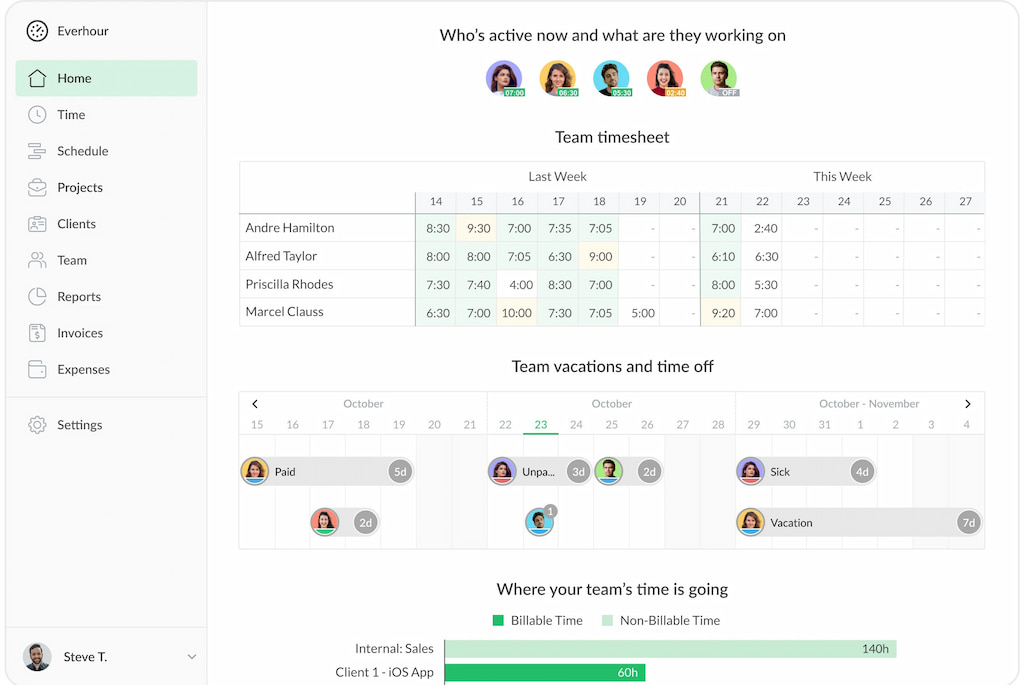
For example, Everhour‘s time tracker allows teams to track time against projects and tasks, compare tracked hours with estimates, and review reports to understand how work is progressing. These insights can support internal capacity planning and help managers identify where processes or workloads may need adjustment.
How Job Market Trends Affect Employers and Employees
The trends shaping the job market create different challenges depending on whether someone is hiring, managing a workforce, or looking for their next opportunity.
What employers need to consider
- Adjust recruitment strategies: Evaluate candidates based on relevant skills and practical capabilities, not just formal qualifications.
- Invest in employee development: Upskill and reskill existing teams to address changing skill requirements and reduce reliance on external hiring.
- Review compensation and benefits: Benchmark salaries and consider flexibility, career opportunities, and other factors that influence retention.
- Adapt workforce planning: Account for demographic changes, different employment arrangements, and shifting demand across industries.
- Improve resource allocation: Understand team capacity and workload distribution to make better use of existing employees.
What employees need to consider
- Develop in-demand skills: Build technical and transferable capabilities that remain relevant as job requirements change.
- Stay adaptable: Learn to work with new technologies and adjust to evolving responsibilities.
- Explore different career paths: Consider opportunities in growing industries and roles that use transferable skills.
- Evaluate the full employment offer: Look beyond salary to consider benefits, flexibility, development opportunities, and job stability.
- Keep learning: Pursue professional development and practical experience to remain competitive in a changing labor market.
How to Adapt to Changing Job Market Trends
Job market trends can create new opportunities, but they also require businesses and employees to adjust their strategies. While no organization can control broader economic or technological changes, it can prepare for them.
Here are five ways to respond:
- Monitor labor market data: Follow employment reports, industry research, salary benchmarks, and job postings to understand how hiring demand and skills requirements are changing.
- Review workforce skills: Identify the capabilities your organization already has and where skills gaps could affect future business needs.
- Invest in employee development: Support upskilling, reskilling, and knowledge sharing so employees can adapt to changing responsibilities and technologies.
- Build flexible workforce plans: Consider different staffing arrangements and prepare for changes in demand without relying exclusively on permanent hiring.
- Review productivity and workloads: Understand how work is distributed across teams, identify capacity constraints, and look for opportunities to improve processes.
Employees can take a similar approach by keeping their skills current, exploring career opportunities in growing fields, and evaluating employers based on more than salary alone.
How to Measure and Track Job Market Trends
Understanding job market trends requires looking at several indicators rather than relying on a single employment statistic. Different data sources reveal different aspects of the labor market, from employer demand to workforce availability and compensation.
The following indicators are particularly useful:
| Indicator | What it tells you | Where to find data |
|---|---|---|
| Job openings and hiring rates | How actively employers are recruiting and filling vacancies | BLS JOLTS |
| Unemployment rate | The share of the labor force actively looking for work but unable to find a job | BLS Employment Situation |
| Wage growth | How compensation changes over time | BLS Earnings Data |
| Labor force participation | The share of the population working or actively seeking employment | BLS Labor Force Statistics |
| Industry employment projections | Which industries and occupations are expected to grow or decline | BLS Employment Projections |
| Skills demand | Which capabilities employers increasingly mention in job postings and workforce research | World Economic Forum |
For businesses, external labor market data is only part of the picture. Internal indicators such as employee turnover, workload distribution, project costs, and time spent on different activities can help managers understand whether their workforce is prepared for changing business needs.
Tools like Everhour provide visibility into time spent on projects and tasks, helping teams compare actual effort with estimates and make more informed decisions about resource allocation.
It’s also important to track indicators over time. A single month’s increase in job openings or wages doesn’t necessarily signal a lasting shift. Comparing several reporting periods, industries, and geographic markets provides a more reliable picture.
FAQs About Job Market Trends
Major job market trends in 2026 include the growing use of AI and automation, skills-based hiring, increasing demand for specialized capabilities, evolving remote and hybrid work arrangements, and greater attention to workforce productivity. Demographic changes and shifting employee expectations are also influencing recruitment and retention.
Demand varies by country, region, and occupation. In the US, the Bureau of Labor Statistics projects particularly strong employment growth in healthcare and social assistance, as well as professional, scientific, and technical services, between 2025 and 2035. Its employment projections provide more detailed information about growing industries and occupations.
Demand is growing for AI and big data skills, cybersecurity expertise, and technological literacy. Analytical thinking, creativity, adaptability, and leadership also remain important. The exact combination depends on the industry and role.
AI is changing how employees perform tasks, automating some routine activities while creating demand for new technical and analytical capabilities. Rather than eliminating every role it affects, AI often changes the responsibilities within existing occupations and increases the importance of AI literacy.
Short-term indicators such as job openings, hiring rates, and unemployment can change monthly. Longer-term trends, including workforce aging, technological adoption, and changing skills requirements, typically develop over several years. Businesses should monitor both to distinguish temporary fluctuations from structural changes.

Maria
A dedicated content enthusiast with extensive experience in international teams and projects of all sizes. Maria thrives on creativity and attention to detail, fueled by a love for fantasy novels, music, classic black-and-white films, and always finding ways to make things better.