


Transition From Freelancer To Agency In A Sustainable Way

Many freelancers eventually reach the same limit: there’s more work available than one person can realistically handle. At first, this looks like success. More clients, more projects, and more income. But over time, growth starts creating pressure instead of flexibility. Delivery slows down, admin work expands, and the business becomes completely dependent on one person’s time and availability. This is usually the point where freelancers start thinking about building an agency.
The transition, however, involves much more than hiring help. Running an agency changes how work is delivered, how clients are managed, and how the business operates day to day. What worked as a solo freelancer often stops working once multiple people, projects, and processes are involved.
Here we will break down what changes when transitioning from freelancer to agency, the challenges that come with scaling, and how to build a structure that can grow beyond one person.
Key Insights
- Transitioning from freelancer to agency is usually driven by operational limits, not just higher income goals.
- The biggest shift is moving from doing the work yourself to building systems that allow other people to deliver it consistently.
- Hiring alone does not solve scaling problems without clear processes, defined services, and structured client management.
- Agency profitability depends heavily on pricing, scope, delegation, and operational efficiency.
- Many freelancers struggle during the transition because they continue operating like solo providers while managing a growing team.
- Sustainable agency growth requires visibility into workload, delivery capacity, and real project costs.
Signs You’re Ready To Transition From Freelancer To Agency
The shift usually happens when demand starts exceeding what one person can consistently deliver. At that point, the constraint is no longer finding work, but handling it sustainably.
- Too much depends on one person — Delivery, communication, sales, and execution all rely on the founder, creating a scalability bottleneck and operational risk.
- Workload consistently exceeds capacity — Regular overtime, constant reprioritization, or inability to complete client work within normal working hours.
- Turning down or delaying projects — Demand exists, but there is no available bandwidth, leading to rejected work, pushed deadlines, or delayed onboarding.
- Revenue has become predictable — Stable monthly income from retainers or recurring clients makes it possible to support additional help without relying on irregular spikes.
- Clients are asking for broader support — Requests expand beyond single services into ongoing work, larger scopes, or faster turnaround times.
Freelancer Vs Agency: What Actually Changes
The transition from freelancer to agency changes far more than team size. It changes how work is delivered, how clients are managed, how pricing works, and where operational pressure comes from inside the business.
| Freelancer | Agency |
|---|---|
| Sells personal time and execution | Builds systems for scalable delivery |
| Work depends on one person’s availability and expertise | Work is distributed across people and processes |
| Tasks handled independently | Requires coordination, delegation, and oversight |
| Client relationship is personal | Clients expect consistent team-based delivery |
| Flexible workflows, minimal documentation | Structured processes and standards become necessary |
| Pricing based on hours or individual projects | Pricing includes overhead, systems, and management costs |
| Growth limited by personal capacity | Growth depends on systems and delegation |
Agencies need structure to scale reliably. Processes for communication, delivery, approvals, and time management become necessary once multiple clients and team members are involved.
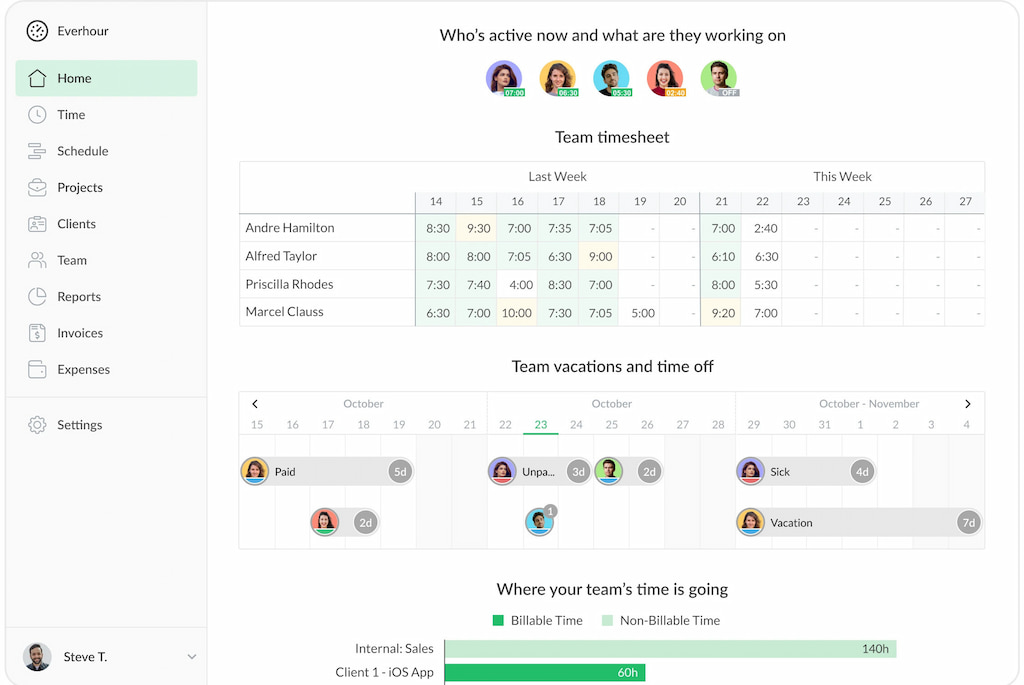
A time tracker like Everhour often becomes more valuable at this stage because it helps agencies track workload, delivery time, and operational efficiency across the entire team instead of only individual tasks.
Common Challenges During The Transition
The hardest part of scaling is not finding more work — it’s adapting to a completely different way of operating.
❗️ Common transition problems include:
- losing visibility once work is delegated
- inconsistent quality across projects
- increased communication and coordination overhead
- difficulty balancing delivery with sales and growth
- becoming stuck as the approval bottleneck for the entire business
Most of these problems appear because freelancer workflows rely heavily on one person’s memory, availability, and direct control. That structure becomes harder to sustain once multiple people and clients are involved.
Building The Foundation Before Scaling
Many freelancers try to scale by adding more clients or hiring help first. In reality, scaling usually works better when the business becomes more repeatable before more people are involved.
That often means shifting away from:
- custom workflows → toward standardized delivery
- undocumented knowledge → toward SOPs and onboarding processes
- reactive communication → toward clearer systems and expectations
- guessing workload and profitability → toward visibility into time, capacity, and project performance
This is also where operational tools become more important. Time tracking tools help agencies understand workload distribution, delivery bottlenecks, and whether projects remain profitable as the team grows.
Positioning matters too. Generalist agencies often struggle with inconsistent workflows and client expectations, while more specialized agencies can standardize delivery much more easily.
Hiring Your First Team Members
The best first hire usually depends on where the business is breaking first.
| If the problem is… | The first hire is usually… |
|---|---|
| repetitive admin work and constant interruptions | operations or administrative support |
| inconsistent delivery or client communication | project coordination or customer support |
| limited growth and lack of outreach | sales or marketing support |
The mistake many founders make is hiring for a role title instead of hiring to remove a specific operational constraint.
Early hires also tend to work best as generalists. In smaller agencies, priorities change quickly, so flexibility is usually more valuable than deep specialization.
Pricing Changes When You Become An Agency
Freelancer pricing and agency pricing operate on completely different assumptions.
As soon as delivery involves multiple people, systems, and coordination, pricing stops being only about time spent doing the work.
For freelancers, pricing is usually tied directly to personal execution — hourly billing or simple project fees based on how long the work takes individually.
Agency pricing works differently because delivery now includes:
- coordination and management time
- reviews and internal communication
- tools, systems, and operational overhead
- inefficiencies that appear once work is delegated
This is why freelancer pricing often breaks during scaling. Revenue may grow while margins quietly shrink.
The shift also changes how agencies think about value. Instead of pricing based purely on hours, agencies start pricing around outcomes, delivery capacity, and ongoing access to a service.
That’s one reason retainers become much more common at agency level. Predictable recurring revenue makes it easier to plan workload, allocate team capacity, and avoid constantly repricing individual tasks or projects.
As the business grows, pricing becomes less about “how long will this take?” and more about:
“what does it cost to deliver this consistently and profitably at scale?”
Managing Clients As An Agency
Client management changes significantly once you move from freelancer to agency. The relationship is no longer just between one person and a client, but between a system and multiple stakeholders.
Setting clearer boundaries and scope
Agencies need stricter scope definitions than freelancers. Without clear boundaries, work expands quickly across multiple people and becomes harder to control.
Scope documents, structured proposals, and defined deliverables help keep expectations aligned before execution starts.
Communication systems
Communication becomes a shared process instead of direct, informal interaction. Most agencies introduce structured channels, scheduled updates, and centralized tracking to avoid information loss across the team.
Preventing scope creep
Scope creep becomes more expensive in an agency model because it affects multiple people, not just one freelancer. Clear approval flows, documented change requests, and visibility into time spent help reduce uncontrolled expansion of work.
Transitioning clients from “you” to “the team”
One of the hardest shifts is moving clients away from working directly with the founder.
This requires:
- introducing account or project owners
- clearly defining communication points
- reinforcing the agency as the delivery unit, not an individual
Without this shift, the business stays personality-dependent instead of system-dependent.
Is Transitioning From Freelancer To Agency Worth It?
Not every freelancer needs to make this transition. It only makes sense when the business consistently exceeds what one person can deliver and there is a clear need for delegation and structure.
Ultimately, the shift is less about hiring people and more about changing how the business works. Sustainable growth depends on systems, delegation, and operational clarity — not just increased output. The goal is to build a business that can deliver consistently, stay profitable, and operate independently of the founder’s daily involvement.

Maria
A dedicated content enthusiast with extensive experience in international teams and projects of all sizes. Maria thrives on creativity and attention to detail, fueled by a love for fantasy novels, music, classic black-and-white films, and always finding ways to make things better.