


Resource Leveling: Definition, Examples, and How It Works

Resource leveling helps project managers balance workloads when the people, equipment, or other resources needed for a project are limited. When several tasks compete for the same resources, the original schedule may no longer be realistic. Leveling adjusts task start dates, durations, or assignments to prevent overallocation and keep work manageable.
In this guide, you’ll learn what resource leveling is, how it works, when to use it, and which techniques can help you balance project workloads without losing sight of deadlines.
TL;DR: Key Takeaways
- Resource leveling adjusts project schedules and assignments to account for limited resource availability and prevent overallocation.
- Its main goal is to create a realistic schedule that matches available capacity, even if this means extending the project timeline.
- Common methods include delaying tasks, changing dependencies, reallocating work, and extending deadlines.
- Resource leveling differs from resource smoothing: leveling can change the project completion date, while smoothing works within existing schedule constraints.
- Regular monitoring matters: project managers need accurate information about resource availability, task progress, and workload to make effective adjustments.
What Is Resource Leveling?
Resource leveling is a project management technique used to balance resource demand with available capacity. It involves adjusting task schedules, assignments, or durations when the resources required to complete planned work exceed what’s available.
Resources can include employees, contractors, equipment, materials, or facilities. In most team-based projects, resource leveling focuses on people: their availability, skills, and capacity to take on work.
For example, imagine a software development project where the same developer is assigned to three tasks scheduled to happen at the same time. Each task requires 20 hours of work, but the developer has only 30 working hours available that week. The schedule assumes 60 hours of capacity, creating an overallocation of 30 hours.
A project manager could resolve this conflict by moving one task to the following week, assigning part of the work to another developer, or extending the task timeline.
The goal is to bring the workload in line with actual availability.
How resource leveling works
Resource leveling starts by comparing planned resource requirements with available capacity. When demand exceeds what’s available, the project manager adjusts the schedule or assignments until the workload becomes manageable.
This may involve:
- Rescheduling tasks: Moving work to later dates when the required resources become available.
- Adjusting task durations: Spreading work over a longer period to reduce pressure on individual resources.
- Reassigning responsibilities: Distributing tasks among other qualified team members with available capacity.
- Changing task dependencies: Adjusting the order of activities when certain tasks don’t need to happen simultaneously.
These adjustments can affect other parts of the project. In particular, delaying tasks on the critical path may push back the final delivery date. That’s why resource leveling requires balancing workload constraints against project priorities and deadlines.
Resource leveling in project management
In project management, resource leveling is used to make schedules more realistic by accounting for the resources a team actually has. A project plan might look achievable on paper, but it can quickly become impractical when the same people are assigned to multiple projects or when unexpected work reduces their availability.
Resource leveling helps project managers identify these conflicts and adjust plans accordingly. It’s especially useful in environments where employees split their time across several projects, specialized skills are in limited supply, or teams have to work within fixed capacity.
The technique doesn’t necessarily make a project faster or reduce the amount of work involved. Instead, it helps ensure that planned work can be completed with the resources available.
Why Is Resource Leveling Important?
Resource leveling helps project managers create schedules that reflect what their teams can realistically deliver. Without it, employees may be assigned more work than they can complete, while project timelines become increasingly difficult to maintain.
Its main benefits include:
Prevent employee overload and burnout
When employees are assigned to several tasks or projects at once, their combined workload can exceed their actual capacity. Resource leveling helps managers redistribute work or adjust deadlines before this becomes a persistent problem. More balanced workloads also make it easier for employees to focus on individual tasks rather than constantly switching between competing priorities.
Resolve resource conflicts
Resource conflicts (including scheduling conflicts) occur when multiple tasks require the same person, equipment, or other limited resource at the same time. Leveling helps identify these overlaps and determine which activities should be rescheduled, reassigned, or prioritized.
Set realistic project timelines
A project timeline is only useful if the team has enough capacity to meet its deadlines. By accounting for resource availability, project managers can avoid relying on unrealistic assumptions and set delivery dates that reflect the work involved.
Improve resource utilization
Resource leveling helps managers distribute work more evenly and make better use of available capacity. It can reveal employees who are consistently overloaded as well as those who have room to take on additional responsibilities.
Reduce delays and scheduling issues
Unresolved resource conflicts can cause bottlenecks, missed deadlines, and last-minute changes. Addressing them during planning helps teams anticipate potential disruptions and create schedules that are easier to maintain.
Resource Leveling vs. Resource Smoothing
Resource leveling and resource smoothing are both techniques for managing resource constraints in project schedules. However, they differ in how much flexibility they allow when adjusting timelines.
Resource leveling prioritizes resource availability, even if this means changing the project’s completion date. Resource smoothing, on the other hand, adjusts activities within the available schedule flexibility without extending the overall project timeline.
Key differences between resource leveling and resource smoothing
| Comparison | Resource leveling | Resource smoothing |
|---|---|---|
| Main priority | Matching work with available resources | Balancing resource demand within schedule constraints |
| Schedule changes | Can change task dates and extend the project | Uses available scheduling flexibility |
| Project completion date | May be delayed | Remains unchanged |
| Critical path | Can affect the critical path | Generally avoids changing the critical path |
| Main constraint | Resource availability | Project deadlines |
For example, imagine two tasks assigned to the same developer. Both are scheduled for the same week, but together they require more hours than the developer has available.
With resource leveling, the project manager might move one task to the following week, even if that delays the project.
With resource smoothing, the manager might move one task within its available float, provided the adjustment doesn’t affect the project’s final delivery date.
When to use each technique
The choice depends on which constraint is more important: resource availability or the project deadline.
Use resource leveling when:
- A team member is assigned more work than they can realistically complete.
- Several tasks compete for the same specialized resource.
- Employee availability or capacity is the main scheduling constraint.
- The project timeline can be adjusted to accommodate resource limitations.
Use resource smoothing when:
- The project completion date is fixed.
- Tasks have scheduling flexibility that can be used to redistribute work.
- Resource demand needs to be balanced without changing the critical path.
- The team can resolve workload peaks within existing schedule constraints.
In practice, project managers may use both techniques at different stages of a project. The important thing is to understand which constraints are flexible and which cannot be changed.
Resource Leveling Methods and Examples
Project managers can use several approaches to resolve resource conflicts, depending on the type of constraint and how much flexibility the schedule allows. The right method depends on task priorities, dependencies, employee availability, and delivery requirements.
Delaying tasks with flexible start dates
If a task doesn’t need to start immediately, moving it to a later date can free up resources for higher-priority work. This is one of the simplest ways to resolve overlapping assignments.
Example: A designer is assigned to two projects in the same week. One task is needed for an upcoming product launch, while the other has a flexible deadline. The project manager postpones the second task until the designer has capacity.
Adjusting task dependencies
Changing the order of activities can help prevent multiple tasks from competing for the same resources. This works when tasks don’t have to happen simultaneously and their dependencies allow for a different sequence.
Example: A development team has one engineer responsible for both setting up a test environment and implementing a new feature. Since implementation depends on the environment being ready, the project manager schedules the setup first and moves other work that would otherwise overlap.
Reallocating resources across projects
When another team member has the required skills and available capacity, transferring some responsibilities can resolve an overallocation without delaying the work.
Example: Two marketing campaigns require copywriting support at the same time. One writer is already at capacity, but another team member has experience with similar content. The project manager reallocates part of the workload to balance assignments.
Extending project timelines
Sometimes there simply aren’t enough resources to meet the original deadline. Extending the timeline allows the team to complete the work without relying on overtime or unrealistic workloads.
Example: A small development team needs to deliver several features, but one engineer is responsible for most of the implementation. The project manager revises the release schedule to give the engineer enough time to complete the work.
Splitting tasks into smaller activities
Breaking a large task into smaller activities can make it easier to distribute work across available time slots or team members. This is particularly useful when different parts of the task can be completed independently.
Example: A website redesign includes research, wireframing, visual design, and asset preparation. Instead of assigning the entire project to one designer, the manager separates the activities and assigns some of them to other team members with the necessary skills.
How to Perform Resource Leveling
Resource leveling works best when project managers understand both the work that needs to be completed and the capacity available to complete it. The following steps provide a practical way to identify conflicts and adjust the schedule.
Identify available resources and their capacity
Start by listing the resources required for the project and determining how much capacity each one has. For employees, consider working hours, planned leave, existing assignments, and other responsibilities.
Don’t assume that an employee’s entire working week is available for project work. Meetings, administrative tasks, and ongoing responsibilities also take time.
Review task requirements and dependencies
Break the project into individual tasks and identify the resources, skills, and estimated effort each one requires. Map task dependencies to understand which activities must happen in sequence and which can run in parallel.
This helps distinguish genuine scheduling conflicts from tasks that can be moved without affecting other work.
Identify resource conflicts and overallocations
Compare planned assignments with available capacity to find periods when resource demand exceeds what’s available.
For example, if an employee has 30 hours of capacity but is assigned 40 hours of work, the schedule contains a 10-hour overallocation. Review these conflicts across the entire project, especially when employees contribute to multiple projects.
Prioritize tasks and adjust the schedule
Not all tasks have the same urgency or impact. Consider deadlines, dependencies, business priorities, and the consequences of delaying each activity.
You can then decide which tasks should happen first and which can be postponed. Pay particular attention to activities on the critical path, since delaying them may affect the project’s completion date.
Reassign work or extend timelines
Once priorities are clear, choose the adjustments that best address the identified constraints. You might move flexible tasks, redistribute responsibilities, reduce overlapping assignments, or extend deadlines.
If reallocating work, make sure the new owner has the necessary skills and capacity. Simply transferring an overloaded task to another busy employee won’t resolve the underlying problem.
Monitor the updated resource plan
Resource leveling isn’t a one-time exercise. Employee availability, project priorities, and task estimates can change throughout the project.
Review actual progress against the revised schedule, check for new capacity conflicts, and adjust assignments when necessary. Regular monitoring helps keep the plan realistic as work progresses.
Resource Leveling Tools and Techniques
Project managers can use different tools to identify resource conflicts, adjust schedules, and monitor workloads. The right choice depends on project complexity, team size, and how much visibility is needed into resource availability.
Resource leveling with project management software
Project management platforms help teams organize tasks, assign responsibilities, track deadlines, and monitor progress. Many also provide workload views that make it easier to spot employees with too many overlapping assignments.
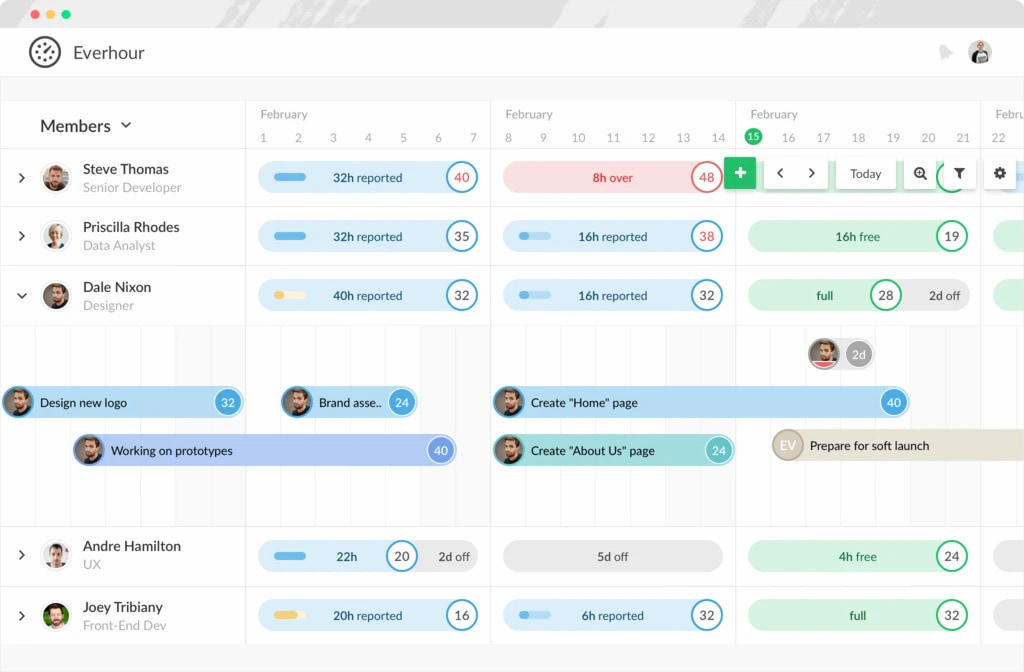
For example, Everhour helps teams track time against projects and tasks, compare actual time with estimates, and review how work is distributed. This information can help project managers identify potential capacity issues and make more informed decisions about reallocating work or adjusting timelines. While Everhour doesn’t automate resource leveling, its time tracker and reporting features provide useful data for resource planning.
Resource calendars and workload charts
Resource calendars show when employees or other resources are available. They can account for working hours, holidays, planned leave, and other scheduling constraints.
Workload charts provide a visual overview of assignments over a selected period. They help managers identify workload peaks, underutilized capacity, and employees who may need their assignments adjusted.
Gantt charts and critical path analysis
Gantt charts display project tasks along a timeline, including their start dates, durations, dependencies, and progress. They help project managers understand how moving one activity may affect other tasks.
Critical path analysis identifies the sequence of activities that determines the shortest possible project duration. It is particularly useful during resource leveling because delays to critical-path tasks can affect the final delivery date.
Spreadsheets and manual resource planning
For smaller projects, spreadsheets can be enough to track assignments, estimated effort, availability, and deadlines. A simple resource allocation table can help managers compare planned workloads against individual capacity.
However, manual tracking becomes harder as the number of projects and team members grows. Spreadsheets also require regular updates, making it easier for scheduling information to become outdated.
Common Resource Leveling Challenges
Although resource leveling helps teams manage capacity constraints, it can also introduce trade-offs. Understanding these challenges makes it easier to choose appropriate adjustments.
Project deadlines may need to change
When resource availability is the main constraint, resolving overallocation may require extending task durations or postponing activities. This can affect delivery commitments, particularly when several tasks depend on one another.
Critical tasks can be delayed
Moving a task on the critical path can extend the entire project. Managers need to consider task dependencies and schedule flexibility before postponing activities that other work relies on.
Resource availability may remain limited
Some projects depend on specialized skills or equipment that only a few people can provide. Reassigning work may not be possible, leaving managers to prioritize activities or negotiate additional resources.
Changes in one project can affect others
In organizations where employees work across several projects, reallocating one person’s time can create conflicts elsewhere. Managers should consider the broader workload rather than optimizing each project in isolation.
Frequently Asked Questions
The main purpose of resource leveling is to balance project resource demand with actual availability. It helps prevent overallocation, resolve scheduling conflicts, and create realistic project timelines.
If a developer is assigned 40 hours of work in a week but only has 30 hours available, a project manager might postpone a lower-priority task or reassign part of the work. This brings the planned workload closer to the developer’s actual capacity.
It can. When tasks are postponed or extended to match resource availability, the project’s completion date may move. However, the impact depends on which activities are adjusted and whether they affect the critical path.
Resource leveling adjusts schedules to resolve resource constraints and can extend the project timeline. Resource smoothing redistributes activities within existing schedule flexibility, without changing the project’s completion date or critical path.
Resource leveling is useful when planned work exceeds available capacity, several tasks compete for the same resources, or employees are consistently overallocated. It is particularly relevant when teams share specialized employees across multiple projects.
Common tools include project management platforms, resource calendars, workload charts, Gantt charts, and spreadsheets. These help managers review assignments, track availability, identify conflicts, and adjust schedules.

Maria
A dedicated content enthusiast with extensive experience in international teams and projects of all sizes. Maria thrives on creativity and attention to detail, fueled by a love for fantasy novels, music, classic black-and-white films, and always finding ways to make things better.