


Beyond Technical Skills: The Power Skills That Count

Technical expertise can help employees get a job done, but it doesn’t always determine how well they work with others, respond to challenges, or make decisions. Skills such as communication, adaptability, and critical thinking often make the difference between completing tasks and achieving strong results.
These capabilities are increasingly described as power skills: the human and cognitive skills that help people navigate complex work, collaborate effectively, and adapt as responsibilities change. Whether you’re developing your own career or building a stronger team, understanding these skills can help you identify where to focus.
TL;DR
- Power skills are transferable human and cognitive capabilities that help employees communicate, solve problems, collaborate, and adapt.
- Key examples include communication, critical thinking, problem-solving, adaptability, emotional intelligence, collaboration, time management, leadership, creativity, and conflict resolution.
- Power skills complement technical expertise and are useful across roles, industries, and career stages.
- You can develop them through deliberate practice, feedback, coaching, and real workplace experience.
- Managers can support development by setting clear goals, creating opportunities to practice, and recognizing observable progress.
10 Essential Power Skills in the Workplace
Power skills influence how employees approach tasks, interact with colleagues, and respond to changing priorities. While the most important skills depend on the role, the following ten are valuable across many workplaces.
| Power skill | What it means | Workplace example |
|---|---|---|
| Communication | Sharing information clearly and listening actively | Explaining project requirements and confirming expectations |
| Critical thinking | Evaluating information and questioning assumptions | Assessing evidence before recommending a solution |
| Problem-solving | Identifying issues and finding workable solutions | Investigating why a project is falling behind schedule |
| Adaptability | Adjusting to changing circumstances and priorities | Reorganizing work when a client changes requirements |
| Emotional intelligence | Recognizing and managing emotions and understanding others’ perspectives | Responding constructively to a colleague’s frustration |
| Collaboration | Working effectively toward shared goals | Coordinating tasks and sharing information across teams |
| Time management | Prioritizing work and using time effectively | Allocating time to high-priority tasks before less urgent requests |
| Leadership | Providing direction, taking responsibility, and supporting others | Helping a team navigate a difficult project decision |
| Creativity | Generating ideas and exploring alternative approaches | Finding a simpler way to complete a repetitive workflow |
| Conflict resolution | Addressing disagreements constructively | Helping colleagues agree on priorities when their needs conflict |
1. Communication
Communication involves expressing ideas clearly, listening actively, and adapting messages to the audience. It also includes asking useful questions, providing context, and confirming that everyone understands what needs to happen next.
At work, strong communication reduces misunderstandings and helps teams coordinate their efforts. For example, a project manager who explains deadlines, responsibilities, and dependencies clearly gives team members a better chance of delivering work on time.
How to develop it: Practice active listening, summarize important decisions after meetings, and ask for feedback on how clearly you communicate.
2. Critical thinking
Critical thinking is the ability to assess information, evaluate evidence, recognize assumptions, and reach reasoned conclusions. Rather than accepting the first explanation or proposed solution, critical thinkers consider alternatives and examine the available facts.
This skill is particularly useful when employees need to make decisions with incomplete information or distinguish meaningful insights from noise. For example, a manager reviewing project performance might investigate the reasons behind missed deadlines before changing team processes.
How to develop it: Ask what evidence supports a conclusion, compare alternative explanations, and identify assumptions before making important decisions.
3. Problem-solving
Problem-solving involves identifying the underlying cause of an issue, evaluating possible solutions, and choosing an appropriate course of action. It combines analytical thinking with practical judgment and follow-through.
For example, if a team repeatedly misses deadlines, the solution may not be to ask employees to work faster. The actual problem could be unclear priorities, unrealistic estimates, or uneven workloads. Identifying the cause helps the team address the issue rather than its symptoms.
How to develop it: Break complex problems into smaller parts, investigate root causes, compare possible solutions, and evaluate whether the chosen approach worked.
4. Adaptability
Adaptability is the ability to adjust to changing requirements, unfamiliar situations, and new ways of working without losing sight of important goals. It doesn’t mean accepting every change without question; it means responding constructively and adjusting plans when circumstances require it.
Adaptable employees can be particularly valuable in dynamic workplaces where priorities, tools, and customer expectations change frequently.
How to develop it: Volunteer for unfamiliar tasks, learn new tools, and practice reassessing priorities when plans change. Reflect on what worked after navigating a difficult situation.
5. Emotional intelligence
Emotional intelligence involves recognizing emotions, managing reactions, understanding other people’s perspectives, and responding appropriately to interpersonal situations.
In the workplace, it can help employees handle feedback, navigate difficult conversations, and maintain productive relationships under pressure. A manager with strong emotional intelligence, for example, can acknowledge a team member’s frustration while still addressing missed expectations.
How to develop it: Reflect on your reactions, listen without immediately becoming defensive, and consider how a situation might look from another person’s perspective.
6. Collaboration
Collaboration means working with others to achieve shared objectives. It requires more than dividing up tasks: employees need to exchange information, coordinate responsibilities, resolve differences, and contribute to collective decisions.
For example, a marketing team launching a campaign may need to coordinate with design, sales, and product teams. Strong collaboration skills help prevent duplicated work, conflicting messages, and avoidable delays.
How to develop it: Clarify responsibilities, share relevant information proactively, ask for input, and make decisions with the team’s overall goals in mind.
7. Time management
Good time management skills help prioritize tasks, allocate time realistically, and manage competing demands. It helps employees distinguish urgent work from important work and maintain a sustainable pace.
For teams, time management also depends on realistic deadlines and a clear understanding of capacity. When employees have more work than they can reasonably complete, individual productivity techniques alone won’t solve the problem.
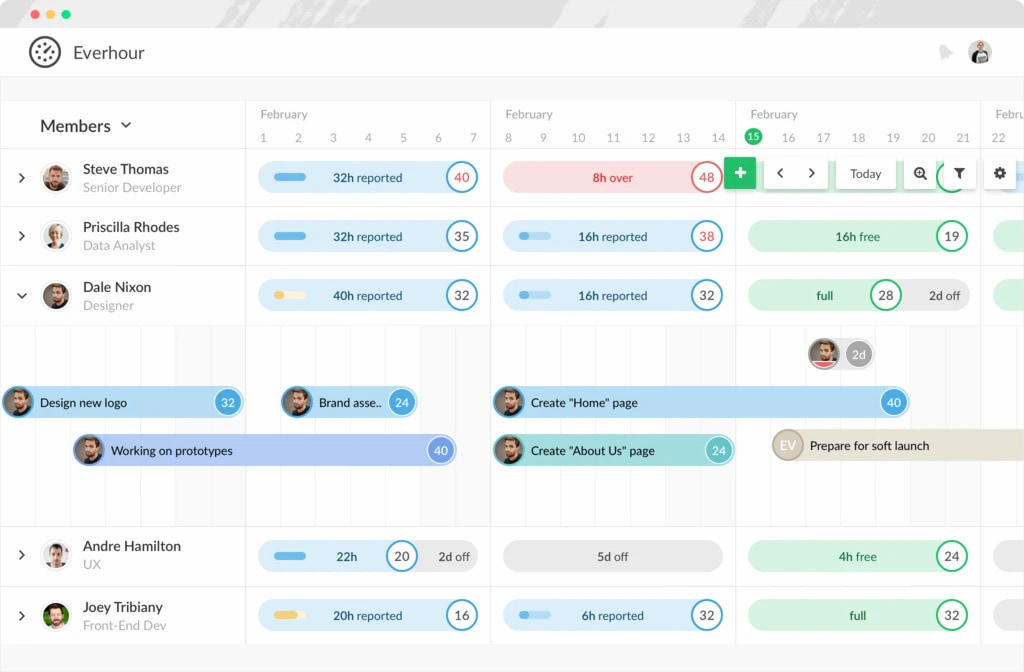
How to develop it: Break projects into manageable tasks, estimate how long work will take, review priorities regularly, and compare planned time with actual time spent. A time tracker as Everhour can help teams track time across tasks and projects, making it easier to understand where time goes and improve future estimates.
8. Leadership
Leadership is the ability to provide direction, take responsibility, support others, and help a group work toward a common goal. It isn’t limited to managers: individual contributors can demonstrate leadership by taking initiative, sharing expertise, and helping colleagues overcome obstacles.
For example, an employee might identify a recurring process problem, propose an improvement, and coordinate with teammates to implement it without being formally responsible for the project.
How to develop it: Take ownership of a task or project, practice making decisions, communicate expectations clearly, and seek opportunities to mentor or support colleagues.
9. Creativity
Creativity involves generating new ideas, exploring alternative approaches, and finding better ways to address challenges. In the workplace, it can apply to product development and design, but also to everyday processes and problem-solving.
A creative employee might suggest automating a repetitive task, redesigning a handoff between teams, or testing a new way to explain a complex concept to customers.
How to develop it: Challenge familiar assumptions, explore multiple solutions before settling on one, and create opportunities to test ideas on a small scale.
10. Conflict resolution
Conflict resolution is the ability to address disagreements constructively and work toward a workable outcome. Differences in priorities, communication styles, and opinions are inevitable in teams; the goal is to handle them without allowing tension to undermine collaboration.
For example, two employees may disagree about which project should receive attention first. Rather than turning the discussion into a personal dispute, they can clarify deadlines, compare business needs, and agree on priorities with their manager.
How to develop it: Address disagreements early, focus on specific issues rather than personalities, listen to different perspectives, and work toward solutions that account for everyone’s legitimate needs.
Power Skills vs. Soft Skills: What’s the Difference?
Power skills and soft skills largely refer to the same broad category of transferable abilities, including communication, teamwork, adaptability, and emotional intelligence. The main difference is emphasis: soft skills is the more established term, while power skills highlights how essential these abilities are to effective work and professional success.
The terminology isn’t standardized across every organization, so the two terms are often used interchangeably.
| Skill category | What it covers | Examples |
|---|---|---|
| Power skills | Transferable abilities that support effective work and collaboration | Communication, adaptability, leadership |
| Soft skills | Interpersonal and behavioral abilities used to work with others | Active listening, empathy, teamwork |
| Hard skills | Technical or role-specific knowledge that can be learned and demonstrated | Data analysis, accounting, programming |
The categories overlap. Communication, for example, can be described as both a soft skill and a power skill. The distinction is less about the ability itself and more about how organizations frame its value.
Hard skills are also essential. A software developer needs programming knowledge, just as an accountant needs financial expertise. But power skills help people apply their technical knowledge effectively, explain their decisions, collaborate with colleagues, and respond to problems.
In practice, successful employees combine both. Technical expertise helps them perform specific tasks, while power skills help them navigate the human and organizational aspects of their work.
How to Develop and Apply Power Skills at Work
Power skills develop through practice, feedback, and experience. Reading about communication or problem-solving can help, but lasting improvement comes from applying these abilities in real situations and reflecting on the results.
Identify the skills you need to improve
Start by reviewing the situations that tend to be most challenging. Do projects stall because expectations aren’t clear? Is it difficult to prioritize competing deadlines? Do disagreements become unproductive? These patterns can help identify which skills would make the greatest difference.
Feedback from colleagues and managers can also reveal blind spots. Skills mapping can also help to see your bottlenecks. Instead of asking whether you’re a good communicator in general, ask specific questions such as whether your project updates provide enough context or whether you make space for others to contribute during discussions.
Practice through everyday work
Power skills can be developed through regular responsibilities, not just formal training. Employees can practice communication by leading meetings, problem-solving by investigating recurring issues, and collaboration by coordinating work across teams.
The key is to choose situations that offer a manageable challenge and an opportunity to apply a particular skill. Someone who wants to improve adaptability, for example, could take on a project involving an unfamiliar process and seek feedback on how they respond to unexpected changes.
Set specific goals and track progress
Broad goals such as “become a better leader” are difficult to act on. Instead, define observable behaviors that indicate progress.
| Development goal | Practical way to apply it |
|---|---|
| Improve communication | Send clearer project updates with decisions, blockers, and next steps |
| Strengthen time management | Estimate tasks, review priorities weekly, and compare planned time with actual effort |
| Develop leadership | Take ownership of a small initiative and coordinate input from colleagues |
| Improve conflict resolution | Practice summarizing the other person’s perspective before proposing a solution |
| Build critical thinking | Document the evidence and assumptions behind important decisions |
Review progress regularly and adjust your approach when something isn’t working. For skills connected to planning and time management, project records and time-tracking data can provide useful evidence of how work is progressing, where delays occur, and whether estimates are realistic.
Use feedback, coaching, and real-world experience
Feedback helps employees understand how their behavior affects others. Managers can support development by discussing specific situations, offering practical suggestions, and creating opportunities to apply new skills. Mentoring, peer feedback, cross-functional projects, and stretch assignments can all provide useful practice.
Organizations should also create an environment where employees can learn without treating every mistake as a failure. People are more likely to practice difficult conversations, take initiative, and experiment with new approaches when expectations are clear and constructive feedback is available.
Power skills shouldn’t be assessed only through self-reported confidence. Look for changes in observable behavior, such as clearer handoffs, more effective meetings, better handling of disagreements, or more realistic project plans. These indicators help employees and managers connect development efforts to everyday work outcomes.
Ultimately, power skills improve when employees repeatedly apply them, receive useful feedback, and adapt their approach. The most effective starting point is to choose one or two skills that address a real workplace challenge and practice them consistently.
Frequently Asked Questions
Power skills and soft skills largely overlap. Both include transferable abilities such as communication, collaboration, adaptability, and emotional intelligence. The term power skills emphasizes how these abilities contribute to workplace performance, effective teamwork, and career growth.
The most important power skills depend on the role, but communication, critical thinking, problem-solving, adaptability, and collaboration are valuable across many professions. Leadership and conflict resolution become particularly important when employees coordinate work, influence decisions, or manage teams.
Yes. Power skills can be developed through deliberate practice, feedback, coaching, and real-world experience. Employees can strengthen communication by practicing clearer updates, for example, or improve problem-solving by investigating the causes of recurring issues rather than addressing symptoms alone.
Employers can assess power skills through behavioral interviews, peer and manager feedback, and observations of how employees handle real workplace situations. Clear, role-specific criteria help make assessments more consistent. For example, collaboration can be evaluated by looking at how an employee shares information, coordinates responsibilities, and responds to feedback.
Power skills help employees communicate expectations, navigate disagreements, make informed decisions, and respond to changing priorities. They also help teams coordinate work more effectively. Combined with technical expertise, these abilities support individual performance and help organizations adapt to new challenges.
Employees can start by identifying one or two skills they want to strengthen, setting specific goals, and practicing in everyday work situations. Seeking feedback from colleagues, taking on unfamiliar responsibilities, and reflecting on challenging interactions can help turn experience into lasting improvement.
Power skills are transferable abilities that influence how people think, communicate, and work with others. Hard skills are specific technical abilities or areas of knowledge, such as programming, financial analysis, or operating specialized software. Most roles require a combination of both: hard skills help employees perform technical tasks, while power skills help them apply their expertise effectively.

Maria
A dedicated content enthusiast with extensive experience in international teams and projects of all sizes. Maria thrives on creativity and attention to detail, fueled by a love for fantasy novels, music, classic black-and-white films, and always finding ways to make things better.