


Workload Balancing: How to Distribute Work Across Your Team

Workload balancing is the process of distributing tasks according to employees’ capacity, skills, availability, and priorities. The goal is to keep workloads manageable without compromising deadlines, quality, or team performance.
A balanced workload doesn’t mean assigning everyone the same number of tasks. Managers need to consider the effort involved, existing commitments, and realistic working capacity. Regular reviews help identify overload, resolve operational bottlenecks, and adjust assignments as project requirements change.
Signs Your Team’s Workload Is Out of Balance
Workload imbalances aren’t always obvious from task counts alone. Watch for these warning signs:
- Uneven workloads: Some employees consistently work overtime while others have spare capacity.
- Recurring operational bottlenecks: Tasks accumulate around employees with specialized skills or approval authority.
- Missed deadlines: Projects fall behind because competing priorities exceed available capacity.
- Overreliance on top performers: The same reliable employees repeatedly receive urgent or additional assignments.
- Excessive work in progress: Team members juggle too many tasks, delaying completion and increasing context switching.
- Poor absence coverage: Vacations or sick leave disrupt delivery because responsibilities are concentrated among too few people.
These symptoms may indicate uneven distribution, insufficient staffing, unrealistic deadlines, or skills gaps. Identifying the underlying cause is essential: reallocating tasks won’t solve a workload that exceeds the team’s overall capacity.
How to Balance Workloads Across a Team
1. Map current assignments and commitments
Start by listing active tasks, recurring responsibilities, deadlines, and upcoming absences. A complete view of assigned work helps managers spot overloaded employees and competing priorities before assigning anything new.
2. Estimate effort, not just task count
Task volume alone doesn’t reflect workload. Compare estimated hours, complexity, and dependencies to understand how much effort each assignment requires. Use actual time data to refine estimates when planned work consistently takes longer than expected.
3. Check capacity before assigning work
Calculate available working time after accounting for existing commitments, meetings, leave, and routine responsibilities. Leave some room for unexpected requests rather than allocating every available hour to planned work.
4. Match assignments to skills and experience
Consider the expertise each task requires, employees’ current workloads, and opportunities to develop new skills. Cross-training can expand the pool of people who can handle specialized work, reducing bottlenecks around individual team members.
5. Revisit priorities and deadlines
When demand exceeds capacity, decide which tasks are essential, which can wait, and which can be reassigned. If the team cannot meet every deadline with available resources, negotiate scope or timelines instead of relying on overtime to compensate.
6. Review and adjust regularly
Workloads change as estimates shift, priorities move, and new requests arrive. Review assignments during project planning and team check-ins, and rebalance work when someone’s capacity changes significantly.
Workload Balancing Strategies That Work
The right approach depends on why workloads become uneven. These strategies help teams distribute work more sustainably:
- Cross-train employees: Develop backup skills so essential tasks don’t depend on one specialist.
- Limit work in progress: Encourage employees to finish existing assignments before taking on more, reducing multitasking and stalled work.
- Employ job rotation: Share routine or less desirable tasks instead of repeatedly assigning them to the same people.
- Build capacity buffers: Reserve time for unplanned work, revisions, and urgent requests.
- Distribute knowledge and ownership: Document processes and establish backup owners to prevent work from accumulating around a single employee.
- Set explicit priorities: Give employees a clear way to resolve competing demands instead of expecting them to treat every request as equally urgent.
Common Workload Balancing Mistakes
Even well-intentioned workload planning can create new problems when managers focus on the wrong indicators.
- Equal task counts: Assigning the same number of tasks to everyone ignores differences in effort, complexity, and experience.
- Full capacity allocation: Planning every available hour leaves no room for interruptions or unexpected work.
- Rewarding efficiency with more work: Continually assigning extra tasks to the fastest employees can create chronic overload.
- Redistributing tasks without changing deadlines: Moving assignments around doesn’t help if the team’s total workload remains unrealistic.
- Using utilization as the only measure: High utilization can look productive while leaving employees overwhelmed and projects vulnerable to delays.
- Ignoring employee input: Managers may overlook hidden work, dependencies, or unrealistic estimates if they make allocation decisions without consulting the people doing the tasks.
How to Measure Workload Balance
No single metric captures workload balance. Combine capacity data with delivery and workload indicators to identify where adjustments are needed.
| Metric | What it reveals |
|---|---|
| Planned hours vs. available capacity | Whether assigned work fits realistic availability |
| Estimated vs. actual time | Whether task estimates reflect the effort required |
| Overtime and after-hours work | Whether workloads are sustainable |
| Work in progress | Whether employees are juggling too many assignments |
| Missed deadlines and blocked tasks | Where capacity constraints delay delivery |
| Work distribution by skill or role | Whether particular employees are becoming bottlenecks |
Review these indicators over time rather than relying on a single snapshot.
For example, consistently high utilization combined with increasing overtime and missed deadlines suggests a capacity problem, not necessarily a need for tighter performance management.
Workload Balancing Tools: What to Look For
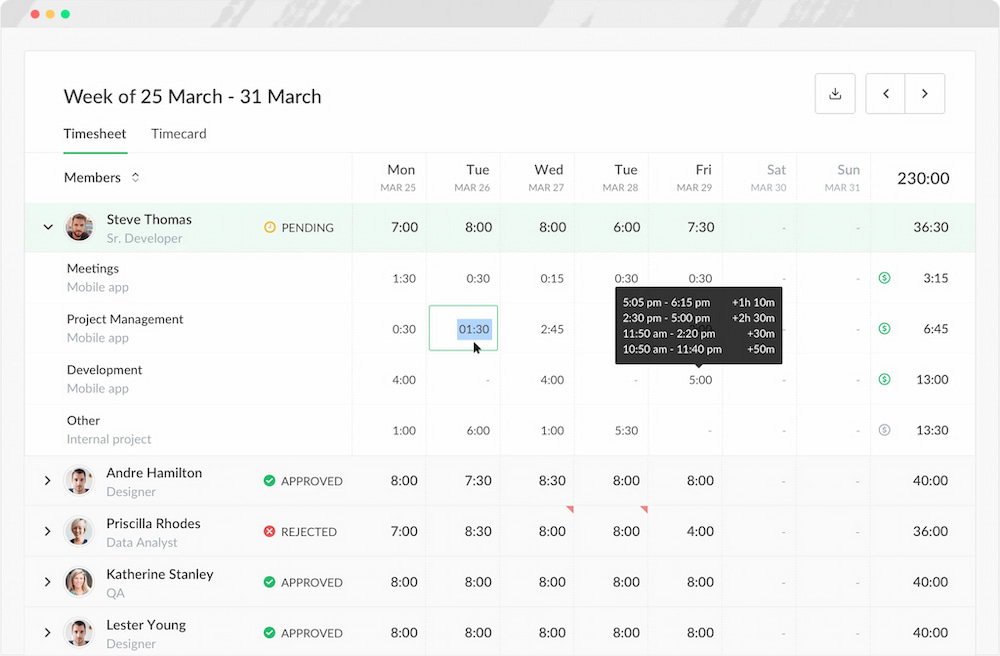
Workload balancing tools help managers compare assignments with team capacity and adjust plans as conditions change. Useful features include workload views by employee or project, availability and time-off tracking, task estimates, and comparisons between planned and actual time.
Everhour‘s time tracker can support this process by tracking time against tasks and projects in tools such as Asana, ClickUp, and Jira. Its reporting helps teams understand where time goes, while its resource planning capabilities help managers review assignments and team availability. These insights can reveal potential imbalances, although managers still need to account for task complexity, competing priorities, and work that time data cannot capture.
Workload Balancing Example
Imagine a four-person product team preparing a release. One developer owns several urgent fixes, another has spare capacity but lacks context on those tasks, and a third will soon be on leave. Meanwhile, a planned feature is competing for the same deadline.
Rather than simply moving tasks to the least busy person, the manager reviews estimated effort, dependencies, and release priorities. A suitable fix is reassigned with time for a handover, the planned feature is moved to the next release, and the team documents ownership for work affected by the upcoming absence.
The result is a more realistic plan without expecting everyone to work longer hours. It also exposes a longer-term improvement: cross-training would make future workload adjustments easier.
Frequently Asked Questions
Workload balancing focuses on distributing work according to capacity and skills. Workload management is broader, covering how work is planned, prioritized, monitored, and adjusted.
Compare the estimated hours required for assigned work with the employee’s realistic available hours. Account for meetings, recurring duties, time off, and a buffer for unexpected tasks.
Consider effort, deadlines, skills, availability, and existing commitments rather than assigning equal numbers of tasks. Fair distribution means sustainable and reasonable workloads, not identical assignments.
Review workloads during project planning and regular team check-ins, and whenever priorities, deadlines, or employee availability change significantly.
Reassess priorities, defer lower-value work, negotiate deadlines, reduce scope, or add capacity where possible. Redistributing existing tasks cannot resolve a persistent gap between demand and available resources.
Conclusion
Effective workload balancing means matching assignments to realistic capacity, skills, and priorities—and adjusting as conditions change. By tracking effort, reviewing commitments, and addressing bottlenecks early, managers can distribute work more sustainably and keep projects moving without relying on chronic overtime.

Maria
A dedicated content enthusiast with extensive experience in international teams and projects of all sizes. Maria thrives on creativity and attention to detail, fueled by a love for fantasy novels, music, classic black-and-white films, and always finding ways to make things better.