


Job Rotation: Definition, Examples, Benefits, and How It Works

Job rotation is a job design practice where employees temporarily move between different roles, tasks, or departments. Unlike a promotion, the move is usually lateral and gives employees experience in different parts of the organization.
Companies use job rotation to build broader skills, improve cross-training, reduce dependency on individual employees, and support professional growth and career development. A well-designed rotation can also give employees more variety without permanently changing their job.
What Is Job Rotation?
Job rotation is the practice of moving an employee between different jobs, roles, tasks, or departments, usually for a defined period. The employee learns and performs work outside their usual position, then may return to their original role or continue into another rotation.
Job rotation can be informal, such as temporarily moving an employee to another team to learn a specific process. It can also be a structured job rotation program where employees follow a planned sequence of roles with specific learning goals.
The move is usually lateral rather than a promotion. The goal is to give employees experience in different areas of the organization while helping the company build a more flexible workforce.
How job rotation works
A typical job rotation includes:
- A starting role: The employee begins in their usual position or one role within a development program.
- A different role or function: They move to another position, team, department, or set of responsibilities.
- A defined rotation period: The employee spends a planned amount of time in the new role.
- Training and support: Someone helps the employee learn the new responsibilities and processes.
- A clear purpose: The rotation may focus on skill development, cross-training, career development, succession planning, or workforce flexibility.
- A review: Managers assess what the employee learned and whether the rotation achieved its intended goal.
The length and structure can vary. Some rotations provide short-term exposure to another function, while others last long enough for employees to develop meaningful competence in the new role.
The important part is that the employee moves between roles with a defined purpose, rather than simply taking on additional work without changing their role or responsibilities.
Types of Job Rotation
Job rotation can take several forms depending on the organizational strategy, the roles involved, and how long employees spend in each position. The rotation can happen within one team or across completely different departments.
| Type | How it works | Example |
|---|---|---|
| Within-team rotation | Employees switch between related responsibilities within the same team | A customer support specialist moves between technical support and onboarding |
| Cross-department rotation | Employees spend time working in different departments | An HR employee rotates between recruiting and HR operations |
| Cross-functional rotation | Employees work with different functions involved in the same workflow | A product employee works with product, engineering, and customer success |
| Temporary rotation | An employee moves into another role for a defined period before returning to their original position | A project coordinator spends three months supporting another project team |
| Structured rotation program | Employees follow a planned sequence of roles with defined learning goals | A graduate rotates through finance, operations, and HR |
The right approach depends on what the organization wants to achieve. A short within-team rotation may be enough for cross-training, while a structured program can give employees broader experience across the organization.
Job Rotation Examples
Job rotation can work in many types of roles, from office functions to retail and manufacturing. The goal isn’t simply to move people around. Each rotation should give employees useful experience, develop specific skills, or improve the team’s ability to cover different responsibilities.
| Role or industry | Rotation example | What employees learn |
|---|---|---|
| HR | Recruiting → HR operations → learning and development | How different HR functions work together |
| Marketing | Content → social media → campaign management | How different marketing activities connect |
| Customer support | Support → onboarding → customer success | More of the customer journey |
| Finance | Accounts payable → budgeting → financial reporting | Different parts of the finance process |
| Retail | Sales floor → inventory → customer service | How different store operations work |
| Manufacturing | Production → quality control → logistics | How products move through the operation |
For example, rotating a customer support employee into customer success can help them understand what happens after an issue is resolved. Similarly, moving an HR employee between recruiting and HR operations can give them a better understanding of the employee lifecycle.
The strongest rotations have a clear learning or business objective. Moving employees between roles without enough training or a defined purpose can create disruption without delivering much benefit.
Benefits of Job Rotation
Job rotation can benefit both employees and employers, particularly when organizations want to develop skills without relying entirely on external hiring.
Build broader skills
Employees gain experience outside their usual responsibilities. This can help them develop transferable skills and understand how different parts of the organization work.
Reduce dependency on individual employees
When only one person knows how to perform a critical task, an absence or departure can create a problem. Rotating employees through important functions gives more people experience with those processes.
Improve cross-functional understanding
Employees who work with different teams see how their work affects other parts of the organization. This can improve communication and make it easier for teams to coordinate work.
Support career development
A rotation can help employees explore different career goals and paths and build experience for future roles. It can also help managers identify employees who are interested in or suited to different types of work.
Reduce repetitive work
Moving between responsibilities can introduce variety for employees whose regular work is highly repetitive. This doesn’t eliminate the need for specialization, but it can make some roles less monotonous.
Improve workforce flexibility
A team with experience across several functions has more options when someone is absent, workload changes, or a new project needs support. Job rotation can therefore contribute to a more adaptable workforce.
Disadvantages of Job Rotation
Job rotation can have drawbacks, especially when employees move between roles too frequently or without enough planning.
Temporary productivity loss
Employees need time to learn new responsibilities, tools, and processes. Productivity may temporarily decrease while they adjust to the new role.
Training requires time and resources
Managers and experienced employees may need to spend time training and supporting employees during a rotation. This can add to the workload of the team.
Less time to develop deep expertise
Rotating between roles can help employees develop broader skills, but frequent moves may make it harder to develop deep expertise in one area.
Not every role is suitable
Some positions require specialized skills, certifications, or extensive training, making them difficult to include in a rotation program.
Can increase workload
If employees are expected to maintain their old responsibilities while learning a new role, rotation can create unnecessary workload and stress.
Job Rotation vs. Job Enlargement vs. Job Enrichment
Job rotation, job enlargement, and job enrichment are all job design strategies, but they change different aspects of an employee’s work.
| Approach | What changes? | Main purpose |
|---|---|---|
| Job rotation | The employee moves between roles | Broader experience |
| Job enlargement | More tasks are added to the same role | More task variety |
| Job enrichment | Responsibility and autonomy increase | More ownership |
In simple terms:
Job rotation moves an employee between jobs. Job enlargement makes one job broader. Job enrichment makes one job deeper.
For example, a customer support employee who takes on onboarding as an additional responsibility is experiencing job enlargement. If they temporarily move from customer support to the onboarding team, that’s job rotation.
How to Implement a Job Rotation Program
A successful job rotation program needs a clear purpose and enough planning to avoid disrupting regular work.
1. Define the purpose
Decide what you want the rotation to achieve. Common goals include:
- Skill development
- Cross-training
- Succession planning
- Internal mobility
- Employee development
- Workforce flexibility
2. Choose suitable roles
Select roles that have transferable skills and can be learned within a reasonable period. Consider whether employees need specific qualifications or extensive training before they can take on the new responsibilities.
3. Set the rotation structure
Decide:
- Who will participate
- Which roles they will rotate through
- How long each rotation will last
- What employees should learn
- Who will provide training and support
Clear expectations make it easier for employees and managers to understand the purpose of each rotation.
4. Plan for workload
Consider what happens to the employee’s existing responsibilities while they’re learning the new role. Someone may need to cover their previous work, and the employee may need dedicated time for training.
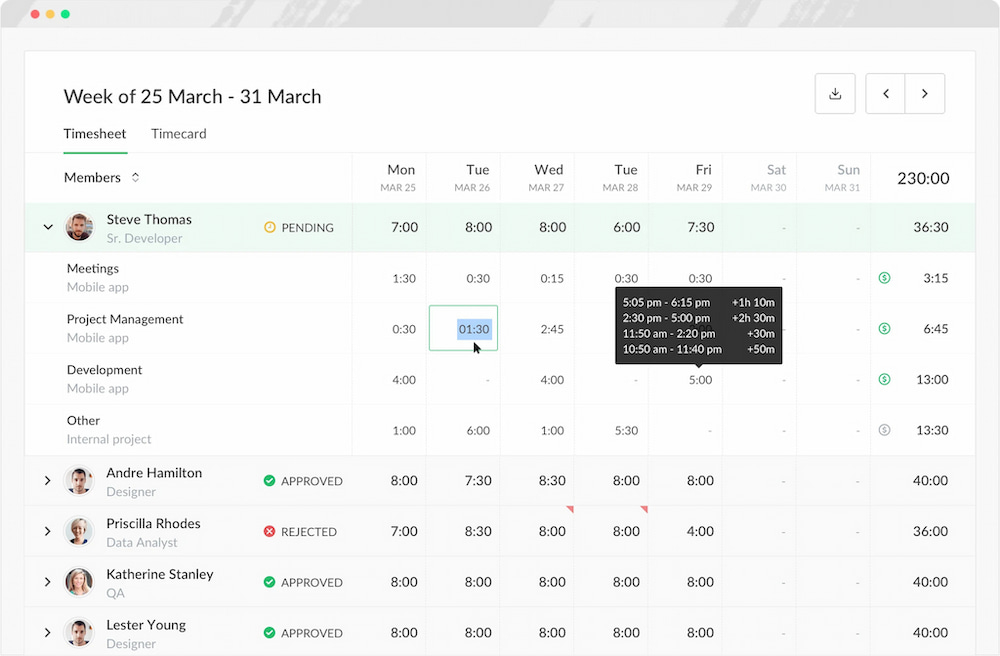
Time tracking can help managers compare planned and actual time spent on training, projects, and other responsibilities during a rotation. A time tracker like Everhour can greatly help with that.
5. Provide support
Give employees the training, documentation, and feedback they need to get comfortable in the new role. A manager or mentor can also help them understand expectations and address problems early.
6. Review the results
After the rotation, check whether employees developed the intended skills and whether the program achieved its goal. Use employee feedback and performance data to improve future rotations.
How Long Should a Job Rotation Last?
There is no fixed length for a job rotation. The right duration depends on the complexity of the role, training requirements, and purpose of the rotation.
Short rotations can work well for exposure and basic cross-training, while longer rotations give employees more time to develop meaningful skills in a new role.
The key is to give employees enough time to learn the role without rotating them so frequently that they never become comfortable or productive.
How to Measure a Job Rotation Program
The right metrics depend on what the rotation is supposed to achieve. Useful measures include:
| Metric | What it measures |
|---|---|
| Time to productivity | How quickly employees become effective in the new role |
| Training time | How much time the rotation requires |
| Cross-coverage | How many employees can perform critical tasks |
| Employee feedback | How useful employees found the rotation |
| Internal mobility | Whether employees move into new roles |
| Retention | Whether participants stay with the company |
| Performance | Whether performance changes after the rotation |
For example, if the goal is cross-training, you can track how many employees are able to cover critical responsibilities after the program. If the goal is career development, internal promotions or moves into new roles may be more useful metrics.
FAQs About Job Rotation
Job rotation is a job design practice where employees move between different roles, tasks, or departments, usually for a defined period.
A customer support employee temporarily moving to customer success is an example of job rotation. They gain experience with a different part of the customer journey before returning to their original role or moving into another position.
Common benefits include broader employee skills, better cross-functional understanding, reduced dependency on individual employees, more career development opportunities, and greater workforce flexibility.
Job rotation can temporarily reduce productivity, require additional training, create staffing challenges, and make it harder for employees to develop deep expertise if rotations happen too frequently.
A job rotation program is a structured system for moving employees between roles or departments according to a planned schedule and defined learning or business objectives.
There is no universal duration. Short rotations can provide exposure or basic cross-training, while longer rotations may be necessary when employees need more time to develop meaningful skills in a new role.
Usually, no. Job rotation is generally a lateral move rather than a promotion. The employee moves to another role or function without necessarily gaining a higher level of authority or compensation.
Job rotation moves an employee between different roles, while job enlargement adds more tasks to the employee’s existing role.
Job rotation changes the role an employee performs, while job enrichment increases the responsibility, autonomy, or decision-making authority within their existing role.
Start by defining the program’s purpose, choosing suitable roles and participants, establishing the rotation schedule and learning goals, planning for workload and training, providing support, and measuring the results.
Conclusion
Job rotation can help organizations build broader skills, improve cross-training, and create stronger internal career paths. But moving employees between roles works best when each rotation has a clear purpose and enough time and support for employees to learn.
Before starting a rotation, consider both employee development and team capacity. Tracking time and measuring the results can help managers understand whether the rotation is creating value and where the program could be improved.

Maria
A dedicated content enthusiast with extensive experience in international teams and projects of all sizes. Maria thrives on creativity and attention to detail, fueled by a love for fantasy novels, music, classic black-and-white films, and always finding ways to make things better.