


Customer Service Skills: Definition, Examples & Tips

Customer service skills are the abilities employees use to communicate with customers, understand their needs, solve problems, and create a positive experience. They include communication, active listening, empathy, problem-solving, patience, product knowledge, and time management.
Good customer service requires more than being friendly. Employees need to understand what customers need, explain solutions clearly, handle difficult interactions, and manage their workload at the same time.
What Are Customer Service Skills?
Customer service skills are the soft and technical abilities employees use to help customers effectively. They apply across phone, email, chat, in-person, and other customer interactions.
The skills needed vary by role, but most customer service work combines several areas:
- Communication skills: Explain information clearly and adjust communication to the customer.
- Interpersonal skills: Build rapport, show empathy, and maintain professional relationships.
- Problem-solving skills: Understand issues and find appropriate solutions.
- Product knowledge: Understand the product or service well enough to answer questions accurately.
- Organizational skills: Manage requests, follow-ups, and competing priorities.
A strong customer service employee needs a combination of these skills. Product knowledge can help someone answer a technical question, for example, but communication and active listening determine whether they can explain the answer in a way the customer understands.
15 Customer Service Skills
Customer service roles require a mix of communication, interpersonal, problem-solving, and organizational skills. The most important skills include:
1. Communication
Customer service employees need to explain information clearly across different channels, from email and chat to phone and face-to-face conversations. Good communication also means avoiding unnecessary jargon and making sure the customer understands the next steps.
2. Active listening
Active listening means paying attention to what the customer is actually saying before responding. Asking clarifying questions and confirming the problem can prevent misunderstandings and unnecessary back-and-forth.
3. Empathy
Empathy helps employees recognize what a customer may be feeling and respond appropriately. It is particularly important when customers are frustrated, confused, or disappointed.
4. Patience
Some customers need more explanation or may repeat the same concern several times. Patience helps employees remain helpful and professional without making the customer feel rushed or dismissed.

5. Problem-solving
Customer service often involves situations that don’t have an obvious answer. Strong problem-solving skills help employees identify the cause of an issue, evaluate possible solutions, and find a practical way forward.
6. Product knowledge
Employees need enough knowledge of the product or service to answer questions accurately and troubleshoot common problems. Strong product knowledge also makes it easier to explain solutions confidently.
7. Conflict resolution
Customer service employees may need to handle complaints, disagreements, or situations where the company cannot give the customer exactly what they want. Conflict resolution skills help them acknowledge the issue, explain available options, and work toward a reasonable outcome.
8. Adaptability
Different customers need different approaches. An employee may need to give detailed guidance to one customer and provide a quick answer to another. Adaptability helps employees adjust their communication and problem-solving approach to the situation.
9. Emotional intelligence
Emotional intelligence helps employees recognize and manage their own emotions while responding appropriately to the emotions of others. This can make difficult conversations easier to handle without escalating tension.
10. Time management
Customer service employees often balance active conversations, follow-ups, administrative work, and new requests. Good time management helps them handle these competing demands without letting important tasks fall through the cracks.
11. Organization
Organization is important when employees manage multiple conversations, tickets, customer records, or follow-ups. Keeping information organized helps prevent missed requests and inconsistent service.
12. Attention to detail
Small mistakes can create additional problems for customers. Attention to detail helps employees enter information correctly, follow procedures, understand the customer’s specific situation, and provide accurate answers.
13. Positive communication
Positive communication keeps interactions constructive without ignoring the customer’s problem. It means focusing on what can be done, explaining limitations clearly, and avoiding language that sounds dismissive or defensive.
14. Collaboration
Some customer problems require help from another team, such as engineering, billing, sales, or product. Customer service employees need to know when to involve others and communicate the relevant information clearly.
15. De-escalation
De-escalation is the ability to reduce tension during a difficult interaction. It involves staying calm, listening carefully, acknowledging the customer’s concern, and guiding the conversation toward a solution.
Customer Service Skills Examples
Customer service skills become easier to understand when you look at how employees use them in real situations.
| Skill | Example in customer service |
|---|---|
| Active listening | Asking clarifying questions before suggesting a solution |
| Empathy | Acknowledging a customer’s frustration before explaining the next steps |
| Problem-solving | Finding an alternative when the customer’s original request isn’t possible |
| Communication | Explaining a technical issue in language the customer can understand |
| Adaptability | Changing the level of guidance depending on what the customer needs |
| Attention to detail | Checking customer information before making an account change |
| Collaboration | Bringing in another team when an issue requires specialized knowledge |
The same skill can look different depending on the situation. A support specialist might use problem-solving to troubleshoot a technical issue, while a retail employee might use it to find an alternative product for a customer.
Hard Skills vs. Soft Skills in Customer Service
Customer service employees need both soft skills and hard skills. Soft skills affect how employees interact with customers, while hard skills are the technical knowledge and abilities they use to do their work.
| Soft skills | Hard skills |
|---|---|
| Communication | CRM software |
| Empathy | Ticketing systems |
| Active listening | Product knowledge |
| Problem-solving | Data entry |
| Patience | Reporting |
| Conflict resolution | Technical troubleshooting |
| Adaptability | Knowledge base management |
The distinction isn’t always absolute. Problem-solving, for example, can involve both technical knowledge and interpersonal judgment. What matters is that employees can combine the two types of skills to resolve customer needs effectively.
Someone can know a CRM system inside out and still struggle in customer interactions if they can’t listen, communicate clearly, or handle conflict. Likewise, strong interpersonal skills aren’t enough if an employee lacks the product knowledge needed to provide accurate help.
Why Are Customer Service Skills Important?
Customer service skills affect more than individual customer interactions. They can influence how quickly teams resolve issues, how often problems are escalated, and how consistently customers receive support.
Better customer experiences
Clear communication, empathy, and active listening make interactions easier for customers and help employees understand what they actually need.
Faster issue resolution
Strong product knowledge and problem-solving skills can reduce unnecessary back-and-forth and help employees reach appropriate solutions more quickly.
Fewer escalations
Employees who can communicate clearly and de-escalate difficult situations may be able to resolve more issues without involving a manager or another team.
More consistent service
Employees with a common set of customer service skills can handle similar situations more consistently, even when different people handle the interaction.
Better employee performance
Strong communication, organization, and time management help employees manage customer requests alongside follow-ups, administrative work, and other responsibilities.
Stronger customer relationships
Customers are more likely to have a positive experience when employees listen carefully, communicate clearly, and follow through on what they promise.
How to Improve Customer Service Skills
Customer service skills can improve through a combination of training, practice, feedback, and experience. The most effective approach depends on the specific skill employees need to develop.
Practice active listening
Use role-playing and real customer interactions to help employees practice asking clarifying questions, identifying the customer’s actual need, and confirming their understanding before responding.
Build product knowledge
Give employees easy access to product documentation, FAQs, knowledge bases, and updates. Employees can provide better support when they don’t have to search for basic information during every interaction.
Train for difficult conversations
Practice common situations involving complaints, refunds, delays, misunderstandings, and escalations. Employees can build confidence before they have to handle these situations with real customers.
Review real interactions
Customer conversations can reveal recurring problems in communication, product knowledge, or problem-solving. Reviewing interactions gives managers specific examples to use during coaching.
Give specific feedback
Instead of telling an employee to “be more empathetic” or “communicate better,” point to a specific interaction and explain what they could have done differently.
Protect time for training
Training competes with regular customer service work. If employees already have a full workload, managers need to account for training and coaching time rather than expecting employees to fit it around their existing responsibilities.
Tracking time spent on customer requests, training, administrative work, and other activities can help managers understand how much capacity teams actually have for development.
How to Assess Customer Service Skills
Customer service skills are difficult to measure with a single metric. Response speed, for example, can show efficiency but doesn’t tell you whether an employee actually solved the customer’s problem.
Use several sources of information to get a more complete picture.
| Method | What it can show |
|---|---|
| Customer feedback | How customers perceive the interaction |
| Quality reviews | Whether employees follow service standards |
| Support ticket reviews | How employees communicate and solve problems |
| Resolution time | How long it takes to resolve issues |
| Escalation rate | How often issues require additional support |
| First-contact resolution | Whether customers get their issue resolved without repeated contact |
| Coaching sessions | Specific skills an employee needs to develop |
| Role-playing exercises | How employees handle realistic customer scenarios |
| Peer feedback | How employees communicate and collaborate with colleagues |
The right metrics depend on what you’re trying to improve. If the goal is better communication, reviewing customer interactions may be more useful than measuring response time. If the goal is faster resolution, resolution time and first-contact resolution may provide more relevant information.
Avoid measuring speed in isolation. Closing tickets quickly isn’t necessarily good performance if customers have to contact the company again to resolve the same problem.
How Time Tracking Can Support Customer Service Skills
Customer service skills aren’t developed in isolation. Training, coaching, reviewing customer interactions, and handling support work all take time. Time tracking can help managers understand where customer service teams spend their capacity and whether employees have enough time for development.
With a time tracker like Everhour, managers can track time across customer support tasks, projects, training, and other work. This can help answer practical questions such as:
- How much time does the team spend handling customer requests?
- How much time goes toward training and skill development?
- Which types of customer issues take the most time to resolve?
- Are employees spending too much time on administrative work?
- Does training time fit within the team’s current capacity?
Time data can also help managers compare workload with performance metrics. For example, a longer resolution time may not indicate a skill problem if employees are handling unusually complex requests or spending significant time on other responsibilities.
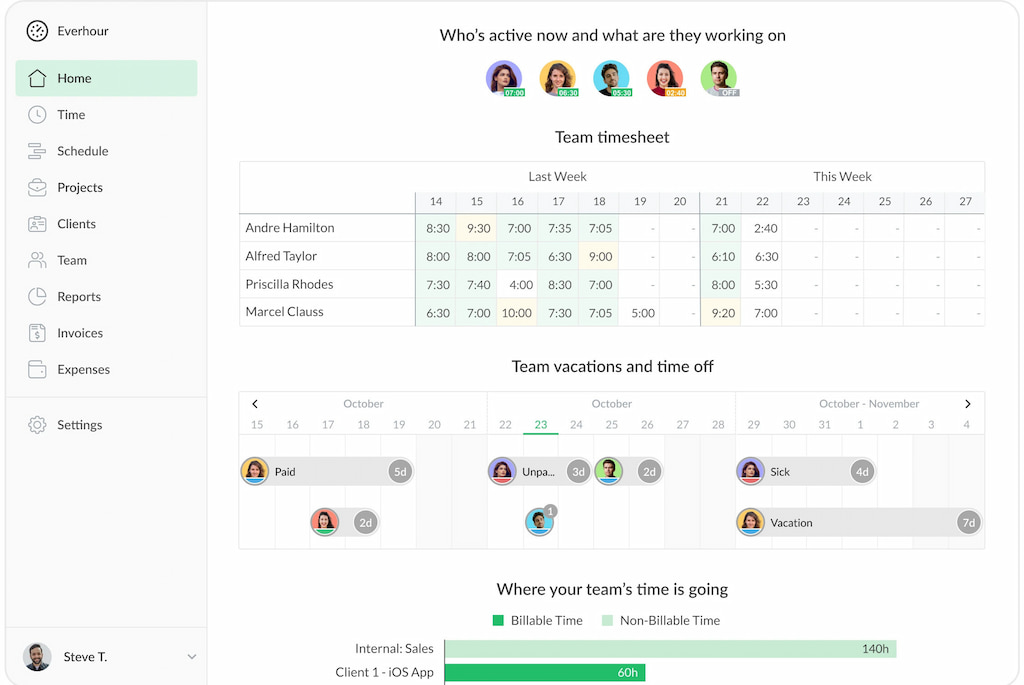
The goal isn’t to use time tracking to judge every customer interaction by the minute. It’s to understand how customer service work is distributed and make better decisions about training, staffing, and workload.
Customer Service Skills by Role
The most important customer service skills depend on the role. A technical support specialist needs strong troubleshooting skills, for example, while a customer success manager may rely more heavily on relationship-building and organization.
| Role | Skills that matter most |
|---|---|
| Customer service representative | Communication, empathy, problem-solving |
| Technical support specialist | Troubleshooting, product knowledge, communication |
| Customer success manager | Relationship building, communication, organization |
| Call center representative | Active listening, patience, time management |
| Retail employee | Communication, product knowledge, adaptability |
| Help desk specialist | Technical knowledge, problem-solving, attention to detail |
These skills often overlap. Most customer-facing roles require a combination of communication and interpersonal skills alongside the technical knowledge needed to solve customer problems.
Common Customer Service Skills Mistakes
Developing customer service skills isn’t just about adding more training. Managers can undermine otherwise good training by focusing on the wrong behaviors or giving employees unrealistic expectations.
| Mistake | Better approach |
|---|---|
| Focusing only on speed | Balance efficiency with resolution quality |
| Using scripted empathy | Respond to what the customer actually said |
| Teaching product knowledge without communication skills | Develop technical and interpersonal skills together |
| Measuring individual metrics in isolation | Look at several performance indicators together |
| Treating every customer the same | Adapt communication to the situation |
| Adding training without protecting time for it | Include training in workload planning |
For example, reducing response time may look like an improvement until you discover that customers need to contact the company again because their problems weren’t fully resolved.
The goal isn’t to make every interaction as short as possible. Good customer service balances efficiency, accuracy, and the quality of the customer experience.
Frequently Asked Questions
Customer service skills are the abilities employees use to communicate with customers, understand their needs, solve problems, and provide effective support. They include communication, active listening, empathy, problem-solving, patience, product knowledge, and organization.
Some of the most important skills include communication, active listening, empathy, problem-solving, patience, product knowledge, conflict resolution, adaptability, and time management.
Examples include active listening, empathy, communication, problem-solving, conflict resolution, emotional intelligence, attention to detail, collaboration, and product knowledge.
Five foundational customer service skills are communication, active listening, empathy, problem-solving, and patience. The most important skills can vary depending on the role and type of customer interaction.
Hard customer service skills include using CRM and ticketing systems, product knowledge, data entry, reporting, technical troubleshooting, and knowledge base management.
Soft skills include communication, empathy, active listening, patience, adaptability, emotional intelligence, conflict resolution, and collaboration.
Customer service skills can improve through targeted training, role-playing, feedback, coaching, product training, and reviewing real customer interactions. Managers should also make time for training instead of adding it on top of an already full workload.
Managers can assess customer service skills through customer feedback, quality reviews, support ticket reviews, resolution metrics, escalation rates, role-playing exercises, coaching sessions, and peer feedback.
Strong customer service skills help employees communicate clearly, solve problems effectively, handle difficult interactions, and provide more consistent support. They can also contribute to faster resolution and better customer relationships.
A customer service representative typically needs communication, active listening, empathy, problem-solving, patience, product knowledge, organization, time management, and conflict resolution skills.
Conclusion
Strong customer service combines communication, empathy, problem-solving, product knowledge, and the ability to manage competing priorities. No single skill determines whether an employee provides good service.
Companies can develop these skills through targeted training, coaching, feedback, and regular review of customer interactions. Managers should also consider workload when planning training and development so employees have enough time to practice new skills.
The goal isn’t simply to make customer service employees faster. It’s to help them resolve customer needs effectively while maintaining a consistent, manageable workload.

Maria
A dedicated content enthusiast with extensive experience in international teams and projects of all sizes. Maria thrives on creativity and attention to detail, fueled by a love for fantasy novels, music, classic black-and-white films, and always finding ways to make things better.