


Cross-Functional Collaboration: Benefits, Examples, and Best Practices

Most projects don’t stay within one department. A product launch, for example, might involve product managers, designers, developers, marketers, sales representatives, and customer support specialists. Each group brings different expertise, but getting everyone to work toward the same outcome takes more than putting them in a shared chat.
Cross-functional collaboration helps people from different departments coordinate their work, share knowledge, and make decisions around common goals. When it works well, teams can solve problems faster, avoid duplicated effort, and deliver projects with fewer handoff delays.
In this guide, we’ll explore how cross-functional collaboration works, why it matters, what can get in its way, and how to make it more effective.
TL;DR: Key Takeaways
- Cross-functional collaboration is when people from different departments or areas of expertise work together toward a shared objective.
- Its main benefits include better problem-solving, fewer departmental silos, improved communication, and stronger alignment around business goals.
- Common challenges include conflicting priorities, unclear responsibilities, communication gaps, and competition for resources.
- Effective collaboration requires structure: teams need shared goals, clear ownership, agreed workflows, and accessible project information.
- The right tools help teams stay coordinated by making tasks, progress, deadlines, and workloads visible across departments.
What Is Cross-Functional Collaboration?
Cross-functional collaboration is a way of working in which employees from different departments, teams, or professional disciplines coordinate their efforts to achieve a common goal. Instead of working in separate departmental silos, participants contribute their individual expertise to a shared project or business initiative.
For example, launching a new software product might require developers to build the product, designers to shape the user experience, marketers to prepare campaigns, sales representatives to develop their pitch, and customer support teams to get ready for incoming questions. Each department has its own responsibilities, but the launch depends on how well these contributions fit together.
Cross-functional collaboration can happen within a dedicated project team or through ongoing coordination between departments. It doesn’t necessarily require employees to change reporting lines or leave their usual teams. They can continue handling their regular responsibilities while contributing to shared initiatives.
How cross-functional collaboration works
Cross-functional collaboration brings together people with different responsibilities and gives them a way to coordinate their contributions. The exact setup varies, but effective collaboration usually involves a few common elements:
- A shared objective: Everyone understands what the group is trying to achieve and how their work contributes to it.
- Complementary expertise: Participants bring different skills and perspectives needed to complete the project.
- Defined responsibilities: Each person knows what they’re accountable for and where their work connects with others.
- Ongoing communication: Team members exchange updates, discuss dependencies, and raise issues before they become bottlenecks.
- Shared visibility: Relevant project information, decisions, deadlines, and progress are accessible to everyone involved.
The goal isn’t to make every department responsible for every decision. It’s to ensure that people can coordinate their work without losing sight of the larger outcome.
Cross-functional collaboration vs. cross-functional teams
The terms cross-functional collaboration and cross-functional teams are closely related, but they describe different things.
A cross-functional team is a group of people from different departments or disciplines assembled to work on a shared objective. Cross-functional collaboration describes the process of coordinating their work, sharing information, and making decisions together.
For example, a company might create a cross-functional team with representatives from engineering, design, and marketing to develop a new feature. The team is the organizational structure; the collaboration is how its members work together.
A cross-functional team doesn’t automatically guarantee effective collaboration. Without clear responsibilities, shared priorities, and regular communication, its members may continue operating as separate departmental representatives rather than functioning as a coordinated group.
Cross-functional collaboration vs. departmental collaboration
Departmental collaboration happens between people within the same function, such as members of the marketing or engineering team. They typically share similar expertise, workflows, and immediate goals.
Cross-functional collaboration extends beyond those boundaries. It brings together people whose responsibilities and priorities may differ but whose work contributes to the same outcome.
For instance, marketing and sales teams may collaborate to improve lead conversion. Marketing focuses on attracting and nurturing potential customers, while sales works on turning qualified leads into clients. Their collaboration helps connect the two stages rather than treating them as unrelated processes.
Why Is Cross-Functional Collaboration Important?
Many business goals depend on work that crosses departmental boundaries. A marketing campaign needs input from sales, a product update requires coordination between design and engineering, and improving customer experience may involve support, operations, and product teams.
When these departments work in isolation, information gets lost, priorities conflict, and decisions take longer. Cross-functional collaboration connects their efforts and helps everyone work toward the same outcome.
Break down departmental silos
Departments can develop their own priorities, processes, and communication habits. Over time, this can make it difficult to share information or understand what other teams are working on.
Cross-functional collaboration encourages employees to exchange knowledge and coordinate decisions across these boundaries. This reduces duplicated work and helps teams spot dependencies before they turn into problems.
Bring different skills and perspectives together
People from different professional backgrounds approach problems differently. Combining their expertise can reveal solutions that one department might overlook.
For example, a product designer may identify usability issues, while a customer support specialist can explain which problems users report most frequently. Bringing these perspectives together helps teams make decisions based on a broader understanding of the problem.
Improve problem-solving and decision-making
Cross-functional teams can evaluate challenges from multiple angles instead of relying on one department’s assumptions. Involving the right people early also reduces the need for repeated discussions and late-stage revisions.
This is particularly valuable for complex projects where decisions in one area can have consequences for several others.
Individual departments often measure success differently. Sales may focus on revenue, marketing on lead generation, and product on adoption or retention.
Cross-functional collaboration connects these departmental objectives to broader business outcomes. It helps employees understand how their contributions fit together and where priorities need to be coordinated.
Speed up project delivery and innovation
When teams communicate early and share information, they can resolve dependencies without waiting for lengthy handoffs between departments. This can reduce delays and make it easier to test ideas, gather feedback, and improve products or processes.
The biggest gains often come from addressing coordination problems early rather than trying to fix them when a project is already behind schedule.
Examples of Cross-Functional Collaboration
Cross-functional collaboration can take many forms, depending on the project and the departments involved. Here are some common workplace examples.
Product development and launch
A new product or feature requires input from several functions throughout its development. Product managers define requirements, designers work on the user experience, developers build the solution, and marketing prepares its positioning and launch materials.
Sales and customer support may also contribute by sharing customer feedback and preparing to answer questions. Regular coordination helps ensure that the product meets user needs and that every department is ready for its release.
Marketing and sales alignment
Marketing and sales teams need to coordinate to attract potential customers and convert them into clients. Marketing develops campaigns and generates leads, while sales follows up with prospects and provides feedback on their quality.
By sharing information about customer expectations, objections, and campaign performance, both teams can improve their messaging and lead qualification processes.
Customer support and product improvement
Customer support teams often have direct insight into recurring user complaints, feature requests, and usability problems. Sharing this information with product managers and developers helps turn customer feedback into actionable improvements.
For example, if support agents repeatedly receive questions about the same feature, they can work with product and design teams to improve its usability or update the documentation.
HR and department-level workforce planning
HR teams can collaborate with department managers to plan hiring, onboarding, training, and employee development. Managers understand the skills their teams need, while HR can help coordinate recruitment and workforce planning.
This collaboration is particularly useful when a company is expanding or introducing new roles that require skills across several departments.
Finance and operations coordination
Finance and operations teams often need to work together when planning budgets, managing resources, or evaluating operational costs. Operations provides information about staffing and day-to-day requirements, while finance helps assess spending and financial constraints.
For example, when planning a new service rollout, both teams can review expected costs, resource requirements, and operational capacity before committing to a timeline.
Common Challenges of Cross-Functional Collaboration
Bringing people from different departments together doesn’t automatically make collaboration effective. Different priorities, communication habits, and ways of working can create friction, especially when responsibilities and expectations aren’t clear.
Conflicting departmental priorities
Each department has its own targets and responsibilities. Sales may want to prioritize a feature that helps close deals, while engineering is focused on technical improvements or existing commitments. Without shared priorities, teams can end up pulling a project in different directions.
How to address it: Establish a common project objective and agree on priorities before work begins. Make sure departmental goals support the shared outcome rather than compete with it.
Unclear roles and responsibilities
When several departments contribute to the same project, ownership can become blurred. Tasks may be duplicated, overlooked, or delayed because nobody knows who has the final say. Ensure complete task and role clarity.
How to address it: Define responsibilities early. Identify task owners, decision-makers, and people who need to be consulted or informed. A responsibility assignment matrix, such as a RACI chart, can help clarify these relationships.
Communication gaps and information silos
Different departments may use separate tools, terminology, and communication channels. Important updates can get buried in conversations or fail to reach the people who depend on them.
How to address it: Agree on where project updates, decisions, and documentation should live. Use shared communication channels and make important information accessible to everyone involved.
Different workflows and working styles
Marketing, engineering, finance, and HR rarely organize their work in exactly the same way. Some teams work in short iterations, while others rely on approval stages, formal processes, or longer planning cycles.
How to address it: Establish a common workflow for the shared project without forcing every department to abandon its internal processes. Agree on handoff requirements, deadlines, and communication expectations.
Competing resource demands
Employees involved in cross-functional projects often have responsibilities within their own departments as well. A developer might be expected to contribute to a product launch while maintaining existing projects, or a designer might receive requests from several teams at once.
How to address it: Review resource availability before assigning work. Discuss competing priorities with department managers, make workload expectations explicit, and adjust assignments when capacity becomes a bottleneck.
Slow decision-making and lack of accountability
Cross-functional projects can involve many stakeholders, making it difficult to reach decisions. Discussions may continue without a clear owner, or teams may wait for approval from people who aren’t directly involved in the work.
How to address it: Define who owns each decision and which stakeholders need to provide input. Set reasonable deadlines for feedback and document final decisions so teams can move forward without reopening the same discussions.
How to Build Effective Cross-Functional Collaboration
Effective cross-functional collaboration needs more than good communication. Teams also need shared priorities, clear ownership, and a reliable way to coordinate their work. These steps can help establish that foundation.
Start by defining what the project needs to achieve and why it matters. Make sure everyone understands the expected outcome, key milestones, and how success will be evaluated.
Department-specific objectives should support the shared goal rather than create competing expectations. For example, a product launch might have targets for release readiness, customer adoption, and revenue. Each department can contribute its own deliverables while working toward the same overall result.
Define roles and responsibilities
Clarify who is responsible for individual tasks, who makes decisions, and which stakeholders need to be involved at different stages.
This doesn’t mean every participant needs to be included in every discussion. Assigning clear ownership helps avoid duplicated effort and makes it easier to identify who should act when something gets delayed.
For larger projects, a RACI matrix can help distinguish between people who are responsible, accountable, consulted, and informed.
Create clear communication channels
Decide how teams will share updates, raise issues, and discuss decisions. Different types of communication may require different channels: quick questions can go through chat, while important project decisions should be documented somewhere accessible.
Agree on expectations for response times and status updates, too. This is especially important when departments have different schedules or work across locations and time zones.
Set expectations for decision-making
Not every decision needs approval from every department. Identify which decisions belong to the project lead, which require specialist input, and which need broader stakeholder agreement.
This helps prevent lengthy approval cycles and gives team members the authority to move work forward within their responsibilities.
Cross-functional projects often involve handoffs between departments. Define what information needs to accompany each handoff, when work is considered ready, and who takes ownership next.
Keep project requirements, timelines, decisions, and supporting documents in a shared location. This reduces reliance on individual messages and makes it easier for new participants to understand the project’s context.
Make project progress visible to everyone
When departments work toward a shared goal, they need a common understanding of what’s completed, what’s in progress, and where work is getting stuck. Shared project boards, status updates, and reporting help teams see how individual contributions fit into the overall timeline.
Time tracking can add another layer of visibility. For example, Everhour lets teams track time against projects and tasks, compare actual hours with estimates, and review how work is distributed. This can help project leads identify workload issues and coordinate resources across teams before they affect delivery.
The aim isn’t to monitor every employee’s activity. It’s to give teams better information about project effort and capacity so they can make more realistic plans.
Review outcomes and adjust collaboration practices
Cross-functional collaboration should evolve as teams learn what works and where coordination breaks down. Review project outcomes, gather feedback from participants, and identify recurring issues such as delayed handoffs, unclear ownership, or unnecessary meetings.
Use these observations to improve workflows for future projects. A short retrospective after a major milestone can be enough to identify changes worth making.
Tools That Support Cross-Functional Collaboration
The right tools help teams share information, coordinate tasks, and maintain visibility across departmental boundaries. Most organizations need a combination of tools rather than one platform that handles every aspect of collaboration.
Project management and task management tools
Project management platforms help teams organize shared work, assign owners, set deadlines, and monitor progress. Features such as task dependencies, project boards, and shared timelines make it easier to coordinate contributions from different departments.
Examples include Asana, Jira, Trello, and ClickUp. The best choice depends on the complexity of your projects and how much structure your teams need.
Communication and collaboration platforms
Chat and video conferencing tools support day-to-day communication, quick questions, and discussions that require input from several departments.
Platforms such as Slack and Microsoft Teams help teams stay connected, while shared channels can reduce the need to relay the same information across multiple conversations.
Cross-functional teams need a reliable place to store project requirements, meeting notes, decisions, and process documentation. Tools such as Notion, Confluence, and Google Drive make it easier to share information and maintain a common source of reference.
Time tracking and workload management tools
When employees contribute to several projects or departments, managers need visibility into how their time is distributed. Time tracking helps compare actual effort with estimates, while workload reports can reveal potential capacity issues.
Everhour‘s time tracker supports this process by letting teams track time against projects and tasks, compare tracked hours with estimates, and generate reports on how work is distributed. Its integrations with tools such as Asana, ClickUp, and Jira also allow teams to track time within their existing project management workflows.
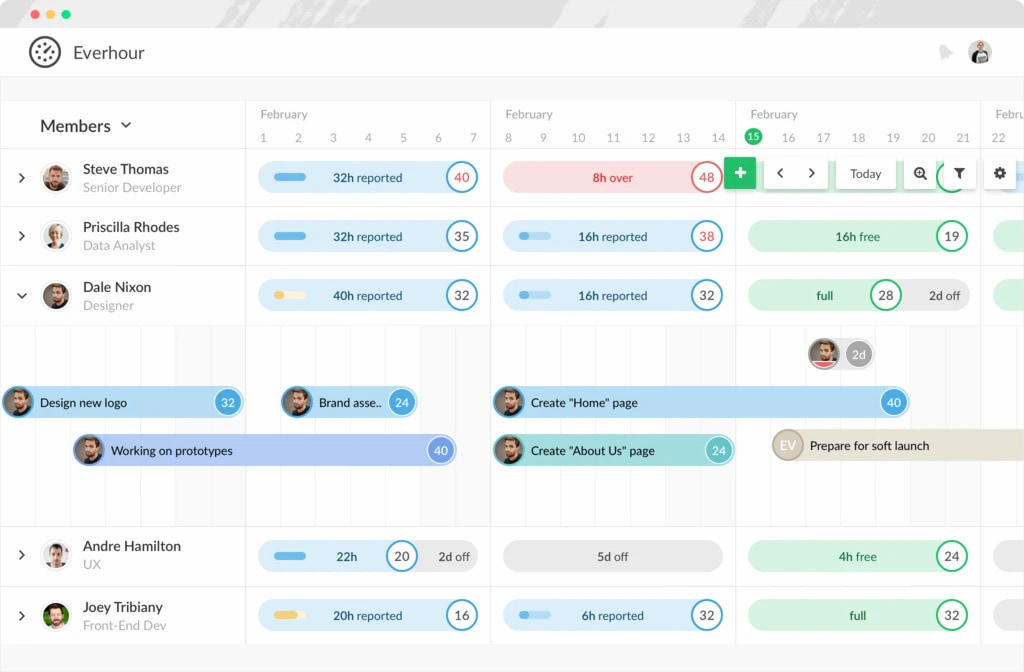
This information can help project leads understand where resources are going, spot workload imbalances, and make better-informed decisions when coordinating cross-functional projects.
Frequently Asked Questions
There isn’t one universally accepted classification of cross-functional teams. However, common arrangements include:
Project teams: Formed to deliver a specific project or initiative.
Product teams: Bring together functions such as product management, design, and engineering to develop and maintain a product.
Operational teams: Coordinate departments involved in ongoing business processes.
Leadership teams: Bring together managers from different functions to make strategic decisions and align organizational priorities.
These categories can overlap, depending on how an organization structures its work.
A product launch is a common example. Product managers, designers, developers, marketers, sales representatives, and customer support specialists coordinate their work to prepare, release, and support a new product. Each department handles different responsibilities, but the launch depends on their contributions coming together.
Successful cross-functional collaboration depends on shared goals, clear responsibilities, consistent communication, and visibility into project progress. Teams also need agreed decision-making processes and a way to resolve competing priorities.
A multidisciplinary team brings together people with different areas of expertise, while a cross-functional team typically includes representatives from different organizational departments or business functions.
The terms often overlap in practice. The distinction is mainly one of emphasis: multidisciplinary describes the range of expertise, while cross-functional highlights the organizational functions involved.
Responsibility is shared across the participants, but project leads and managers usually play a central coordinating role. They establish priorities, clarify ownership, manage dependencies, and help resolve conflicts.
Department heads also need to support collaboration by making resources available and ensuring that departmental objectives don’t undermine shared project goals.
Start by establishing shared objectives and creating opportunities for departments to exchange information. Clarify responsibilities, use shared documentation and communication channels, and involve relevant stakeholders in planning and decision-making.
It’s also important to address organizational incentives that encourage departments to prioritize their own results over broader business outcomes.
Common barriers include conflicting priorities, unclear responsibilities, communication gaps, different workflows, limited resource availability, and slow decision-making. These issues are easier to address when teams establish shared expectations and coordination processes before work begins.

Maria
A dedicated content enthusiast with extensive experience in international teams and projects of all sizes. Maria thrives on creativity and attention to detail, fueled by a love for fantasy novels, music, classic black-and-white films, and always finding ways to make things better.