


How Many Working Hours In A Year: Full-Time & Part-Time Calculations

Most people know the standard answer: a full-time employee works 2,080 hours per year. But in reality, yearly average working hours are rarely that simple.
Public holidays, PTO, unpaid breaks, overtime, leap years, and different work schedules can all change the total significantly. A salaried employee working a standard office schedule will end up with very different yearly hours than someone working part-time, rotating shifts, or compressed workweeks.
That’s why businesses calculate annual work hours carefully — not just for payroll, but also for staffing, scheduling, labor forecasting, and project planning.
In this article, we’ll break down how many working hours there are in a year, how the numbers change across schedules, and how to calculate actual yearly work hours more accurately in 2026.
Working Hours In a Year Based On Different Workweeks
Not all employees follow the same work schedule, which is why annual working hours can vary significantly even before accounting for holidays or leave. The most common reference point is the standard 40-hour workweek, but many roles operate on reduced schedules or compressed work patterns depending on industry, contract type, or region.
Here’s how annual working hours typically break down by weekly schedule:
| Weekly Hours | Approximate Yearly Hours |
|---|---|
| 40 | 2,080 |
| 37.5 | 1,950 |
| 35 | 1,820 |
| 30 | 1,560 |
| 20 | 1,040 |
Compressed schedules such as 4-day workweeks don’t change total hours by default. They typically redistribute the same weekly hours across fewer days, which can affect daily workload intensity but not necessarily annual totals.
Number Of Working Hours In A Year For A Full-Time Employee
A standard full-time schedule is usually based on a 40-hour workweek, which equals 2,080 working hours per year (40 × 52 weeks). This is the baseline most companies use for payroll, salary calculations, and workforce planning.
In reality, though, employees rarely work the full theoretical 2,080 hours. Public holidays, PTO, sick leave, unpaid breaks, and overtime can all shift the final number throughout the year.
Companies also often separate:
- scheduled hours → contracted working time
- paid hours → hours processed through payroll
- actual worked hours → time employees spend actively working
These numbers don’t always match, especially in businesses with flexible schedules, shift work, or overtime tracking.
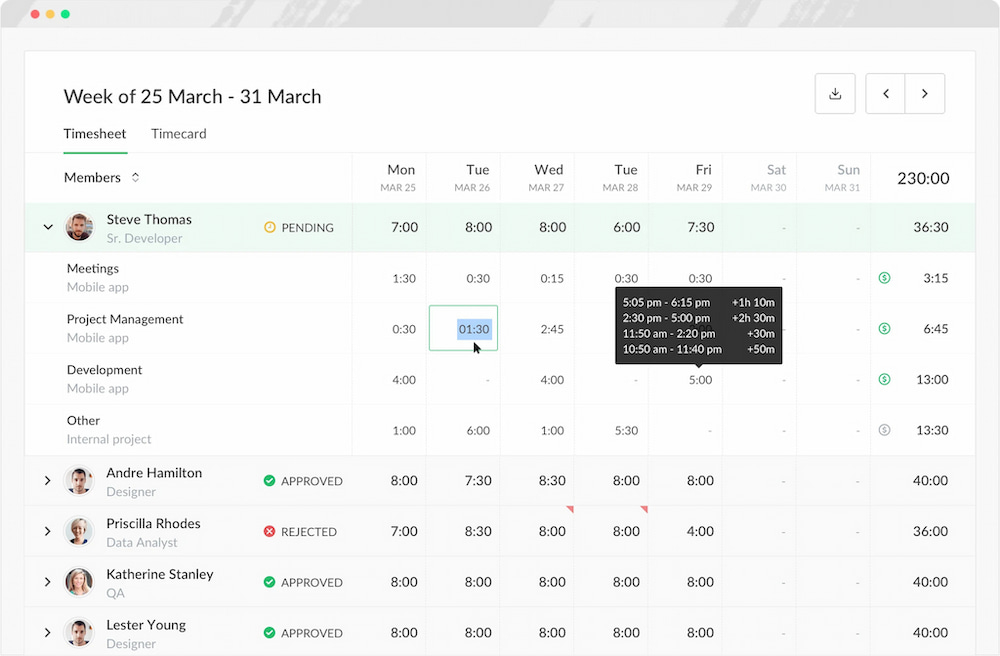
A time tracker like Everhour is often used for this purpose, giving teams clearer visibility into where time is actually spent across projects and helping managers compare estimated vs tracked hours more effectively.
Number Of Working Hours In A Year For A Part-Time Employee
Part-time working hours vary based on weekly schedules, so there is no single annual total. Instead, yearly hours are calculated by multiplying weekly hours by 52 weeks, then adjusting for leave and holidays.
Common part-time ranges include 20, 25, and 30-hour weeks, along with flexible or shift-based arrangements.
Typical part-time yearly hours
- 30-hour week → ~1,560 hours/year
- 25-hour week → ~1,300 hours/year
- 20-hour week → ~1,040 hours/year
These are baseline figures before holidays, PTO, or unpaid leave are deducted.
How part-time work is structured
Part-time roles can be fixed reduced schedules, hourly-based contracts, or rotating shift-based work. Shift-based roles in industries like retail, hospitality, and healthcare often fluctuate week to week, which makes annual totals less stable.
Pay structure differences
Hourly roles pay directly based on time worked, while salaried part-time roles are tied to a fixed schedule regardless of small variations in weekly hours. Hourly tracking provides more precise annual totals, especially in variable schedules.
Part-time annual hours scale directly from weekly hours, but actual totals vary depending on leave, schedule changes, and industry structure.
How Many Non-Work Hours Are There In 2026?
A full calendar year contains 8,760 total hours, but only a portion of that is typically spent working. The rest makes up non-work time, which includes weekends, holidays, leave, and personal time off.
Non-work time includes:
- weekends
- public and federal holidays
- vacation and PTO
- sick leave
- personal leave
Work vs non-work hours overview
| Category | Approximate Hours |
|---|---|
| Total hours in year | 8,760 |
| Typical work hours | ~2,080 |
| Non-work hours | ~6,680 |
How PTO And Holidays Affect Annual Work Hours
Paid time off (PTO) and public holidays directly reduce the number of hours an employee is actually available to work over the course of a year. While annual working hours are often calculated from a fixed schedule, time off creates a measurable gap between theoretical and real working time.
Typical impact on annual work hours
| Time Off Type | Typical Annual Reduction |
|---|---|
| Federal holidays | ~80 hours |
| 2 weeks PTO | ~80 hours |
| 3 weeks PTO | ~120 hours |
These values vary depending on country-specific labor laws and company policies, but they consistently reduce total yearly working hours across most full-time roles.
Should Breaks Count As Work Hours?
Whether breaks count as working time depends on company policy, local labor laws, and how time is tracked. In many workplaces, breaks are partially paid or fully unpaid, which directly affects how annual work hours are calculated.
Common types of breaks
- paid short breaks (e.g. 15-minute breaks)
- unpaid meal breaks (e.g. 30–60 minutes)
- automatic shift deductions in hourly roles
Paid vs unpaid breaks
Paid breaks are usually included in total working hours, while unpaid meal periods are excluded. This difference can significantly change timesheet totals, especially in shift-based roles.
Labor law differences
Break rules vary by country and industry. Some regions require mandatory unpaid meal breaks after a certain number of hours, while others allow more flexible arrangements depending on the employer.
Timesheet implications
Break handling directly impacts how hours are recorded and calculated. Many companies distinguish between:
- total shift time
- billable or paid working time
- non-billable break time
This is also where Everhour can also be used, helping teams separate billable vs non-billable time and improve timesheet accuracy across projects and employees.
How To Calculate Working Hours In A Year
Calculating annual working hours is about starting with a baseline schedule and then adjusting for real-world factors like holidays, PTO, and unpaid time.
Step 1: Calculate total scheduled hours
Start with the standard formula:
- weekly hours × 52 weeks
- example: 40 × 52 = 2,080 hours
Step 2: Subtract holidays and PTO
Remove any paid time off from the total, including:
- public holidays
- vacation days
- sick leave
Step 3: Adjust for unpaid leave
Factor in any additional unpaid time off depending on company policy or country regulations.
Step 4: Factor in unpaid breaks
Some work schedules include unpaid lunch or break deductions, especially in hourly or shift-based roles.
Using tools to simplify the process
Not every team calculates this manually. Time tracking tools help automate these steps by:
- automating hour calculations
- reducing manual spreadsheet work
- comparing planned vs actual hours
Example Calculation (2026)
To understand how annual working hours change in practice, let’s walk through a simple 2026 example using a standard full-time schedule.
Starting point
- 40-hour workweek
- 52 weeks per year
- = 2,080 scheduled hours
Time off adjustments
Now subtract common time off:
- 11 paid holidays
- 10 PTO days (≈ 80 hours)
- unpaid lunch breaks (varies by company policy)
Adjusted annual hours
After accounting for holidays and PTO, the total working time decreases:
- Scheduled hours: 2,080
- Minus holidays + PTO: ~168 hours
- Adjusted annual hours: ~1,912 hours (before break adjustments)
If unpaid breaks are included (common in hourly or shift-based roles), the effective worked time may be slightly lower depending on daily break structure.
How To Calculate Annual Hours For Irregular Shifts
Not all employees follow a fixed 40-hour schedule. In industries like healthcare, retail, and hospitality, working hours often vary week to week due to shift rotations, seasonal demand, and staffing needs.
This makes annual work hours less predictable and more dependent on actual scheduling patterns.
Common irregular work patterns
- rotating shift schedules (day/night shifts)
- compressed workweeks (e.g. 4-on/4-off)
- seasonal or demand-based schedules
- overtime-heavy roles
How annual hours are calculated
Instead of using a fixed formula, irregular schedules are typically calculated based on actual shifts worked over time:
- average weekly hours × number of working weeks
- or total tracked shifts across the year
Example scenarios
- 12-hour shifts can significantly increase weekly totals even with fewer working days
- 4-on/4-off rotations may balance out over longer cycles
- seasonal roles may concentrate hours into specific months rather than spreading evenly
FAQ
A standard full-time schedule is usually based on 2,080 hours per year, calculated from a 40-hour workweek across 52 weeks.
No. The 2,080-hour calculation is a baseline before vacation days, holidays, sick leave, or unpaid time off are deducted.
It depends on the number of public holidays and PTO days. In many cases, actual annual working hours fall closer to 1,900–1,950 hours after common leave adjustments.
Most months average around 160–174 working hours for full-time employees, depending on the calendar and number of working days.
A typical quarter contains roughly 500–530 working hours for a full-time schedule, depending on holidays and month length.
Leap years add one extra calendar day, but annual work hours only increase if that additional day falls on a normal working day.
Usually not. Paid short breaks may count as working time, while unpaid meal breaks are typically excluded from total worked hours.
A 37.5-hour weekly schedule equals approximately 1,950 hours per year before PTO and holidays are deducted.
Conclusion
The standard “2,080 working hours per year” figure is useful as a baseline, but real annual work hours are shaped by schedules, holidays, PTO, breaks, and overtime.
For businesses, understanding these differences is important for payroll accuracy, staffing, workload planning, and project forecasting. And as more teams move toward flexible schedules and hybrid work arrangements, tracking actual worked time is becoming more important than relying only on fixed yearly assumptions.

Maria
A dedicated content enthusiast with extensive experience in international teams and projects of all sizes. Maria thrives on creativity and attention to detail, fueled by a love for fantasy novels, music, classic black-and-white films, and always finding ways to make things better.