


Job Design: Methods, Examples, and Best Practices

Job design is the process of deciding how a job is structured: which tasks an employee handles, what responsibilities they have, how they work with others, and how much autonomy they have.
Good job design helps organizations organize work effectively while giving employees clear responsibilities and a manageable way to do their jobs. It can involve anything from combining related tasks to giving employees more decision-making authority.
This guide explains the main job design methods, how they differ, and how to apply them when creating or improving roles.
What Is Job Design?
Job design is the process of structuring a job’s tasks, responsibilities, workflows, and decision-making authority. Its goal is to create roles that meet organizational strategy and needs while considering employees’ skills, workload, and working experience.
For example, a customer support role might initially involve answering incoming tickets using fixed scripts. Redesigning the role could give employees more authority to resolve common issues independently or responsibility for identifying recurring customer problems.
Job design applies to new roles as well as existing ones. It can help address repetitive work, unclear responsibilities, inefficient workflows, or limited opportunities to develop skills.
It’s also different from writing a job description. Job design determines how work is organized; a job description documents the role and its expectations.
Examples of Job Design
Job design can change the tasks people perform, the decisions they can make, or how their work connects with other roles.
| Situation | Original job design | Redesigned job |
|---|---|---|
| Repetitive work | An employee performs one task throughout the day | The employee handles several related tasks |
| Limited autonomy | A manager approves every routine decision | The employee makes decisions within agreed limits |
| Narrow responsibilities | An employee completes assigned tasks but doesn’t plan the work | The employee also plans activities and reviews results |
| Siloed workflow | Each employee handles one step without seeing the full process | Employees coordinate across multiple stages |
| Limited development | An employee repeats familiar tasks | The employee takes on new responsibilities with appropriate training |
These changes illustrate different ways to structure work, but not every role needs all of them. Standardized tasks may be essential for safety or consistency, while other roles benefit from greater variety or autonomy.
The right approach depends on the work itself, employees’ capabilities, and the problem the organization is trying to solve.
Why Is Job Design Important?
Job design affects how work gets done, how responsibilities are distributed, and what employees can achieve in their roles. A well-designed job balances organizational needs with the resources and authority people need to do their work effectively.
Productivity and workflow efficiency
Clear responsibilities and well-organized tasks reduce duplicated effort, unnecessary handoffs, and confusion about who does what.
Employee motivation and job satisfaction
Appropriate autonomy, varied tasks, and a clear sense of contribution can make work more engaging and increase employee motivation. Simply adding responsibilities, however, won’t help if employees are already overloaded.
Skill development and flexibility
Roles that include learning opportunities and different responsibilities can help employees build skills and prepare for future positions.
Workload and employee well-being
Job design helps organizations distribute responsibilities and set realistic expectations. Poorly designed roles can create operational bottlenecks, constant interruptions, or workloads that are difficult to sustain.
Accountability and role clarity
Employees need to know what they’re responsible for, which decisions they can make, and when they should involve others. Clear boundaries help teams coordinate their work.
What Are the Main Job Design Methods?
Job design methods change different aspects of a role. Some focus on task variety, while others increase responsibility, autonomy, or flexibility across roles.
| Method | What changes | Best suited for |
|---|---|---|
| Job simplification | Tasks are narrowed and standardized | Work requiring consistency and efficiency |
| Job enlargement | More tasks are added at a similar responsibility level | Increasing task variety |
| Job enrichment | Employees gain more autonomy and responsibility | Increasing ownership and decision-making |
| Job rotation | Employees move between tasks or roles | Cross-training and broader skills |
| Job crafting | Employees adjust aspects of their work within agreed boundaries | Aligning work with strengths and interests |
Job simplification
Job simplification breaks work into narrower, standardized tasks. It can improve consistency and make processes easier to learn, especially when tasks are repetitive or require precise procedures. The trade-off is that highly simplified roles can become monotonous if employees have little variety or control.
Job enlargement
Job enlargement adds more tasks at a similar level of responsibility. For example, a customer support employee might handle both incoming questions and follow-up requests instead of doing just one type of task. It increases task variety without necessarily giving the employee more decision-making authority.
Job enrichment
Job enrichment adds greater responsibility, autonomy, or control over how work is completed. A support employee might move beyond answering questions to investigating recurring problems and recommending process improvements.
Unlike job enlargement, enrichment changes the depth of a role, not just the number of tasks.
Job rotation
Job rotation moves employees between different tasks or roles, often according to a planned schedule. It can help employees learn new skills, understand other functions, and provide cover when colleagues are unavailable.
Rotation works best when employees receive adequate training and the new assignments have a clear purpose.
Job crafting
Finally, job crafting allows employees to make appropriate adjustments to their tasks, working relationships, or approach to their role. For example, an employee who enjoys mentoring might take on more peer coaching while continuing to meet their core responsibilities.
Unlike manager-led job redesign, job crafting often starts with the employee. Changes still need to fit team priorities, workload limits, and role expectations.
Job Design vs. Job Analysis vs. Job Description
These three concepts are related, but they serve different purposes.
| Concept | Main purpose | Example |
|---|---|---|
| Job analysis | Understand a role’s tasks, responsibilities, and requirements | Identify the skills and activities needed for a customer support role |
| Job design | Decide how the work should be organized | Combine customer inquiries, follow-ups, and issue investigation into one role |
| Job description | Document the role’s duties and expectations | List the role’s responsibilities, required skills, and reporting relationships |
Job analysis helps organizations understand the work that needs to be done. Job design determines how that work is structured, and the job description communicates the resulting expectations.
How to Design or Redesign a Job
Effective job design starts with a specific problem to solve. Adding responsibilities or changing tasks without understanding the underlying issue can create more work without improving the role.
1. Identify the problem
Determine what isn’t working. Employees may be repeating the same tasks, waiting for approvals, dealing with unclear responsibilities, or struggling with an uneven workload.
2. Analyze the current role
Review the tasks employees perform, how responsibilities are distributed, where handoffs occur, and which skills the work requires. Employee feedback can help reveal problems that aren’t obvious from process documentation alone.
3. Choose an appropriate job design method
Match the method to the problem. Job enlargement can introduce more variety, while job enrichment can give employees greater autonomy. Job rotation may help develop broader skills, while simplification can make repetitive processes more consistent.
4. Define responsibilities and decision-making
Clarify what employees own, which decisions they can make independently, and when they need approval or support. Additional responsibility should come with the authority and resources needed to manage it.
5. Check workload and available resources
Make sure the proposed changes are realistic. If employees take on new tasks, consider what can be removed, delegated, or streamlined to keep the workload manageable.
6. Test the new design and gather feedback
Pilot the changes before making them permanent. Ask employees whether responsibilities are clearer, workflows are easier to manage, and the new arrangement creates any unexpected difficulties.
7. Measure the results
Evaluate whether the redesign addresses the original problem. Depending on the role, useful indicators may include completion times, errors, rework, workload distribution, employee feedback, and clarity of responsibilities. Use the results to refine the design where necessary.
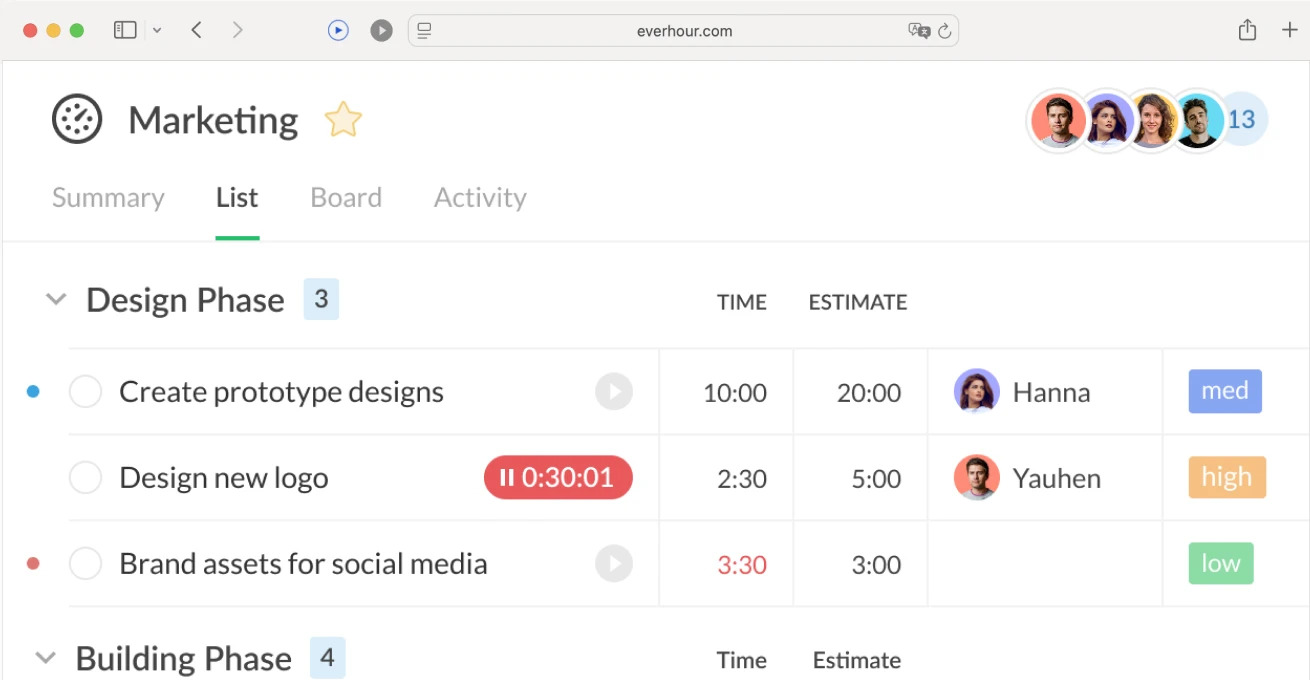
Time tracking data can help managers understand how work is distributed across a team. With Everhour’s time tracker, teams can track time against tasks and projects, compare estimates with actual time spent, and identify roles where recurring tasks take longer than expected. These insights can inform decisions about workload distribution, task allocation, and where responsibilities may need to change.
What Makes a Good Job Design?
Good job design balances organizational needs with employees’ skills, workload, and ability to make decisions. The right structure depends on the role, but effective job design usually includes:
- Clear responsibilities: Employees understand what they own and what is expected of them.
- Manageable workloads: Tasks and deadlines are realistic given the available time and resources.
- Appropriate autonomy: Employees have enough authority to complete their work without unnecessary approvals.
- A suitable level of variety: Tasks offer enough variety to support engagement without making the role unnecessarily complex.
- Opportunities for development: Employees can apply existing skills and develop new ones where appropriate.
- Connected tasks and outcomes: Employees understand how their work contributes to broader team or organizational goals.
- Sustainable working conditions: The role can be performed consistently without relying on excessive workloads or constant overtime.
Not every job needs maximum autonomy or variety. Highly standardized work may be necessary for safety, quality, or consistency. Good design means finding the right balance for the work being done.
Job Design Mistakes to Avoid
Even well-intentioned changes can make jobs harder to manage. Watch out for these common mistakes:
- Adding tasks without adjusting workloads. More variety can become overload if employees are expected to do everything they did before, plus additional work.
- Increasing responsibility without authority. Employees cannot be accountable for outcomes if they lack the power to make relevant decisions.
- Introducing job rotation without training. Moving employees between roles without preparation can increase errors and disrupt workflows.
- Assuming every role needs more variety. Some tasks benefit from specialization and consistent procedures rather than frequent changes.
- Redesigning jobs without employee input. Managers may overlook practical difficulties when they don’t consult the people doing the work.
- Measuring productivity alone. Faster completion times mean little if quality declines or workloads become unsustainable.
The key is to evaluate job design as a whole. Changes should improve how work is organized without creating new problems for employees or the organization.
How to Evaluate Job Design
Job design should be reviewed after implementation and whenever responsibilities, workflows, or organizational needs change. Use a combination of performance data and employee feedback to assess whether the role is working as intended.
Ask these questions:
- Workload: Is the work distributed fairly, and can employees complete it within their available time?
- Efficiency: Have unnecessary steps, delays, or duplicated tasks been reduced?
- Role clarity: Do employees understand their responsibilities and decision-making authority?
- Quality: Are errors, rework, and missed deadlines improving or worsening?
- Employee experience: Do employees have the resources, autonomy, and support they need?
- Development: Does the role provide appropriate opportunities to use or build skills?
Choose measures that relate to the original problem. If the goal was to reduce approval delays, for example, track decision turnaround times. If the goal was to improve workload balance, examine task distribution and employee feedback.
No single metric tells the whole story. A successful redesign should improve the targeted outcome without compromising work quality, role clarity, or employee well-being.
Frequently Asked Questions
Structuring a customer support role with clear responsibilities, defined workflows, access to relevant tools, and autonomy to resolve common customer issues is an example of job design.
The main methods are job rotation (moving between tasks or roles), job enlargement (adding tasks at the same responsibility level), job enrichment (increasing autonomy and decision-making), and job simplification (breaking work into specialized tasks).
Job analysis identifies what a job involves, including its tasks, responsibilities, and required skills. Job design determines how those tasks and responsibilities should be organized.
Job design establishes how a role is structured. Job redesign modifies an existing role to address issues such as inefficient workflows, excessive workloads, or low employee engagement.
Job design can improve motivation by making work more meaningful, manageable, and varied. Clear expectations, appropriate workloads, skill development, and greater autonomy can increase engagement and job satisfaction.
HR teams, managers, and organizational leaders typically share responsibility for job design. HR provides guidance on role structure, managers define operational needs, and employees offer feedback on day-to-day work.
Job enlargement adds tasks at the same level of responsibility, while job enrichment gives employees greater autonomy, ownership, or decision-making authority.
Job rotation moves employees between tasks or roles to develop skills, reduce repetitive work, and improve workforce flexibility. It is one method of job design that broadens employees’ experience without necessarily changing their level of responsibility.
Conclusion
Job design structures responsibilities, workflows, autonomy, and workloads to support business goals and employee performance. Start by identifying what’s not working in a role, then choose the job design method that addresses the specific problem.

Maria
A dedicated content enthusiast with extensive experience in international teams and projects of all sizes. Maria thrives on creativity and attention to detail, fueled by a love for fantasy novels, music, classic black-and-white films, and always finding ways to make things better.