


How To Make Time Go Faster: Psychology-Backed Tips That Actually Work

Some days vanish. Others make you check the clock every five minutes — and the more you do, the slower everything crawls. If you’ve ever wondered how to make time go faster at work, you’re not imagining the struggle. Researchers studying time perception have found that how fast time seems to pass is directly tied to attention, cognitive load, and engagement. When your brain is absorbed in something meaningful, it stops monitoring the clock. When it isn’t, time becomes the thing it tracks instead.
For anyone managing knowledge work — long focus sessions, repetitive admin tasks, back-to-back meetings — understanding this has real practical value. This article breaks down what actually drives time perception, and what you can do to make time pass faster throughout your workday, whether you’re studying, waiting, or just grinding through a slow afternoon.
Why Time Feels Slow In The First Place
Time feels slow for one core reason: your brain has nothing better to do than monitor it.
Psychologist John Eastwood, whose research on boredom has been widely cited, describes this as the brain failing to effectively engage attention with its environment. When that happens, time becomes the thing you focus on instead — and that awareness is exactly what makes it drag.
A few conditions reliably trigger this:
- Repetitive tasks give your brain little to process, so attention drifts
- Uncertainty — waiting for news, a reply, a meeting — keeps your mind on permanent standby
- Anxiety narrows focus and makes each passing moment feel heavier
The flip side is equally well documented. Novelty forces your brain to actively process new information, pulling attention away from time entirely. It’s why a new experience can feel rich and memorable even if it only lasted an hour — while a routine afternoon at your desk disappears without leaving much trace.
Attention is the key factor. When your brain is occupied with a challenging task, it has fewer resources available to monitor time. When attention is idle, the opposite happens: awareness shifts toward the passage of time itself.
How To Make Time Go Faster At Work
Workdays feel slow when tasks are repetitive, unfocused, or mentally disconnected. The goal isn’t to trick yourself into thinking less time has passed — it’s to stay engaged enough that you stop noticing every minute. Here’s what actually helps.
Break large tasks into smaller milestones
Big tasks create mental resistance because progress feels invisible. When you can’t see yourself moving forward, your brain has little to anchor to — and time fills that gap.
Breaking work into smaller, completable chunks gives your brain regular progress signals. Instead of “finish the report,” try milestones like “outline the report,” “write the introduction,” or “complete the first draft.”
Visible progress helps prevent the feeling that you’re working for hours without moving forward.
Stop checking the clock
This one is counterintuitive but well supported: the more often you check the time, the slower the day feels. Every glance pulls your attention back to the passage of time itself, which is precisely what makes it drag.
If you find yourself clock-watching, it’s usually a signal that you need a clearer task to focus on — not that the day is actually going slowly.
Use structured work intervals
Structured intervals help by creating a sense of urgency and focus within a defined window. Popular approaches include 25-minute Pomodoro sessions, 60–90 minute deep work blocks, and scheduled breaks in between.
The psychological shift is simple: instead of trying to get through the whole day, you’re only focused on the current session.
Add background stimulation for low-focus tasks
For repetitive or administrative work, music, ambient noise, or podcasts can reduce the mental drag and help maintain engagement. The goal isn’t to distract yourself — it’s to give your brain just enough additional input to stop fixating on how slowly things are moving.
Switch between task types strategically
Doing the same type of work for hours accelerates mental fatigue and makes time crawl. Alternating between different kinds of tasks — deep thinking, communication, admin — reduces monotony without the cost of constant context switching.
Track progress visibly
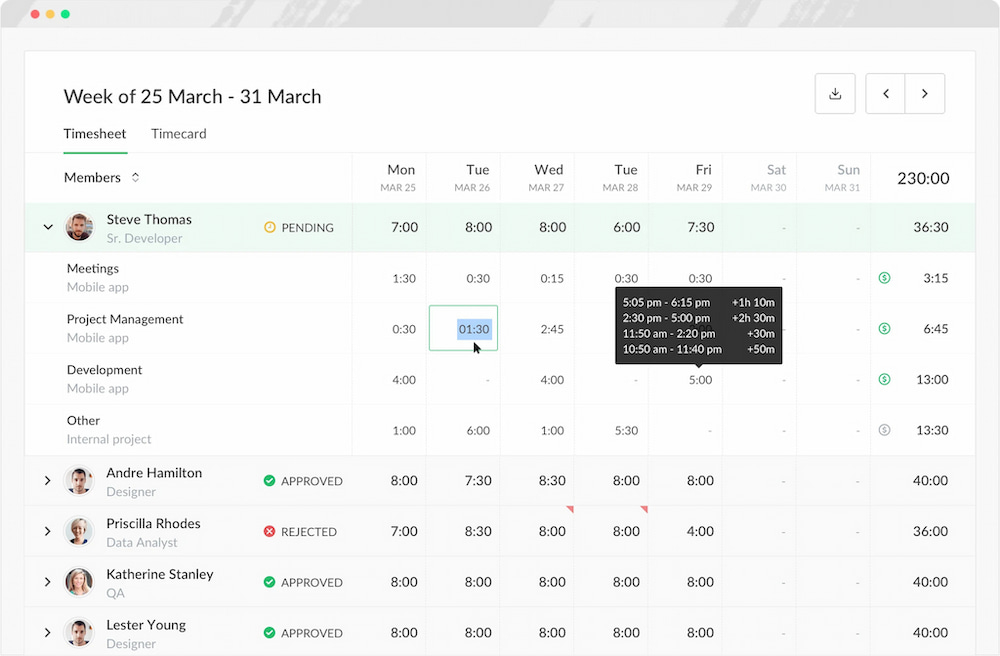
One underrated reason workdays feel slow is that progress stays invisible until the very end. Using a time tracker or project management tool to log completed work in real time gives your brain the progress signals it needs to stay motivated — and makes the day feel more structured overall.
A time tracker like Everhour integrates directly into your existing project management workflow, so tracking time doesn’t become another task on your list. Seeing logged hours and completed work stack up throughout the day is a small but surprisingly effective way to make a long workday feel less endless.
Create artificial urgency
Set a timer and challenge yourself to finish a specific piece of work before it ends. Even a self-imposed deadline can increase focus because your brain starts treating the task as something active rather than open-ended.
The tasks that feel slowest are rarely the hardest ones. They’re the ones your brain checked out of five minutes in.
Don’t break your rhythm
Every time you switch tabs or check your phone mid-task, your brain resets instead of settling. Even a light flow state makes repetitive work feel faster — but you can only get there if you actually let yourself stay in it.
How To Make Time Go Faster At School Or While Studying
Twenty minutes of passive studying can feel longer than a focused hour. The difference isn’t the time — it’s what your brain is doing with it.
When studying feels slow, it’s usually because the activity looks productive without actually being demanding. Rereading notes, highlighting, sitting through a lecture without interacting — none of it requires enough cognitive effort to pull attention away from the clock.
The methods that actually make time move faster
Active recall, problem-solving, and self-testing all force your brain to work rather than drift. The effort feels harder in the moment, but paradoxically those sessions feel shorter — because your attention is fully occupied. Switching topics before fatigue sets in helps too.
Short, timed study bursts with clear endpoints are almost always more time-efficient than open-ended sessions that stretch until motivation runs out.
The clock-checking trap
The more often you check how much time is left, the slower everything feels. It creates a loop that’s hard to break once you’re in it:
Check time → feel stuck → check again → feel more stuck
Simply removing the clock from view — or committing to a fixed session length upfront — is often enough to disrupt it.
The study sessions that feel fastest are usually the ones where the most actual learning happened. Fast time and productive time tend to be the same thing.
How To Make Time Go Faster While Waiting
Waiting might be the purest form of slow time. No task to complete, no progress to make — just you and the gap between now and whatever comes next.
The reason it feels so long isn’t the wait itself, it’s uncertainty. When you don’t know exactly when something will happen — a client response, an approval, a meeting running late — your brain treats it like an open loop. Part of your attention stays permanently allocated to checking whether it’s resolved yet, and that constant background monitoring is what stretches the experience.
The instinct is to reach for your phone — but aimless scrolling rarely helps. Your attention stays half-anchored to the wait, so you get neither genuine distraction nor genuine rest.
What actually works is full absorption — reading a chapter of a book, listening to a podcast episode, solving a puzzle, or tackling a small task you’ve been putting off. Activities with a clear beginning and end tend to work particularly well because they give your attention something concrete to follow.
Can You Actually Control How Fast Time Feels?
The honest answer is that you can’t control time itself — but you can reliably influence how it feels, and the mechanism is simpler than most people expect. It comes down to one thing: where your attention is.
When your brain is monitoring time, it slows down. When it’s absorbed in something else, time compresses. Being busy doesn’t automatically trigger this — you can be busy and bored, busy and easily distracted, or busy and genuinely engaged. Only the last one actually changes the experience.
Flow state is the strongest version of this
Flow is the state where you’re fully absorbed in what you’re doing — not self-monitoring, not clock-watching, just working. It tends to happen when challenge level matches skill level: not so easy your brain checks out, not so hard it panics. Writing, coding, designing, problem-solving, gaming, and learning new skills are all common flow-state activities.
Smaller daily habits make a consistent difference too
- Movement breaks up the sameness of long sessions in a way that sitting through them doesn’t
- Social interaction pulls attention outward, away from internal time-tracking
- Routines reduce decision fatigue and let your brain settle into a rhythm
- Absorbing work — slightly challenging, creative, or new — does more for time perception than any productivity system
Time feels faster when you stop trying to manage it and start giving your attention somewhere worth putting it.
What Usually Makes Time Feel Slower
Time feels slower in very predictable situations — usually when there’s low engagement or too much attention on time itself.
Common triggers
- Unstructured waiting periods
- Repetitive or low-focus tasks
- Multitasking with constant interruptions
- Anxiety or uncertainty
- Doomscrolling or passive screen time
- Frequently checking the clock
The pattern behind it
In most cases, it’s not the activity itself that slows time down — it’s the lack of focus or visible progress. When attention has nothing solid to anchor to, time becomes the thing your brain starts tracking instead of the work itself.
FAQ
Waiting creates uncertainty. When you don’t know exactly when something will happen, part of your attention stays focused on monitoring the situation. The more often your brain checks whether the wait is over, the longer the experience tends to feel.
Long shifts usually feel faster when work is broken into smaller milestones rather than treated as one long block of time. Setting short-term goals, tracking progress, changing task types throughout the day, and avoiding constant clock-checking can make a noticeable difference.
Anxiety increases self-awareness and makes your brain hypervigilant. Instead of focusing on an activity, attention shifts toward thoughts, worries, or physical sensations, which often stretches perceived time.
It can. Music provides additional stimulation and can reduce boredom during repetitive tasks. Many people find that music, podcasts, or audiobooks make routine work feel shorter because attention is spread across multiple sources of input.
One popular explanation is that adulthood contains more routine and fewer novel experiences. Because the brain creates fewer distinct memories from repetitive days, months and years can feel compressed when looking back on them.
The most reliable method is deep engagement. Activities that require focus, problem-solving, creativity, learning, or meaningful interaction tend to pull attention away from the clock and make time pass more quickly.
Yes. Many people reduce clock-checking by working in fixed focus sessions, hiding visible clocks, setting timers for breaks, or giving themselves a specific task goal to reach before checking the time again. The less attention you devote to monitoring time, the faster it often feels.
Bottom Line
Time feels slow when attention has nowhere meaningful to go. Whether you’re working, studying, waiting, or tackling repetitive tasks, the same principle applies: the more engaged your mind becomes, the less it notices the clock. While you can’t speed up time itself, you can shape how it feels by creating focus, reducing distractions, and staying actively involved in what you’re doing.
Make sure to check you don’t have any signs of poor time management and don’t spend precious minutes or hours on useless tasks!

Maria
A dedicated content enthusiast with extensive experience in international teams and projects of all sizes. Maria thrives on creativity and attention to detail, fueled by a love for fantasy novels, music, classic black-and-white films, and always finding ways to make things better.