


Average Work Days in a Month Explained (2026 Guide)

The number of work days in a month might seem straightforward at first, but it changes more than most people expect. Weekends, public holidays, and even the way the calendar falls in a given year can all shift the total.
For most months, the average lands somewhere between 20 and 23 work days, but there’s no fixed number that applies everywhere. That variation matters for payroll, employee scheduling, workload and resource planning, and forecasting team capacity.
In this article, we’ll break down how many work days are in a typical month, why the numbers change, and how businesses use these averages in real planning and operations.
Key Insights
- Most months contain 20 to 23 work days, depending on how weekends and holidays fall
- The long-term average is about 21.7 work days per month in a standard work year
- Work day totals shift based on weekends, public holidays, and leap years
- Businesses use average work days for payroll, staffing, capacity planning, and forecasting
- The exact number can vary by country, industry, and local workweek structure (e.g., 4-day vs 5-day weeks)
- Months with heavy holidays or long weekends can significantly reduce effective work days
What Is Considered A Work Day?
A “work day” isn’t always as simple as Monday to Friday. It generally refers to any day employees are scheduled to work under a standard business or company schedule, but the exact definition can vary depending on context.
- Standard Monday–Friday definition
In most office-based environments, a work day typically refers to weekdays (Monday through Friday), excluding weekends. - Work days vs business days
Work days refer to employee working schedules, while business days usually refer to days when a company or institution is officially open and operating. These often overlap but are not always identical. - Excluding weekends and holidays
Most work day calculations exclude Saturdays, Sundays, and public holidays, which can reduce the total number of work days in a month. - Variations across industries and countries
Work day definitions can differ based on region and industry — for example, retail, hospitality, healthcare, and shift-based roles often include weekends, rotating schedules, or non-standard workweeks.
Average Work Days In A Month
The number of work days in a month is not fixed. It depends on how weekends and holidays fall, but most months average between 20 and 23 work days. Across a full year, this typically balances out to about 21.7 work days per month.
Instead of looking at each month individually, businesses often rely on this average for payroll, scheduling, and workforce planning, since it smooths out seasonal variations.
Average work days by year type
| Year type | Average work days per month |
|---|---|
| Standard year | ~21.7 work days |
| Leap year | ~21.75 work days |
| 2024 (recent leap year) | ~21.83 work days |
| 2028 (next leap year) | Will vary slightly depending on weekday distribution and holidays |
Over a full year, this usually translates to roughly 260–262 work days total, depending on the calendar structure.
Why the average changes
The number of work days shifts slightly each year because of a few key factors:
- Month length variations – Some months simply contain more weekdays than others
- Weekend placement – Whether weekends fall at the start or end of a month affects totals
- Public holidays – Local holidays can reduce working days in specific months or countries
These small variations are why businesses prefer using averages rather than fixed monthly assumptions when planning staffing or payroll.
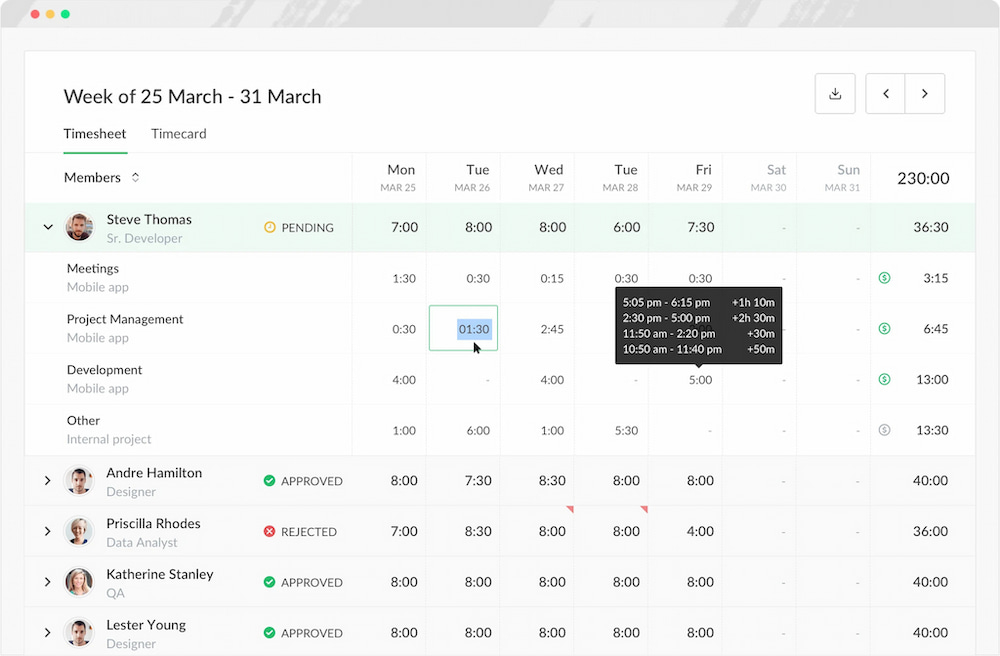
Many teams also use a time tracker like Everhour to connect the averages with real tracked hours for payroll and capacity planning.
Average Work Days By Month
Work days vary from month to month depending on how weekends fall and whether public holidays reduce the number of working days. While exact totals change each year, most months fall within a fairly predictable range.
Typical work days by month
| Month | Typical work days |
|---|---|
| January | 21–22 |
| February | 19–21 |
| March | 21–23 |
| April | 20–22 |
| May | 21–23 |
| June | 20–22 |
| July | 21–23 |
| August | 21–23 |
| September | 20–22 |
| October | 21–23 |
| November | 20–22 |
| December | 19–22 |
Note: Work day totals can shift significantly due to public and federal holidays, which vary by country and sometimes fall on weekdays, reducing the actual number of working days in a given month.
How To Calculate Work Days In A Month
Work days are calculated by taking the total number of calendar days in a month and removing non-working days like weekends and public holidays. Businesses use this to get a more realistic view of available working time for payroll, scheduling, and workforce planning.
The basic formula
Work days = Total days − Weekend days − Public holidaysOr in plain terms:
calendar days → remove weekends → remove holidays → remaining work days
Example calculation
Let’s take a typical month:
- 30 total days
- 8 weekend days
- 1 public holiday
30 − 8 − 1 = 21 work daysResult: 21 working days in the month
Why this matters in practice
Work day calculations aren’t just theoretical — they directly shape how teams operate:
- Payroll accuracy → ensures salaries and hourly wages reflect real working time
- Scheduling efficiency → helps managers plan shifts around actual availability
- Capacity planning → shows how much work a team can realistically handle
- PTO tracking → balances paid leave against available working days
Quick mental model
Think of it like this:
A month is not “30 days of work” — it’s “30 days minus life happening (weekends + holidays).”
That’s why most businesses don’t rely on raw calendar days when planning operations — they rely on net work days instead.
Average Work Hours Per Month
The number of work hours in a month depends on the length of the workweek and the average number of work days in that month. Because months vary slightly, businesses usually rely on monthly averages rather than fixed totals.
These figures are especially useful for converting salaries into hourly equivalents, forecasting labor costs, and planning team capacity.
Average monthly work hours
| Workweek type | Average monthly work hours |
|---|---|
| 40-hour week | ~173–174 hours |
| 37.5-hour week | ~162–163 hours |
Where these numbers come from
These averages are based on:
- typical monthly work days (~21–22 per month)
- standard full-time schedules
- variation in weekends and holidays across the year
Because no two months have exactly the same number of working days, these figures are smoothed into yearly averages.
Why businesses use monthly hour averages
Instead of calculating hours from scratch every month, companies use these benchmarks for:
- Salary conversion → translating annual salaries into hourly rates
- Labor forecasting → estimating staffing costs across periods
- Budget planning → predicting payroll expenses more consistently
- Workload planning → balancing capacity across teams and projects
Factors That Affect Monthly Work Days
Monthly work days are not always consistent. Even when two months have the same number of calendar days, the actual number of working days can change depending on holidays, scheduling structures, and industry requirements.
Public holidays
Holidays are one of the biggest reasons monthly work day totals fluctuate.
- Federal holidays can reduce standard work days for government offices and many businesses
- Country-specific holidays vary widely across regions and can significantly affect international teams
- Some holidays fall on weekends, while others remove weekdays from the schedule entirely
This is why work day calculations often differ between countries even within the same calendar month.
Leap years and February differences
Leap years slightly change annual work day totals because February gains an extra day every four years.
- A standard February usually has fewer work days than most months
- Leap years can slightly increase yearly averages depending on how weekdays fall
- Weekend placement still matters more than the extra day itself
Because of this, average monthly work days are rarely perfectly consistent year to year.
Alternative workweeks
Not every business follows a traditional Monday–Friday schedule. Some organizations now use:
- 4-day workweeks with longer daily shifts
- Rotating shift schedules that change weekly or monthly
- Retail and hospitality schedules that prioritize weekends instead of weekdays
These models can significantly change how businesses define and calculate work days.
Industry-specific schedules
Different industries often follow completely different scheduling patterns.
| Industry | Common scheduling pattern |
|---|---|
| Healthcare | Rotating shifts, overnight coverage, weekend staffing |
| Retail | Weekend-heavy scheduling and seasonal fluctuations |
| Manufacturing | Shift-based operations and continuous production cycles |
In industries with non-traditional schedules, “work days” may not align with standard business calendars at all.
Average Work Days vs Business Days
The terms work days and business days are often used interchangeably, but they don’t always mean the same thing. The difference usually comes down to whether you’re measuring employee working time or general company operations.
| Work days | Business days |
|---|---|
| Usually employee-focused | Usually operations-focused |
| Based on employee schedules | Based on company operating hours |
| Often excludes holidays and non-working shifts | May still include limited operational days |
| Common in payroll and scheduling | Common in shipping, banking, and service timelines |
For example, a company may still consider Friday a business day even if part of the workforce is off or working reduced hours. Meanwhile, work days are usually tied more directly to when employees are actually scheduled to work.
This distinction becomes especially important for:
- payroll calculations
- delivery timelines
- PTO tracking
- project scheduling
- customer service operations
In industries with rotating shifts or non-traditional schedules, business days and work days can differ significantly.
FAQ
Most months contain between 20 and 23 work days, depending on weekends, holidays, and the length of the month.
Across a standard year, the average is usually around 21.7 work days per month.
For a standard 40-hour workweek, the monthly average is typically around 173–174 work hours.
Usually not. Public holidays are commonly excluded from work day calculations when employees are not scheduled to work.
Work days are generally tied to employee schedules, while business days refer more broadly to when a company operates or provides services.
Businesses use work day averages for payroll, scheduling, staffing forecasts, PTO tracking, and workload planning.
Yes. Industries like healthcare, retail, manufacturing, and hospitality often use non-traditional schedules that change how work days are calculated.
Conclusion
Average work days per month may seem simple at first, but they influence many parts of business operations — from payroll and staffing to scheduling and workforce planning.
Because work day totals change based on weekends, holidays, leap years, and industry schedules, businesses often rely on monthly averages instead of fixed numbers. Understanding these patterns helps teams plan labor costs more accurately, forecast capacity, and avoid scheduling inefficiencies throughout the year.

Maria
A dedicated content enthusiast with extensive experience in international teams and projects of all sizes. Maria thrives on creativity and attention to detail, fueled by a love for fantasy novels, music, classic black-and-white films, and always finding ways to make things better.