


4-5-4 Calendar Explained: How Retailers Structure the Year

Many retailers rely on the 4-5-4 calendar instead of traditional calendar months to make sales, staffing, and operational reporting more consistent throughout the year. Unlike standard monthly calendars, the 4-5-4 retail calendar organizes the year into weekly periods that better align weekends, holidays, and shopping patterns across comparable periods.
This structure helps retailers analyze year-over-year performance more accurately, especially during major seasonal events and high-volume sales periods. It also improves labor forecasting, payroll planning, inventory management, and workforce scheduling.
In this article, we’ll explain how the 4-5-4 calendar works, why retailers use it, how it compares to other retail calendars, and how it affects retail scheduling, payroll, and operational planning.
Key Insights
- The 4-5-4 calendar divides each quarter into two 4-week months and one 5-week month.
- Retailers use the system to make weekly and yearly sales comparisons more consistent.
- The calendar keeps weekends, holidays, and peak shopping periods better aligned from year to year.
- Many businesses use the 4-5-4 structure to improve labor scheduling, payroll planning, and inventory forecasting.
- Some retail calendar years include a 53rd week to keep the schedule aligned with the standard calendar over time.
What Is A 4-5-4 Calendar?
A 4-5-4 calendar is a retail reporting calendar that organizes the year into full weeks instead of traditional calendar months. Retailers use it to make sales, staffing, and operational comparisons more consistent from year to year.
The “4-5-4” structure refers to how weeks are distributed within each quarter:
| Month in quarter | Weeks |
|---|---|
| First month | 4 weeks |
| Second month | 5 weeks |
| Third month | 4 weeks |
This creates a standardized 13-week quarter that repeats throughout the year.
Unlike standard calendar months — which vary in length and shift weekdays every year — the 4-5-4 calendar keeps weekends and comparable shopping periods more closely aligned.
That matters in retail because customer traffic and revenue are heavily concentrated around weekends, holidays, and seasonal events.
For example, comparing sales from equivalent Saturdays is usually far more accurate than comparing the same calendar date across different years.
Why Retailers Use The 4-5-4 Calendar
Traditional calendar months don’t always reflect how retail actually works. Weekends shift, holidays land on different weekdays, and comparing the same dates year over year can produce misleading results.
The 4-5-4 calendar creates more consistent reporting periods by aligning business performance around full retail weeks instead of uneven calendar months.
Retailers use it to:
- compare sales performance more accurately across years
- keep weekends and peak shopping periods aligned
- analyze holiday demand with fewer reporting distortions
- forecast staffing needs more consistently
- improve inventory and demand planning
- simplify operational reporting across multiple stores and locations
How The 4-5-4 Calendar Works
Weekly structure
At its core, the system is based on full weeks rather than dates. Each reporting period always starts and ends on the same day of the week, which helps keep sales patterns consistent.
52-week structure
A standard retail year typically contains 52 weeks. The 4-5-4 calendar divides these weeks evenly across four quarters, with each quarter following the same pattern. In some years, a 53rd week may be added to realign the calendar with the actual solar year.
13 weeks per quarter
Each quarter contains 13 weeks in total. This structure repeats throughout the year, which makes performance comparisons between quarters much more reliable.
Why weekends matter in retail reporting
The 4-5-4 calendar keeps weekend distribution consistent across reporting periods, which makes it easier to compare sales performance year over year without distortions caused by shifting calendar dates.
4-5-4 Calendar vs 4-4-5 Calendar
The 4-5-4 and 4-4-5 calendars are both retail reporting structures designed to standardize weekly comparisons. The main difference is where the 5-week month falls within each quarter, which can slightly change reporting patterns and operational focus.
| 4-5-4 calendar | 4-4-5 calendar |
|---|---|
| Middle month has 5 weeks | Last month has 5 weeks |
| Common in retail | Common in retail and manufacturing |
| More consistent mid-quarter sales alignment | Often used for end-of-quarter planning and reporting |
| Better weekend alignment for some retailers | Slightly different reporting cadence depending on business needs |
Both systems aim to solve the same problem: making year-over-year comparisons more consistent by using full weeks instead of irregular calendar months. The choice between them usually comes down to how a business wants to structure its internal reporting cycles and which part of the quarter it prefers to emphasize for performance tracking.
What Is A 53-Week Year?
Most retail calendars are built around 52 full weeks. But because a real calendar year is slightly longer than exactly 52 weeks, the retail calendar slowly drifts out of alignment over time.
Every few years, retailers add an extra week to reset the calendar and keep reporting periods aligned with seasons, holidays, and shopping cycles. Without this adjustment, important retail periods would gradually shift further away from the actual calendar year.
A 53-week year usually happens every 5–6 years, though the exact timing can vary depending on the reporting system being used.
For retailers, that extra week can create a few reporting complications:
- annual revenue may appear artificially higher
- year-over-year comparisons become harder to interpret
- weekly payroll schedules may include an additional pay period
- labor and inventory forecasting can become temporarily distorted
Because of this, retailers often compare performance on a per-week basis during 53-week years instead of relying only on annual totals.
The extra week may sound minor, but in large retail operations it can significantly affect sales reporting, staffing analysis, and payroll planning.
Advantages And Challenges Of The 4-5-4 Calendar
The 4-5-4 calendar creates more consistent retail reporting and operational planning, but it also introduces additional complexity behind the scenes.
| Advantages | Challenges |
|---|---|
| More accurate year-over-year sales comparisons | More complex accounting and reporting setup |
| Better alignment of weekends and seasonal shopping periods | Can create confusion when compared with standard calendar months |
| More predictable staffing and scheduling patterns | 53-week years require reporting adjustments |
| Improved labor forecasting and workforce planning | Payroll and scheduling systems must stay carefully aligned |
| Cleaner financial reporting with less calendar distortion | May require custom configuration across internal systems |
| More reliable inventory and demand forecasting | Cross-team reporting can become harder outside retail environments |
How The 4-5-4 Calendar Affects Payroll And Scheduling
The 4-5-4 calendar doesn’t just impact reporting — it also shapes how retailers plan labor, shifts, and payroll cycles across the year. Because everything is aligned to consistent weekly blocks, workforce planning becomes more structured and easier to forecast.
Employee scheduling consistency
Shifts tend to follow stable weekly patterns, which makes it easier to build repeatable schedules and reduce gaps or overlaps in coverage.
Labor forecasting
Since each period contains a fixed number of weeks, retailers can more accurately predict staffing needs based on historical performance within the same retail periods.
Overtime planning
Clear weekly structure helps managers anticipate overtime risks earlier, especially during peak retail periods when demand spikes.
Payroll period alignment
Payroll becomes easier to synchronize with retail reporting cycles, reducing mismatches between labor cost tracking and financial reporting.
Workforce management visibility
This is where tools become important. Many retailers use retail scheduling software like Shifts by Everhour to get clearer visibility into shifts, hours worked, and labor costs across different stores and teams.
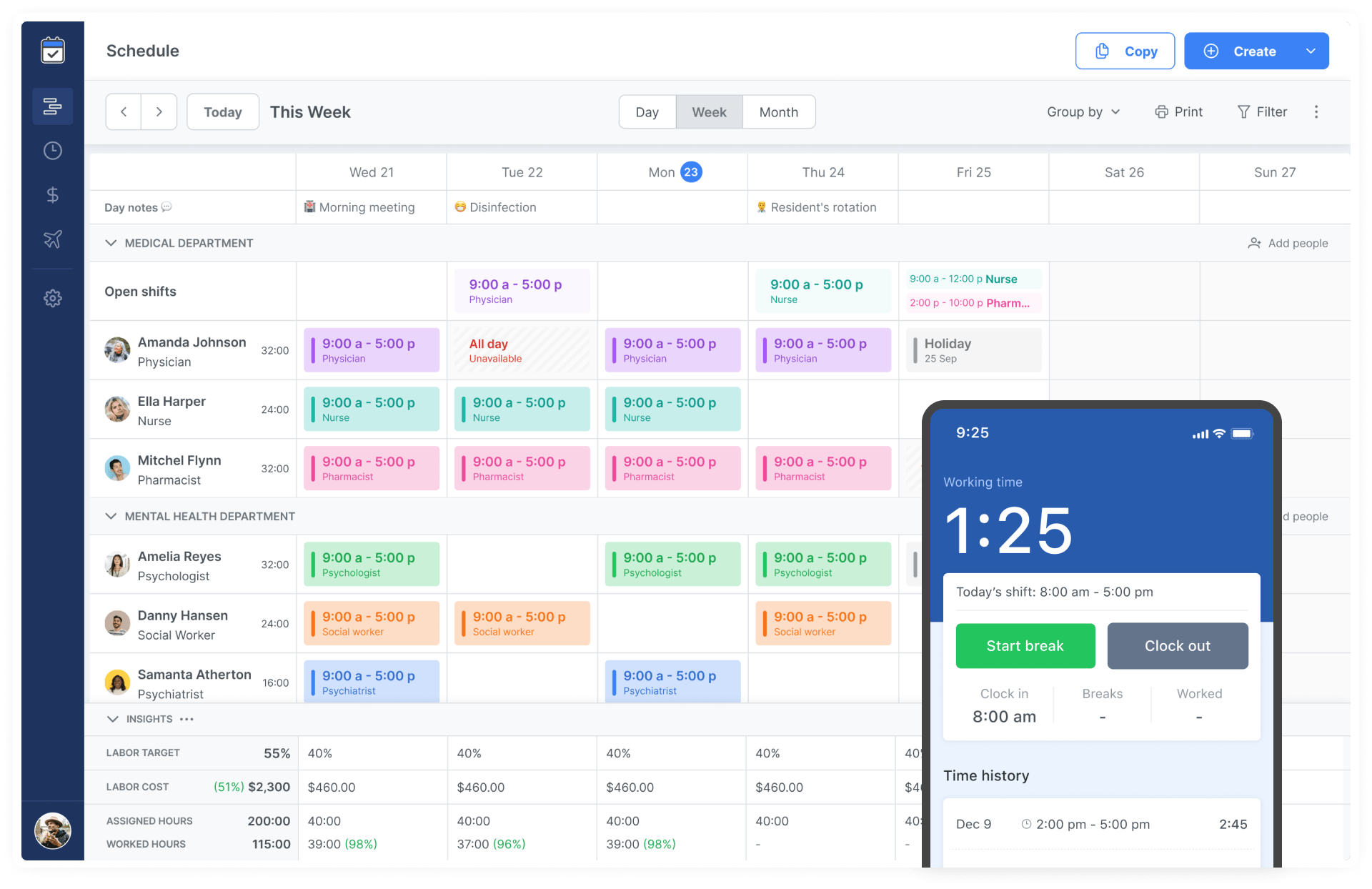
It helps connect scheduling decisions with actual labor data, which is especially useful in 4-5-4 environments where consistency matters.
FAQ
It is a retail reporting calendar that divides the year into 4-week, 5-week, and 4-week months for consistent weekly comparison.
To standardize reporting periods so sales and performance data can be compared across the same number of weeks each year.
The difference is the placement of the 5-week month. In 4-5-4 it sits in the middle of the quarter, while in 4-4-5 it appears at the end.
It is a year where an extra retail week is added to keep the calendar aligned with the solar year cycle.
No. It is a retail industry standard, not a legal requirement.
It was developed by the National Retail Federation (NRF) to standardize retail reporting.
It mainly affects how labor costs are aligned with reporting periods, especially in weekly payroll environments where timing consistency matters.
Conclusion
The 4-5-4 calendar helps retailers standardize reporting and operational planning across the year. By aligning performance with consistent weekly periods, it improves the accuracy of sales comparisons, staffing decisions, and inventory planning.
Its biggest value is in operational consistency — especially during seasonal peaks and 53-week years, where accurate scheduling and workforce visibility become critical for maintaining stable performance.

Maria
A dedicated content enthusiast with extensive experience in international teams and projects of all sizes. Maria thrives on creativity and attention to detail, fueled by a love for fantasy novels, music, classic black-and-white films, and always finding ways to make things better.