


Employee Strengths: Key Skills That Drive Better Performance

Employee strengths are the qualities and abilities that allow someone to perform their work effectively and consistently. These can include technical skills, soft skills, and personal traits that shape how a person approaches tasks, solves problems, and collaborates with others.
Understanding employee strengths isn’t just helpful — it’s essential for improving performance, building stronger teams, and making better hiring and management decisions. When strengths are clearly identified and used well, employees tend to be more productive, engaged, and aligned with their roles.
In this article, we’ll break down what employee strengths are, share practical examples, and explain how to identify and apply them in the workplace.
What Are Employee Strengths?
Employee strengths are the abilities and qualities that enable someone to perform well in their role. They reflect what a person does consistently well, combining knowledge, experience, and natural tendencies that support strong performance at work.
It’s easy to confuse strengths with skills or traits, but they’re not exactly the same:
- Strengths: areas where someone consistently performs well and adds value
- Skills: learned abilities that can be developed through training and practice
- Traits: natural characteristics or tendencies, such as being detail-oriented or outgoing
In practice, strengths often sit at the intersection of skills and traits — for example, strong communication may come from both learned techniques and a natural ability to connect with others.
Employee strengths matter because they directly influence how work gets done. When people use their strengths regularly, they tend to be more efficient, produce better results, and feel more engaged in their roles.
Types of Employee Strengths
Employee strengths can take different forms depending on the role, industry, and work environment. In most cases, strong performance comes from a combination of technical ability, soft skills, and personal qualities rather than just one area. Grouping strengths into categories makes it easier to identify them, evaluate performance, and apply them effectively in the workplace.
Technical strengths
These are job-specific abilities required to perform tasks and handle tools, systems, or processes related to a role.
- Tool proficiency: ability to use software, platforms, or equipment effectively
- Process knowledge: understanding workflows, systems, and operational procedures
- Data handling: working with reports, analytics, or technical information
- Problem-solving in context: applying technical knowledge to resolve issues
Technical strengths are often measurable and can be developed through training and experience.
Soft skills
Soft skills shape how employees work with others and adapt to different situations.
- Communication: expressing ideas clearly and listening effectively
- Teamwork: collaborating and contributing to group goals
- Adaptability: adjusting to changes, new tools, or shifting priorities
- Time management: organizing tasks and meeting deadlines

These strengths are essential across all roles, especially in team-based environments.
Leadership strengths
Leadership strengths aren’t limited to management roles — they also apply to individuals who take initiative and guide work.
- Decision-making: evaluating options and choosing effective solutions
- Accountability: taking responsibility for outcomes and actions
- Delegation: assigning tasks based on strengths and priorities
- Initiative: proactively identifying and addressing opportunities or issues
These strengths support direction, ownership, and progress within teams.
Work ethic strengths
Work ethic reflects how consistently and reliably someone approaches their responsibilities.
- Reliability: showing up consistently and delivering on commitments
- Consistency: maintaining steady performance over time
- Discipline: staying focused and following through on tasks
- Attention to detail: ensuring accuracy and minimizing errors
These strengths are key for maintaining quality and dependability in daily work.
Interpersonal strengths
Interpersonal strengths focus on how employees build relationships and navigate interactions.
- Empathy: understanding and considering others’ perspectives
- Conflict resolution: handling disagreements constructively
- Collaboration: working effectively across teams and roles
- Relationship building: creating trust and positive working dynamics
These strengths are especially important in collaborative and client-facing roles.
Most roles rely on a mix of these strengths. Understanding how they work together is what drives consistent performance and better outcomes.
How to Identify Employee Strengths
Identifying employee strengths requires a combination of structured evaluation, feedback, and observation over time. Using multiple sources helps create a more accurate and well-rounded view of how an employee performs in real work situations.
- Performance reviews — formal evaluations highlight consistent patterns in performance, achievements, and areas where an employee excels. These reviews provide a structured way to identify recurring strengths over time.
- Feedback from managers and peers — input from people who regularly work with the employee offers valuable perspective on collaboration, communication, and reliability. Peer feedback can often reveal strengths that aren’t visible in formal evaluations.
- Self-assessments — employees reflect on their own performance, identifying what they feel confident doing and where they believe they perform best. This helps align personal perception with external feedback.
- Observing day-to-day work — watching how an employee handles tasks, solves problems, and interacts with others provides practical insight into their natural strengths in action, not just on paper.
- Using tools and data (e.g., time tracking insights) — work data can highlight patterns such as productivity trends, task completion rates, and time allocation. A time tracker (for example, Everhour) can help managers understand how employees actually spend their time and where they perform most effectively.
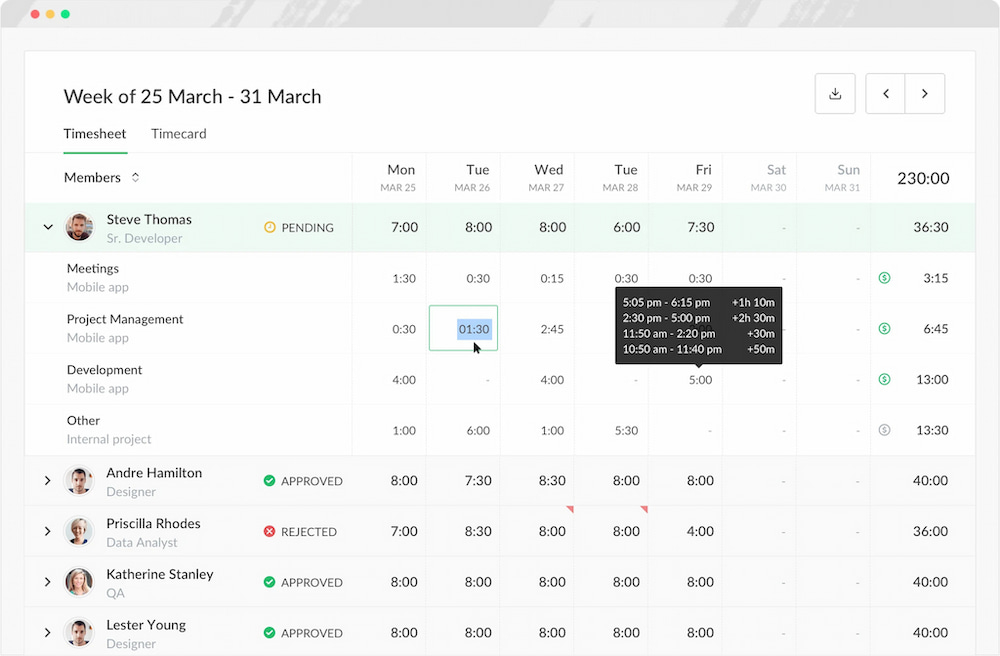
The most reliable understanding of employee strengths comes from combining qualitative feedback with real performance data rather than relying on a single source.
How to Develop Employee Strengths
Developing employee strengths is most effective when it’s intentional and aligned with both individual capabilities and business needs. Rather than focusing only on fixing weaknesses, organizations can improve performance by helping employees further build and apply what they already do well.
- Targeted training — provide learning opportunities that focus on specific strengths, such as advanced tools, communication techniques, or leadership skills. Training works best when it is relevant to the employee’s role and current responsibilities.
- Assigning the right tasks — give employees work that allows them to use their strengths regularly. When tasks align with what someone does best, they tend to perform more efficiently and with higher quality.
- Regular feedback — offer consistent, specific feedback that reinforces what the employee is doing well. Constructive feedback helps refine strengths and ensures they are applied effectively in different situations.

- Mentorship and coaching — pair employees with mentors or coaches who can guide their employee development, share experience, and provide perspective. This support helps employees grow their strengths in a more structured way.
- Creating professional growth opportunities — provide chances to take on new responsibilities, lead projects, or work across teams. Stretch assignments allow employees to apply and expand their strengths in real-world scenarios.
How to Use Employee Strengths in the Workplace
Using employee strengths effectively is not just about identifying them, but applying them in a way that improves both individual performance and overall team outcomes. When strengths are aligned with work, teams operate more efficiently and with fewer friction points.
- Role alignment — match employees to roles and responsibilities that fit their strengths. When people work in areas where they naturally perform well, they tend to be more productive, engaged, and consistent in their output.
- Improving team performance — understanding the strengths within a team helps distribute work more effectively. Teams that leverage individual strengths can complete tasks faster, solve problems more efficiently, and maintain higher quality standards.
- Delegation based on strengths — assign tasks according to what each person does best rather than distributing work randomly. This ensures that complex or high-impact tasks are handled by those most equipped to execute them successfully.
- Building balanced teams — combine different strengths across team members to create a well-rounded group. A mix of technical, analytical, creative, and interpersonal strengths allows teams to handle a wider range of challenges and collaborate more effectively.
When employee strengths are intentionally applied to roles, tasks, and team structure, organizations can improve efficiency, reduce misalignment, and get better results from the same resources.
FAQs
What are employee strengths?
Employee strengths are the abilities, skills, and qualities that help someone perform effectively in their role. These can include technical skills, soft skills, and personal traits that contribute to consistent performance and positive outcomes at work.
What are examples of employee strengths?
Common examples include communication, problem-solving, adaptability, attention to detail, time management, leadership, teamwork, creativity, critical thinking, and reliability. These strengths appear across many roles and industries.
How do you identify employee strengths?
Employee strengths can be identified through performance reviews, feedback from managers and peers, self-assessments, direct observation of day-to-day work, and data from tools such as time tracking or productivity platforms like Everhour.
Why are employee strengths important?
Employee strengths help improve performance, increase productivity, and support better collaboration. When people use their strengths at work, there’s better employee engagement, they become more efficient and effective in their roles.
What is the difference between strengths and skills?
Skills are learned and developed through training and practice, while strengths are areas where a person consistently performs well. Strengths often combine both skills and natural tendencies.
How can managers use employee strengths effectively?
Managers can use strengths by aligning roles with capabilities, delegating tasks based on strengths, building balanced teams, and providing opportunities for employees to apply and develop what they do best.
Conclusion
Employee strengths play a central role in how individuals perform and how teams function. By understanding what strengths are, recognizing common examples, and identifying them through feedback, observation, and data, organizations can make more informed decisions about hiring, task allocation, and team structure.
When strengths are actively developed and applied in the workplace, employees tend to be more productive, engaged, and confident in their roles. For employers, this leads to better performance, improved collaboration, and more efficient use of resources.
Using a time tracker like Everhour to track work patterns and time allocation can also help teams better understand where strengths are being used most effectively and where adjustments may be needed.

Maria
A dedicated content enthusiast with extensive experience in international teams and projects of all sizes. Maria thrives on creativity and attention to detail, fueled by a love for fantasy novels, music, classic black-and-white films, and always finding ways to make things better.