


Job Enlargement: Definition, Examples, Benefits, and How It Works

Job enlargement means expanding an employee’s role by adding more tasks at roughly the same level of responsibility. Instead of doing a narrow set of repetitive duties, employees take on a broader range of related tasks within their existing role.
Companies use job enlargement to increase task variety, broaden employees’ skills, improve workforce flexibility, and reduce overly specialized roles. However, adding tasks doesn’t automatically improve a job. If managers simply add responsibilities without considering workload, training, or employee capacity, job enlargement can become little more than extra work.
This guide explains how job enlargement works, shows practical examples, compares it with job enrichment and job rotation, and looks at how managers can expand roles without creating unnecessary workload.
What Is Job Enlargement?
Job enlargement is a job design approach that increases the horizontal scope of a role. An employee takes on additional tasks that generally require a similar level of skill, responsibility, and decision-making authority.
For example, a customer service representative who previously answered customer questions might also process returns and update customer records. The employee now handles more types of tasks, but the role doesn’t necessarily give them greater authority or managerial responsibility.
The key idea is breadth rather than depth: job enlargement makes a role wider by increasing task variety, while keeping the overall level of responsibility relatively similar.
How job enlargement works
A simple way to think about it is:
Before: Task A + Task B + Task C
After: Task A + Task B + Task C + Task D + Task E
The additional tasks should have a reasonable connection to the existing role. For example, an HR coordinator who schedules interviews might also maintain candidate records or coordinate onboarding. The company broadens the role without turning the coordinator into a hiring manager.
Job enlargement can help employees develop a wider range of skills and understand more of the workflow around their existing responsibilities. But managers should also consider whether employees have enough capacity to absorb the additional work.
What changes with job enlargement?
| Before enlargement | After enlargement | |
|---|---|---|
| Task variety | Narrower range of tasks | Broader range of tasks |
| Number of tasks | Fewer | More |
| Responsibility level | Existing level | Usually similar |
| Decision-making authority | Existing authority | Usually unchanged |
| Skills used | More limited | Broader range of skills |
The distinction matters because more tasks don’t necessarily mean more authority. If an employee gains significant decision-making power, ownership, or responsibility rather than simply taking on additional tasks, the change may be closer to job enrichment than job enlargement.
Job Enlargement Examples
Job enlargement can look different depending on the role, but the basic pattern stays the same: an employee takes on additional tasks that fit within the existing level of the job.
| Role | Before job enlargement | After job enlargement |
|---|---|---|
| Customer service representative | Answers customer questions | Answers questions, processes returns, and updates customer records |
| HR coordinator | Schedules interviews | Schedules interviews, maintains candidate records, and coordinates onboarding |
| Marketing coordinator | Manages social media posts | Manages social posts, email campaigns, and basic reporting |
| Project coordinator | Updates project documentation | Updates documentation, coordinates meetings, and maintains task information |
| Retail employee | Works at checkout | Works at checkout, restocks products, and handles basic customer requests |
These changes broaden the employee’s responsibilities without necessarily changing their position or giving them managerial authority. A company might also use job enlargement as a development opportunity, allowing employees to build adjacent skills before taking on a more advanced role.
Job Enlargement vs. Job Enrichment vs. Job Rotation
Job enlargement, job enrichment, and job rotation all change the way employees perform their work, but they do so in different ways.
| Approach | What changes? | Main purpose |
|---|---|---|
| Job enlargement | Employees take on more tasks at a similar level | Increase task variety |
| Job enrichment | Employees gain more autonomy, responsibility, or decision-making authority | Increase ownership and motivation |
| Job rotation | Employees move between different roles or functions | Broaden experience and skills |
A simple way to remember the difference:
Job enlargement makes a job broader. Job enrichment makes it deeper. Job rotation moves an employee between different jobs or functions.
For example, adding customer record management to a customer service role is job enlargement. Giving that employee authority to resolve certain customer issues without manager approval is closer to job enrichment. Moving the employee between customer service, sales support, and returns for set periods is job rotation.
Understanding the distinction matters because each approach solves a different workplace problem. A company looking to reduce repetitive work may use enlargement, while a manager trying to increase employee autonomy may get better results from enrichment.
Why Do Companies Use Job Enlargement?
Companies generally use job enlargement when they want to broaden roles without immediately changing employees’ positions or levels of authority.
Reduce repetitive work
Employees who perform the same narrow tasks throughout the day can experience boredom and disengagement. Adding related responsibilities creates more variety and can make the role less repetitive.
Build broader skills
Employees can develop skills outside their usual responsibilities by taking on adjacent tasks. This can make them more versatile and prepare them for future roles.
Improve workforce flexibility
A team becomes less dependent on one person when several employees know how to handle related tasks. Broader roles can make it easier to cover absences, respond to changing workloads, and redistribute work.
Improve understanding of the workflow
Employees who handle several connected parts of a process can see how their work affects other tasks and teams. That broader context can make coordination easier and help employees spot problems earlier.
Support employee development
Job enlargement can give employees opportunities to learn without requiring an immediate promotion. Managers can gradually expand responsibilities while assessing which skills employees want and need to develop.
When Job Enlargement Doesn’t Work
Job enlargement doesn’t automatically make work more engaging. Adding tasks to an already full role can increase workload without adding meaningful variety or development opportunities.
Watch for these problems:
- More work without more capacity: Employees take on additional tasks while their existing deadlines and workload stay the same.
- Unrelated responsibilities: New tasks don’t fit the employee’s role or require completely different skills.
- Insufficient training: Employees receive new responsibilities without enough time or support to learn them.
- More context switching: Employees constantly move between unrelated tasks, making it harder to focus and complete work efficiently.
- Responsibility without support: Employees become accountable for more work without getting the resources, authority, or information they need.
- No meaningful benefit for employees: The company gets broader coverage, but employees see only additional work and no opportunity to develop.
The key question is not simply “Can we give this employee more tasks?” It’s “Can we broaden this role without making the employee’s workload unreasonable?”
How to Implement Job Enlargement Effectively
A successful job enlargement process starts with the existing role rather than a list of extra tasks. Managers should understand the employee’s current responsibilities, capacity, and skills before deciding what to add.
1. Map the current role
List the employee’s regular tasks, recurring responsibilities, deadlines, and related activities. This gives you a baseline for deciding which parts of the role could reasonably expand.
Add responsibilities that connect to the employee’s existing work or help them develop useful adjacent skills. Avoid adding unrelated tasks simply because someone needs to do them.
3. Check employee capacity
Consider how much time the employee already spends on projects, meetings, administrative work, and recurring tasks.
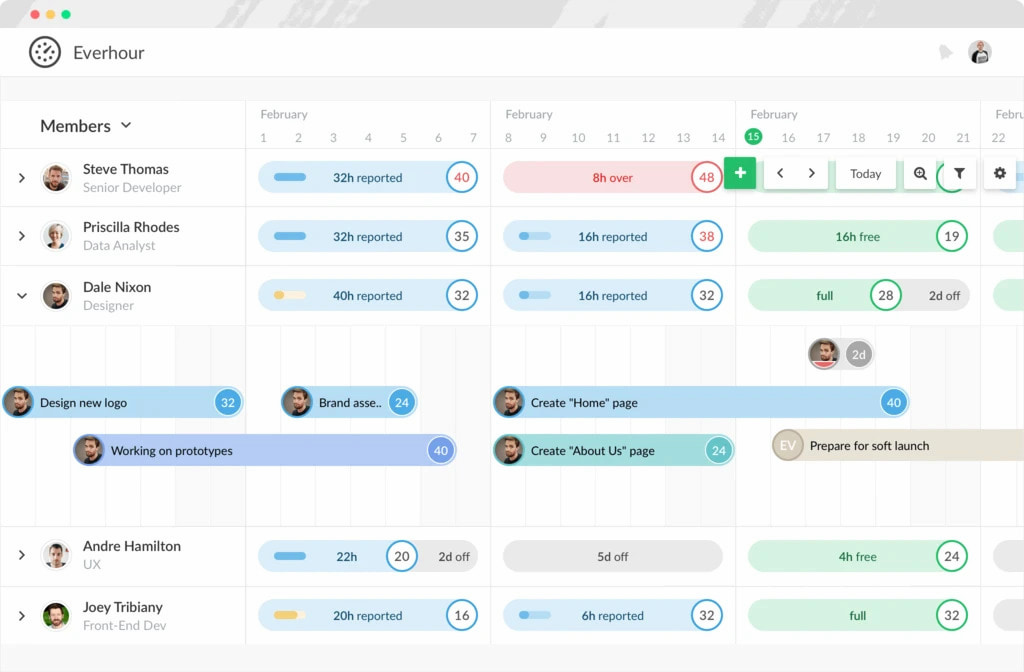
Everhour’s time tracker can help managers understand this workload with actual time data. Teams can track time by project or task, compare actual hours with estimates, and identify recurring work that already consumes most of an employee’s capacity. That gives managers a better basis for deciding whether to expand a role or redistribute existing work first.
4. Provide training and support
Don’t assume employees can immediately take over unfamiliar responsibilities. Give them the training, documentation, tools, and support they need to perform the new tasks effectively.
5. Set clear expectations
Define what changes and what doesn’t. Employees should know which tasks they now own, what decisions they can make independently, and which responsibilities remain with other team members.
6. Review the expanded role
Give the employee time to adjust, then review workload, performance, and feedback. If the broader role consistently creates overtime, delays, or errors, reconsider the task mix instead of simply expecting the employee to work faster.
Job Enlargement and Employee Workload
Job enlargement changes the scope of a role, but it doesn’t have to increase the employee’s overall workload. Managers can add variety by redistributing responsibilities, removing redundant tasks, or adjusting priorities alongside the new work.
This distinction becomes important when teams use job enlargement to improve flexibility. If an employee already spends nearly all of their available capacity on existing work, adding three more responsibilities doesn’t create a broader role, it creates a heavier workload.
Time tracking can help managers see the difference. For example, reviewing time spent across projects and tasks can reveal whether an employee has capacity for additional responsibilities or whether existing work already fills their schedule.
How to Measure Whether Job Enlargement Is Working
Don’t judge an expanded role only by whether the employee now handles more tasks. Look at whether the change improves flexibility and task variety without creating unnecessary workload or reducing performance.
| Signal | What it shows |
|---|---|
| Time by task | Whether work is spread across more responsibilities |
| Overtime | Whether the expanded role exceeds capacity |
| Completion time | Whether new tasks cause delays |
| Errors and rework | Whether employees need more support |
| Employee feedback | Whether the role feels broader or simply heavier |
| Cross-coverage | Whether more employees can handle related work |
| Productivity | Whether broader roles improve output |
You don’t need to see every metric improve. The goal is to determine whether the expanded role creates a useful balance between task variety, employee development, and team capacity.
If time spent and overtime rise sharply while productivity or employee feedback gets worse, the company may have increased workload rather than successfully enlarged the job.
Frequently Asked Questions
Job enlargement is a job design approach that expands an employee’s role by adding more tasks at a similar level of responsibility. It increases the breadth and variety of work without necessarily giving the employee more authority.
A customer service representative who previously answered customer questions might also process returns and update customer records. The employee takes on more related tasks, but their level of authority remains largely the same.
Job enlargement adds more tasks to a role, while job enrichment adds greater responsibility, autonomy, or decision-making authority. Enlargement makes a job broader; enrichment makes it deeper.
Job enlargement adds tasks to an employee’s existing role. Job rotation moves employees between different roles or functions, usually to broaden their experience and skills.
No. Job enlargement usually increases the range of tasks within an existing role without changing the employee’s level, authority, or position. A change that adds substantially more responsibility or decision-making authority may be closer to a promotion or job enrichment.
Job enlargement can increase task variety, broaden employee strengths and skills, improve workforce flexibility, reduce repetitive work, and give employees experience with related responsibilities.
Poorly planned job enlargement can increase workload, create more context switching, require new training, or leave employees feeling that the company has simply given them more work without additional support.
It can, but it shouldn’t necessarily do so. Effective job enlargement broadens a role while managers consider existing workload and employee capacity. If employees already work at full capacity, managers may need to redistribute or remove existing tasks before adding new ones.
Conclusion
Job enlargement can make roles broader, more varied, and more flexible without changing an employee’s level of responsibility. It works best when managers add related tasks, provide appropriate training, and make sure employees have enough capacity to handle the expanded role.
The distinction between more variety and more workload matters. Before expanding a role, managers should look at how employees actually spend their time, what capacity they have, and whether the additional responsibilities support both employee development and team needs.
Everhour can help teams make that decision with time data from projects and tasks. By comparing actual time with estimates and reviewing workload patterns, managers can determine whether an employee has room for additional responsibilities or needs a different workload first.

Maria
A dedicated content enthusiast with extensive experience in international teams and projects of all sizes. Maria thrives on creativity and attention to detail, fueled by a love for fantasy novels, music, classic black-and-white films, and always finding ways to make things better.